Get Full Government Meeting Transcripts, Videos, & Alerts Forever!
Get email alerts on the City Budget Trends topic
No spam. Unsubscribe anytime.
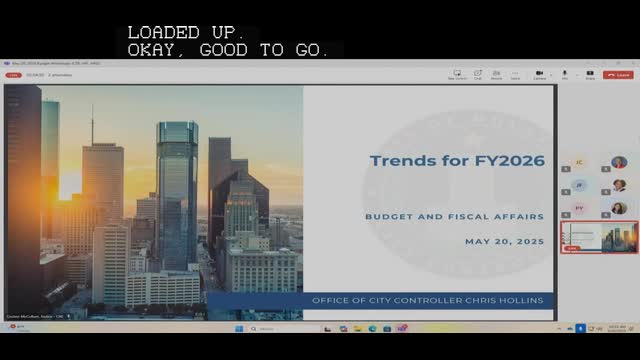
City controller warns of shrinking fund balance, highlights overtime and settlement risks in trends report
Summary
The City Controller presented a trends report to the Houston City Council that flagged a projected decline in fund balance and multiple budget risks tied to overtime, settlement exposure and uncertain federal reimbursements for disasters.
The City Controller presented a trends report to the Houston City Council that flagged a projected decline in fund balance and multiple budget risks tied to overtime, settlement exposure and uncertain federal reimbursements for disasters.
The controller said general fund revenue (excluding other sources) is projected to increase by just over $20 million in the proposed budget, driven primarily by an anticipated nearly $80 million increase in property-tax revenue that the administration is projecting at the voter-imposed revenue cap. That projection, the controller noted, implies choices about the tax rate and local revenue assumptions.
The trends report underscored a large variance between budgeted and actual overtime: last year the city budgeted $65 million for general-fund overtime but spent about $130 million. In the proposed FY26 budget the controller said overtime was budgeted at $58 million; council members questioned whether cutting the overtime projection by more than half without clear operational changes is realistic. The controller and other staff cited HFD's planned classified hires and improved staffing dashboards as part of the explanation for projected overtime reductions.
The presentation also highlighted contingent liability related to a settlement with engineers: if the court does not approve the settlement, the controller said the city would face an impact of roughly $91 million in the next fiscal year and about $92 million in the current fiscal year. The controller presented balanced and adverse scenarios so the council could see the financial implications if the court approves or rejects the settlement.
Other items called out in the trends report included: a projected 1.3% decrease in sales-tax revenue under the conservative case; a projection of roughly $3 billion in taxable property value; a $74 million decrease in overall spending from FY25 to FY26 driven mainly by overtime reductions, debt-service adjustments, voluntary retirement savings and departmental reductions; and a $17 million anticipated savings line the controller described as unusual because it appears as a general plug rather than traced to specific departmental cuts.
Council members questioned preparedness for disaster costs the city might not receive federal reimbursement for. The controller said the federal picture is uncertain, FEMA reimbursement is not assured, and the city's current budget stabilization fund and general-fund reserves may be insufficient to cover large unreimbursed disaster expenditures. The controller recommended a realistic runway and continued vigilance over revenue and long-term liabilities including OPEB and pension obligations.
Council members pressed on the voluntary retirement program's savings estimate and asked whether savings properly reflect service-level impacts. The controller said more detail had been requested from administration staff on the underlying departmental reductions and the status of audits that had identified savings. The controller also noted the city's long-term liabilities and the negative outlook from rating agencies, which are watching for a sustainable plan to address recurring costs and long-term obligations.
The controller closed by saying enterprise funds (airports, utilities, convention) generally remain healthy in the proposed budget, with airport revenues projected to exceed expenses and combined utility-system revenue projected to exceed expenses by a modest margin, but emphasized that the general fund remains under pressure and that the council should weigh revenues and recurring costs carefully before adoption.