Get Full Government Meeting Transcripts, Videos, & Alerts Forever!
Get email alerts on the Technology Ai topic
No spam. Unsubscribe anytime.
Assembly hears update on state generative AI projects; LAO presses for POC reporting
Summary
State officials described several generative AI proofs of concept moving toward minimum viable products, while the Legislative Analyst—s Office urged clearer reporting on what the administration learned before scaling and requested continued monthly oversight meetings.
State officials told the Assembly Subcommittee 5 on State Administration that several state generative AI proofs of concept have moved beyond the pilot stage but that the legislature still lacks full information about how the pilots informed decisions to scale up.
Justin Howard, deputy secretary for fiscal policy and administration at the California Government Operations Agency, told the panel that a handful of proof-of-concept projects have advanced into minimum viable product phases, naming work at the California Department of Tax and Fee Administration and Caltrans and saying the California Department of Public Health has a budget change proposal pending in the May revision to scale a healthcare facilities inspections project.
The Legislative Analyst—s Office, represented by Brian Metzger, warned the committee that the administration had not provided the scaled-up contracts or analyses showing how first-round tests informed expansion. "We do not have the scaled up contract to review and do not know how demonstrations and tests during the first round informed the administration's decision to go ahead with a broader implementation of this technology," Metzger said. He recommended the administration publish a report describing lessons learned from each proof of concept, whether a contract resulted, and contract amounts and terms, and urged the Legislature to treat the first two POC rounds as a pilot period for 2025—6 and 2026 to preserve legislative oversight.
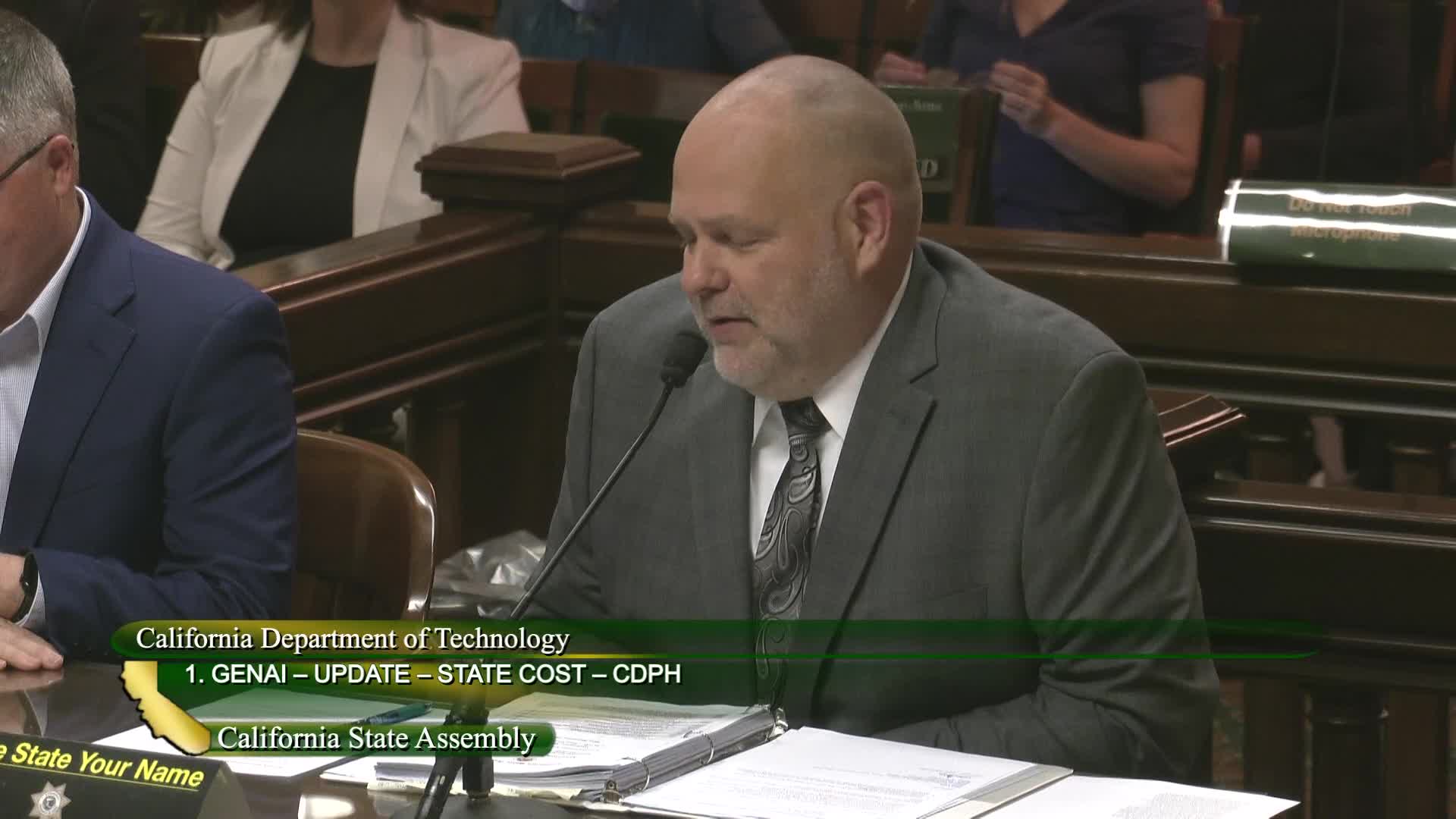
Jared Johnson, deputy state CIO and chief deputy director at the California Department of Technology, described the new project delivery lifecycle the administration plans to use for generative AI projects. "Project delivery lifecycle prioritizes an iterative value driven approach to generative AI project planning, leveraging proofs of concepts and minimum viable products and iterative phasing to reduce risk and confirm business value before scaling into production," Johnson said, and added the administration has established internal sandboxes and will add project status to the state's project portfolio dashboard. Johnson also said that any AI-related budget change proposals that come through the Legislature will be treated as non-delegated projects and receive standard CDT oversight.
Department of Finance officials said the CDPH budget change proposal was filed in the spring after departments moved from small POC spending to negotiations with vendors about larger contracts. Committee members and the LAO pressed for more transparency on the roughly $8 million CDPH request and how other AI-related proposals in the budget fit together; witnesses said some AI activity is funded from a mix of special funds and departmental resources.
The committee did not take action; members and the LAO emphasized continued monthly meetings and clearer documentation as the administration scales projects.
Ending: The subcommittee requested the administration provide more detailed POC-to-contract documentation and maintain the regular legislative-and-LAO briefings referenced in budget bill language. The LAO and members said they will continue to seek written explanations of how pilot outcomes led to decisions to scale specific projects.