Get Full Government Meeting Transcripts, Videos, & Alerts Forever!
Get email alerts on the Waste Management topic
No spam. Unsubscribe anytime.
Austin Resource Recovery outlines 'road to zero waste,' highlights on‑demand bulk pickups and education programs
Summary
Austin Resource Recovery Assistant Director Ron Romero presented the department’s initiatives May 21, including curbside composting, new on‑demand brush/bulky/HHW pickups, programs to boost reuse and repair, and a 90% diversion goal by 2040. Romero shared early performance metrics and requested follow‑up on detailed trends and emissions data.
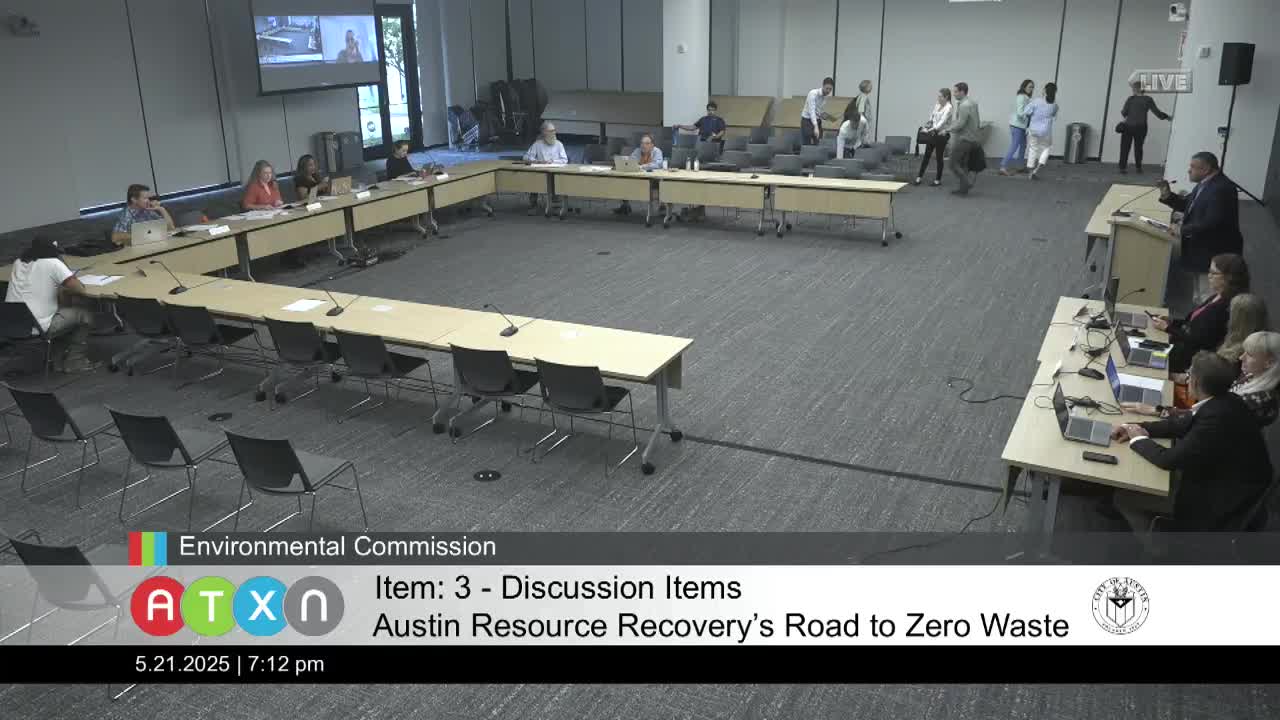
Austin Resource Recovery (ARR) presented an overview of its services and initiatives to the Environmental Commission on May 21 as the department pursues a long‑term goal of dramatically reducing landfill waste and increasing resource recovery.
ARR Assistant Director Ron Romero said the department’s mission is “to provide essential services to protect people and our planet,” and outlined the department’s “big three” curbside services — trash, recycling and composting — plus citywide services such as street sweeping, litter abatement, a reuse directory and several outreach programs.
Why the presentation matters
ARR emphasized that changes to collection programs, business outreach and education are intended to lower landfill disposal, reduce contamination in the recycling stream and increase reuse. Romero described a goal to divert 90% of material from landfill by 2040, and told commissioners ARR is tracking program performance, contamination rates and participation as it pilots service changes such as on‑demand bulky/brush/household‑hazardous‑waste (HHW) collections.
Key programs and metrics presented
- Curbside services: ARR said it serves roughly 220,000 residential customers with weekly trash, biweekly recycling and weekly composting collection. - On‑demand bulky/brush/HHW: ARR moved from a rotating schedule to an on‑demand model in January 2025; the department reported increased use, reduced overtime and early indications of fuel and personnel efficiencies and said it will return with one‑year performance data. - Reuse and repair programs: ARR highlighted the Austin Reuse Directory, the Fix It Clinic (repair education at libraries), Generation Zero (K–12 outreach partnered with Keep Austin Beautiful) and Move Out ATX (student move‑out reuse). ARR also described a Zero Waste block‑leader volunteer program to spread neighborhood outreach. - Processing and contamination: Romero said residential recycling is processed by two contractors, Balcones Recycling and TDS, and that roughly 60% of the residential stream goes to Balcones and 40% to TDS. Romero reported a contamination rate of about 15% in the most recent audit; he said the remaining 85% of material is expected to be recycled under contract.
Commissioners’ questions and next steps
Commissioners asked about equitable access to compost carts (the green cart), service availability citywide, multilingual outreach, the environmental impacts of the on‑demand model (fuel and emissions), opportunities for business compliance with recycling and composting ordinances, and how ARR measures trends (per‑capita waste, historical trajectories and food‑waste emissions). Romero said ARR has a business‑outreach unit working with developers and companies, that many training and outreach resources are available in Spanish, and that ARR will compile and return with trend data and a one‑year evaluation of the on‑demand bulky program.
Romero also offered to return with deeper data on diversion and per‑capita trends and said ARR is tracking food‑waste metrics in coordination with Travis County and other partners. He invited commissioners to share topics for future deep‑dives and offered to provide slides and follow‑up links to department data.