Get Full Government Meeting Transcripts, Videos, & Alerts Forever!
Get email alerts on the Trade With Canada topic
No spam. Unsubscribe anytime.
Tariff uncertainty with Canada threatens Ohio manufacturers, panelists say
Summary
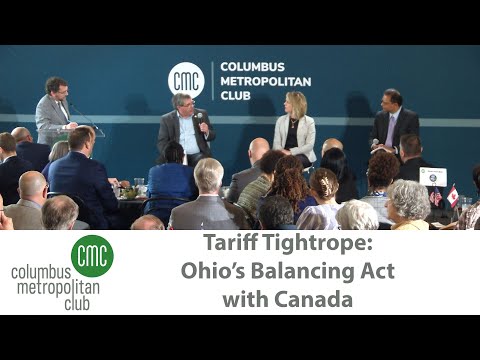
Panelists at a Columbus Metropolitan Club forum on May discussed how recent U.S. tariff moves and retaliatory measures by Canada are creating uncertainty for Ohio manufacturers, farmers and small businesses, and urged more predictable federal policy to protect integrated North American supply chains.
Consul General Colin Bird of Canada in Detroit and Ohio lawmakers and business leaders told a Columbus Metropolitan Club audience that recent U.S. tariff measures and reciprocal Canadian responses are creating costly uncertainty for Ohio’s manufacturers, farms and small businesses.
The forum on trade with Canada on May in Columbus featured remarks from Consul General Colin Bird, State House Minority Leader Lisonbee Russo (representing Ohio’s Seventh District), Bala, executive vice president and chief human resources officer at Scribe, and moderator Dan Eaton of Columbus Business First. “We need to move those tariffs off the table, and they are still there,” Consul General Bird said of measures affecting steel, aluminum and other sectors. Bala said uncertainty is the immediate business problem: “One thing businesses do not like is uncertainty.”
The discussion matters because Canada is Ohio’s largest trading partner; panelists said much of the state’s manufacturing inputs come from or through Canada and that tariffs or trade barriers could disrupt supply chains, raise costs and slow regional investment. Panelists cited steel and aluminum tariffs and a paused auto-parts action as examples of measures that have changed the operating environment for regional industry.
Bird said there has been “a step back on some of the most-damaging potential tariffs,” but cautioned that tariffs on steel and aluminum and other sectoral investigations (lumber, pharmaceuticals, critical minerals) remain potential risks. He described North American production as highly integrated, noting roughly 70% of some manufacturing inputs into Ohio are sourced from Canada and that Ohio exports more to Canada than to its next six export markets combined. “For the last 30 years … we’ve been working to make trade across our mutual border as seamless as possible,” he said.
State House Minority Leader Lisonbee Russo said the direct effects are higher costs for manufacturers, farmers and small businesses that are ultimately passed to consumers. “It is working Ohioans who pay for this particular policy,” Russo said, adding she had spoken that week with workers at two facilities that faced layoffs or reduced production tied to trade uncertainty.
Bala described four business impacts—demand, supply (raw materials), financials and people—and said many global companies are monitoring tariff developments daily. He referenced a 90-day pause tied to an April decision and said July 8 is a date companies were watching in the near term for policy clarity.
Panelists gave examples and figures cited during the forum: steel and aluminum tariffs were described as 25 percent in prior rounds; Bird and others said about 98 percent of U.S.-Canada trade operates tariff-free under negotiated arrangements such as the USMCA; panelists also referenced a roughly 700 Canadian companies operating in Ohio. One speaker said an aluminum tariff can add about $3,000 to the retail price of a popular pickup truck model.
Infrastructure and logistics also featured in the conversation. Bird highlighted the Gordie Howe International Bridge, which he said Canada financed and expects to open with six new lanes and additional customs booths this fall; he said Canada financed the project and expects to recover costs through tolls. Panelists argued improved cross-border infrastructure—along with projects such as the Brent Spence Bridge and Soo Locks upgrades—supports the integrated supply chains that benefit Ohio.
Audience questions focused on who pays tariffs (importers in the United States, panelists said), how small businesses can make their case to federal policymakers (Russo urged local owners to tell their stories to state and federal leaders), and whether corporations should publicly comment on trade policy. Bala and other business panelists said many companies are watching before taking public stands because policy can change quickly.
Panelists warned of uneven regional effects: several speakers said the Great Lakes economy, including Ohio, is disproportionately exposed to disruptions with Canada and could lose investment to Southern states if tariffs erect barriers inside North American supply chains. Bird and others also noted non-tariff factors that have already drawn investment, such as incentives tied to labor costs and supply-chain policy changes under earlier trade negotiatons.
No formal actions, votes or policy decisions were taken at the forum, which was a public discussion rather than a policymaking meeting. Panelists and audience members said the most direct avenues for change are federal trade policy and coordinated advocacy by governors, state delegations and business groups.
The conversation concluded with panelists urging clearer, predictable federal trade rules to preserve integrated North American manufacturing, citing both short-term business disruptions and longer-term investment effects. The Columbus Metropolitan Club said events on related policy topics will continue in coming weeks.