Get Full Government Meeting Transcripts, Videos, & Alerts Forever!
Get email alerts on the Land Development Regulations topic
No spam. Unsubscribe anytime.
Council confirms LDR scoping priorities for FY26; sustainability and comprehensive plan discussion continues
Summary
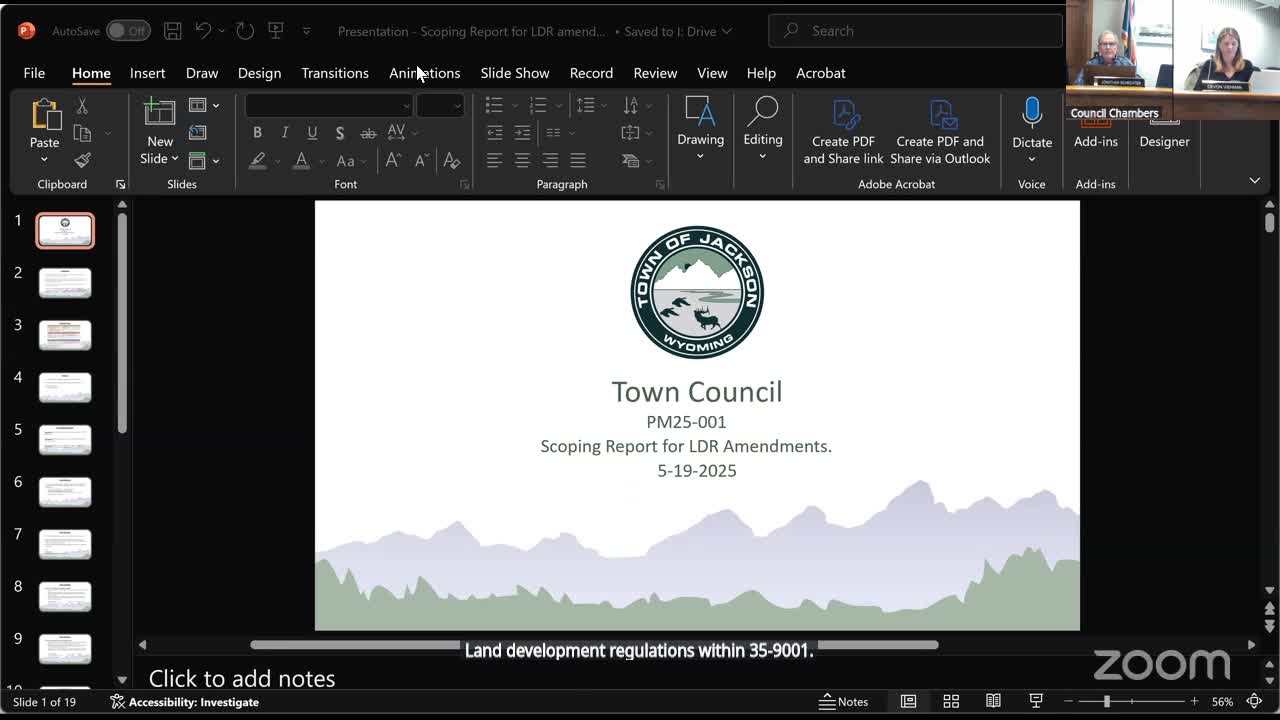
Town planning staff and council confirmed a prioritized work plan for LDR amendments in FY26 on May 19, identifying updates to the 2-for-1 workforce housing bonus, the Natural Resource Overlay, and a biennial LDR cleanup as top tasks while continuing discussions about sustainability and a possible comprehensive-plan update.
Town planning staff presented a scoping report May 19 outlining priorities for updates to the Land Development Regulations (LDRs) and initial planning for a possible comprehensive plan update. Councilmembers indicated support for staff's recommended FY26 priorities but asked staff to preserve flexibility for sustainability and design-guideline work that community members have urged.
Staff said the FY26 priorities, informed by a joint town-county meeting, are: - Update to the 2-for-1 workforce housing bonus (to review deed restrictions, unit size and other program details); - Update to the Natural Resource Overlay (to align town mapping and standards with recently completed county work and review water-body setbacks); - A biennial LDR update ("cleanup") to correct code ambiguities and make targeted clarifications.
Paul Anthony, director of planning and building, told council the county had completed a Natural Resource Overlay update and the town's overlay has not been updated since 1994. He recommended using similar mapping and tiering used by the county so developers face consistent environmental expectations when projects cross jurisdictional lines.
Council and staff also discussed whether a separate sustainability LDR update should be prioritized. Staff said sustainability work is already embedded in many town programs (housing, transportation demand management, ecosystem stewardship) and described three possible LDR approaches: remove regulatory barriers to sustainable practices; add incentives (carrots) for green building and water conservation; or adopt mandatory standards where the council decides a requirement is warranted.
Councilmembers pressed staff on measurable goals. One member said the 2-for-1 program's success should be evaluated on the quantity and type of deed-restricted housing produced and whether the deed restrictions are producing the desired housing outcomes. Staff said roughly 500 units remain in the 2-for-1 pool and the update should consider unit size, deed restriction type (workforce versus deeper affordability), and the ratio used by the bonus.
Public comment came from the Jackson Hole Conservation Alliance, which urged the council to move quickly on moratorium-era items and to not delay sustainability or other LDR changes until a comprehensive-plan update that could take years.
Councilors expressed general comfort with the FY26 list and asked staff to scope and schedule the comprehensive-plan outreach (staff suggested a scoping outreach step in FY26 followed by a full effort later). Council asked staff to maintain a modest reserve of capacity for emergent issues and citizen-initiated code changes.
No formal ordinance was adopted at the meeting; council signaled agreement with staff's priorities and asked staff to return with detailed scopes, cost estimates and timelines for each project.