Get Full Government Meeting Transcripts, Videos, & Alerts Forever!
Get email alerts on the Affordable Housing Tax topic
No spam. Unsubscribe anytime.
Pima County supervisors continue debate over proposed property-tax increase to fund affordable housing
Summary
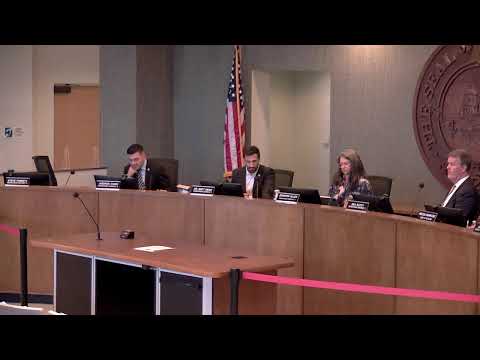
After hours of public comment and nearly two hours of board debate, the Board of Supervisors on May 20 continued action on Supervisor Ramón Hines’s proposal to dedicate a temporary property-tax increase for affordable housing to a special meeting on June 3, while keeping the budget tax cap in place.
PIMA COUNTY — The Pima County Board of Supervisors continued discussion May 20 on a proposal from Supervisor Ramón Hines to dedicate a limited property-tax increase to fund affordable housing, sending the item to a June 3 meeting for further work while leaving the county’s tentative budget tax ceiling unchanged.
Hines’s revised proposal would have set a temporary general-fund levy equivalent to a 3-cent increase per $100 of assessed value for most of a 10-year period but with a short ramp up and ramp down (1.5 cents in year 1, 3 cents for eight years, and 1.5 cents in year 10). Hines told the board the shortened ramp would generate “approximately $225,000,000 to be dedicated toward affordable housing, over that decade-long period.”
The proposal sparked lengthy public comment and a wide-ranging board debate about timing, process and taxpayer burden. Supporters included housing advocates and service providers who said local funding is needed to preserve and build deeply affordable units and to prevent homelessness. Opponents — including some homeowners and one supervisor — warned that the plan would redistribute taxpayer money to subsidize rentals and urged waiting for a draft regional housing strategy.
Why it matters: Board members said the decision will shape county housing policy for years and affect county spending priorities. Supporters argued the revenue would accelerate construction, preservation and homelessness prevention; critics said the board should finalize a regional housing plan before committing a new decade-long revenue stream.
What happened at the meeting - Hines presented a revised version of the plan submitted on Friday, describing the 10-year program with a first-year partial rate and a partial final-year ramp-down. He framed it as a targeted, time-bound revenue stream to be administered with guardrails and oversight. - Public comment included residents, service providers and housing advocates. Dr. Keith Bentley of Tucson Alliance for Housing Justice said the proposal “meets a third of the need identified in the Eco Northwest analysis.” April Putney, a homeowner who supports the plan, said, “I’m totally fine with that.” David Lutz spoke against the tax increase: “I come to oppose the property-tax increase.” Glenda Avalos, who said her family would shoulder the increase, urged action: “Although this is an increase on my family, we are willing to bear it to help our brothers and sisters in the struggle.” - Supervisor D. Cano signaled conditional support for a smaller first-year change and for guardrails. She told the board her office believes it can increase housing investment “to approximately $10,000,000 through targeted internal adjustments in this current fiscal year,” while also asking staff to identify internal efficiencies. - Supervisor John Christie argued against moving forward before the Regional Affordable Housing Commission finishes a draft plan, saying the board should not “put the cart before the horse.” He stressed that many residents associate “affordable housing” with homeownership and warned the proposal focuses on subsidized rental development.
Board action and next steps - A motion by Supervisor Christie to continue the item until the commission’s draft plan failed on a 2–3 vote. - Supervisor Hines then moved his revised 1.5¢/3¢/1.5¢ ramp proposal; discussion continued and multiple amendments and substitute motions followed. - Supervisor Cano offered a substitute motion asking staff to return the item at the next regular meeting with additional written material and funding criteria; that motion passed and the board continued the item to June 3 with the proviso that staff post additional material in advance. - The board kept the county’s tentative tax rate ceiling in place; county administrator feedback made clear anything approved now could be lowered before final budget adoption on June 17 but could not be increased after today’s tentative adoption.
Discussion highlights and concerns - Timing vs. planning: Supporters said funding should be secured now because housing production takes years; critics said final funding decisions should follow the regional commission’s recommended plan and agreed criteria. - Targeting and oversight: Several supervisors sought explicit “guardrails” — geographic targets, minimum percentages for preservation versus new construction, and measurable outcomes. Supervisor Cano said Friday’s revised memo lacked sufficient spending criteria and guardrails; Hines said he would accept added criteria. - Tax incidence: Opponents stressed the increase would fall on homeowners, including low‑income fixed‑income households, and argued the county must show internal budget discipline first. Supporters said a modest property-tax increase is a progressive way to fund urgent needs and would avert larger downstream public costs from homelessness and health impacts. - Funding scale and deliverability: Staff and advocates noted the county’s current affordable housing efforts are already funded through gap-finance programs and ARPA. Hines’s memo projected ~ $225 million over 10 years under the ramp schedule; advocates described that as a first step, not a full solution.
Authority and oversight - The draft policy title was Board of Supervisors Policy D-22.17 — “General Fund 3¢ for Affordable Housing.” The board asked staff to tie allocation and implementation to recommendations from the Regional Affordable Housing Commission, to identify performance benchmarks and to return with spending criteria.
What to watch next - June 3: The board will revisit Hines’s policy proposal with additional materials submitted by Supervisor Cano and staff. The Regional Affordable Housing Commission is due to produce a draft housing strategy later in the year; multiple supervisors said the commission’s work should inform any long-term funding decision. - June 17: Final budget adoption. Staff reminded the board that the tentative ceiling set today can be lowered through the budget process but not raised.
Ending: The item remained unresolved at the conclusion of the meeting. Supporters and opponents said they would keep pushing for their approaches; staff were directed to post additional materials ahead of the June 3 continuation so the board and the public could examine specific guardrails and spending criteria.