Get Full Government Meeting Transcripts, Videos, & Alerts Forever!
Get email alerts on the Land Use Zoning topic
No spam. Unsubscribe anytime.
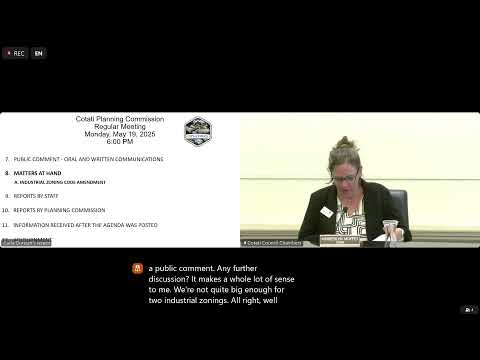
Cotati Planning Commission backs combining two industrial zoning districts into single Commercial Industrial zone
Summary
The Cotati Planning Commission recommended that the City Council adopt an ordinance to combine the city’s two industrial zoning districts into a single Commercial Industrial (CI) district.
The Cotati Planning Commission recommended that the City Council adopt an ordinance to combine the city’s two industrial zoning districts into a single Commercial Industrial (CI) district. The commission voted unanimously to forward the recommendation after a staff presentation explaining the change and a brief discussion.
The recommendation aims to align the zoning code with the city’s General Plan (adopted 2015), simplify the code for the public and staff, and provide more flexibility for uses within the city’s industrial area north of Helmand Lane. Community Development planner Autumn Bus told the commission the proposal is largely a housekeeping measure intended to make the zoning code consistent with the General Plan and to reduce confusion caused by two closely overlapping districts.
"This item we have for you tonight is a request to hold a public hearing and to consider making a recommendation to the city council on an ordinance that would amend the industrial zoning portion of our land use code," Autumn Bus said, describing staff’s recommendation and the draft ordinance’s intent. She said staff is proposing to combine the Commercial Industrial (CI) and General Industrial (IG) districts into a single CI district because existing land-use tables already include the full range of uses contemplated by the General Plan.
Bus said the combined district would not broaden the overall list of allowed uses beyond what the General Plan contemplates, but would allow more flexibility for semi-industrial and freeway‑adjacent activities. She gave examples of uses the change is meant to better accommodate, including indoor sports facilities, breweries and wineries, artist studios and business incubators.
Staff proposed adjusting permit requirements for three specific land uses: to make brewpubs a minor use permit (they are not currently allowed in either industrial district), and to change breweries and minor vehicle services from a use permit to a minor use permit. Bus said heavier industrial uses — such as heavy manufacturing and processing, construction contractors, dry cleaning and medium recycling facilities — would continue to require a use permit and continue to come before the Planning Commission for site‑specific conditions to minimize impacts.
Commissioners expressed support for the approach as a simplification of overlapping rules for a relatively small industrial area. After public comment (none on the item), a motion to approve the resolution recommending the ordinance was made and seconded; the commission voted unanimously in favor. The commission’s action was a recommendation to the City Council; the council will consider the ordinance and any required public hearing.
Implementation questions raised during the presentation included which permit types would change, the boundaries of the affected industrial area (the portion identified north of Helmand Lane) and which uses would remain subject to use permits. Planner Autumn Bus said existing businesses would not be displaced by the change and that the intent is to be inclusive rather than restrictive.
The commission also received brief staff updates after the vote, including a note that the Community Development work plan will be finalized with the city budget adoption in June and that the commission’s July 21 meeting was canceled for summer break.