Get Full Government Meeting Transcripts, Videos, & Alerts Forever!
Get email alerts on the Discrimination Investigations Audit topic
No spam. Unsubscribe anytime.
City audit finds inconsistent investigations, training gaps in discrimination and harassment cases
Summary
A city Auditor's Office review concluded some discrimination, harassment and retaliation investigations in Austin were incomplete, delayed or inconsistently documented; the audit made five recommendations including enhanced investigator training, improved quality control and a consolidated case-management system.
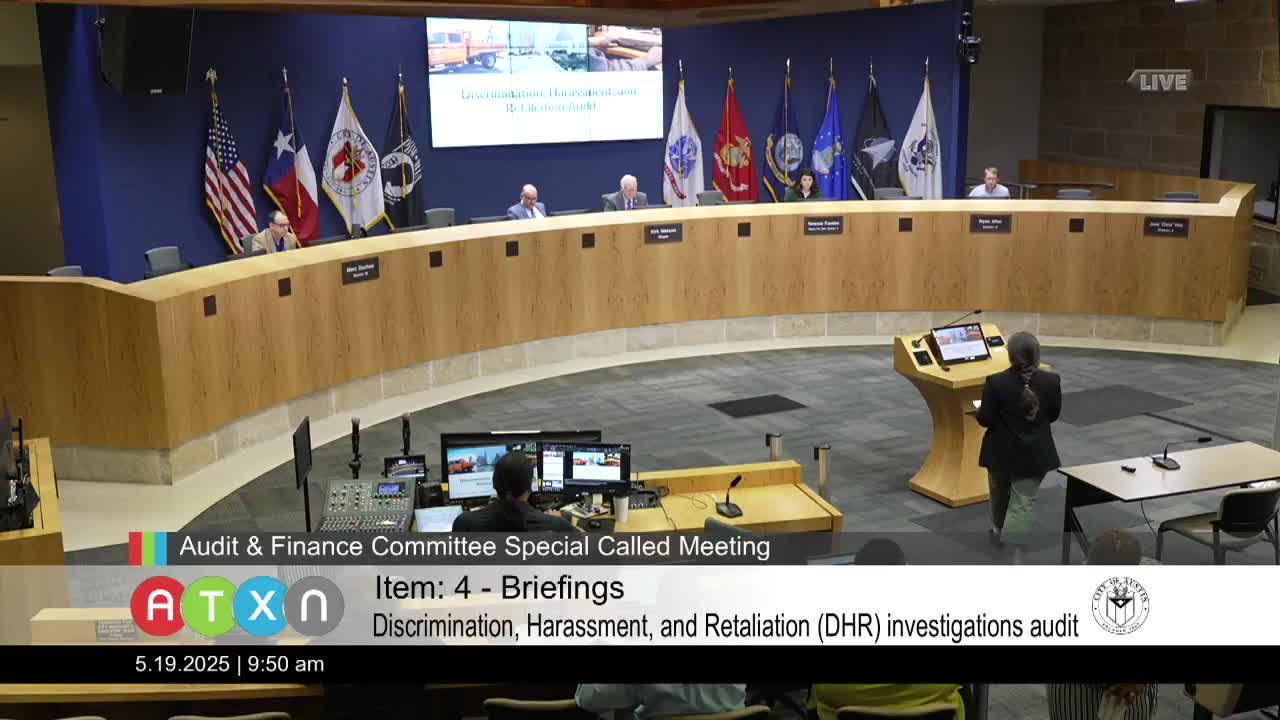
The city auditor’s office presented results of an audit on discrimination, harassment and retaliation investigations to the Audit and Finance Committee on May 19.
Mariel Dempster, the lead auditor on the project, said the audit examined whether the City of Austin effectively and equitably addresses discrimination, harassment and retaliation complaints. Dempster said the office reviewed investigations from fiscal years 2018 through 2024 and found three primary findings, one observation and five recommendations.
Dempster told the committee some investigations “miss essential steps from the city's guidelines, are not well documented, or take too long,” and that those shortcomings can undermine employee trust. She gave an example in which an anonymous allegation naming multiple individuals received only a single interview with the department HR manager and no interviews with the named employees or witnesses; the auditor concluded the investigation work there was inadequate under city guidelines.
The audit found less than 40% of investigations were completed within the 120-day guideline and identified unexplained delays, including gaps of months between interviews and a two-month delay in investigator assignment in some cases. The audit also found uneven investigator training: the EEOC model calls for an initial 32 hours plus ongoing hours annually, while city investigators had been required to complete an 18-hour training developed after the prior audit and that periodic refresher training had not been implemented.
On case tracking, Dempster said the city’s case-management system (AIM ON target) was still in use but inconsistently employed across departments; some units used SharePoint or Excel, and at least one reported not using the central system at all. The auditor’s sample showed only three of ten complaints the auditor’s office referred to HRD were identifiable in the case-management system; inconsistent recording can hide patterns and prevent accurate reporting of outcomes.
Dempster said the audit issued five recommendations: improve training for HR investigators; update quality-control processes for investigations; research alternatives to formal investigations when appropriate (for example, mediated resolution in limited cases); implement and enforce use of a new case-management system; and require and enforce periodic training for all employees on discrimination, harassment and retaliation.
Susan Sims, the city’s human resources director, said HRD agrees with the recommendations and described measures underway. Sims said staff turnover during COVID reduced investigator capacity and that new leadership and hires have been rebuilding the unit. She outlined plans to use the city’s upcoming Workday implementation and Workday Learning to centralize complaint intake, improve tracking and provide annual training that can be monitored centrally.
Nathan Brown, assistant director in HR, described the new HR portal approach and said employees will be able to log complaints directly; HR will transition to a custom portal with Workday integration targeted for rollout this fall. Brown said the existing AIM ON target product was designed for HR staff rather than employee self-reporting and was not user-friendly.
Committee members pressed HR and the auditor on the scale of the issues. Dempster reported the audit reviewed 1987 investigations recorded in the case-management system from fiscal 2018 to 2024 and that about 77% of those investigations resulted in unsubstantiated findings; she cautioned the system tracks investigations (not every complaint), so the numbers may undercount overall allegations.
Council members asked whether some complaints should be handled by alternatives to investigation. Dempster and HR staff said mediation and other alternatives could be useful in appropriate, less-severe cases, but that serious allegations still require formal investigation. HR said it will use Workday Learning and Austin Essentials to track and improve training completion rates, which the auditor found were incomplete for a large share of employees.
The committee did not take a formal vote on the audit’s recommendations at this meeting; HRD told the committee it accepts the recommendations and will work with the auditor’s office on implementation and follow-up.