Get Full Government Meeting Transcripts, Videos, & Alerts Forever!
Get email alerts on the Pensions topic
No spam. Unsubscribe anytime.
House passes bipartisan pension bill, Senate File 2884, on 133-1 vote
Summary
The Minnesota House passed Senate File 2884, a bipartisan pension package that adjusts cost-of-living benefits, creates study groups for certain public-safety-adjacent roles and alters duty-disability provisions; the measure passed by a 133-1 recorded vote and was sent to the governor.
The Minnesota House passed Senate File 2884, a bipartisan pension bill, on a 133-1 recorded vote after members suspended the rules to give the measure a third reading and final passage.
Members described the measure as a broad package of pension changes that provides cost-of-living adjustments for some public employees, establishes a work group to study pension options for probation officers and 9-1-1 telecommunications staff, and changes duty-disability provisions for police and fire personnel. Representative Niska moved to suspend the rules and advance the bill under the procedures permitted by Article IV, Section 19 of the Minnesota Constitution; the motion carried and the bill received final passage later in the session.
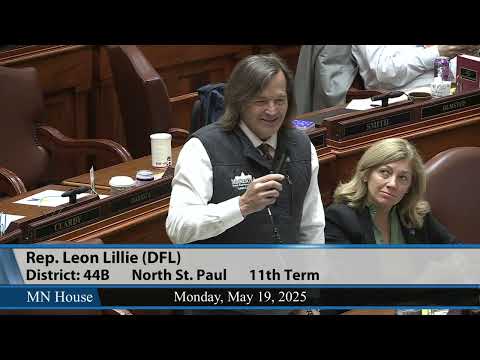
The bill grew out of the bipartisan Pension Commission, several members said on the floor. "This is the bipartisan pension bill from the pension commission," Representative Lilly said during floor debate, urging members to support the measure. Representative O'Driscoll called the commission's work a long-term effort to protect funds and restore cost-of-living adjustments when funding allows: "When we get our pension funds moving in the right direction... we will be back to provide you cost of living allocation and adjustments." Representative Nadeau said the legislation represents a structural funding change, noting "this is the first time that we have $8,080,000,000 in each biennium moving forward." (As stated on the floor.)
Floor speakers outlined several specific policy elements and next steps. The bill directs a work group to study pension changes for probation officers and 9-1-1 telecommunications staff and permits consideration of adjacent public-safety roles (forensic scientists and certain civil employees). That work group is expected to report back by Jan. 15, 2026, according to remarks on the floor. The measure also contains provisions affecting duty-disability benefits in police and fire spaces; some speakers said funding provided in the prior biennium was one-time only and additional adjustments remain under discussion.
Not all members agreed the bill was fully equitable. Representative Herr said St. Paul teachers received no benefit under the teacher COLA provisions in the package and said a requested $1,000,000 for the Saint Paul Teachers Retirement Association was not included. Representative Roach cast the lone recorded no vote and read a constituent statement criticizing limits on post-injury health insurance, saying, in part, that limiting health insurance coverage to five years for those disabled on the job is "atrocious and inhumane." Several other members acknowledged there were difficult trade-offs to achieve bipartisan consensus.
Floor debate also included fiscal comparisons offered by members describing alternative options considered: one proposal to change teacher retirement eligibility to 62 with 30 years had been estimated at roughly $240 million, another at about $75 million, and the option included in SF 2884 was described on the floor as costing about $35 million. Representatives also referenced prior investments (a one-time $600 million described from the last biennium) and said the bill aims to balance improved benefits with long-term fund solvency.
After the final roll call the clerk announced "There being 133 yays and 1 nay, the bill is passed and its title agreed to." The bill will now go to the governor for consideration.
Provenance: The motion to suspend rules and the bill's final passage appear in the transcript beginning with the motion recorded at 0.56 seconds into the transcript and concluding with the roll call and result recorded at 2718.805 seconds.
Ending: Lawmakers on both sides described the bill as an incremental, bipartisan step on pensions that will require additional follow-up work, including a January 2026 report from a study group tasked with examining probation and 9-1-1 retirement options; some members said they will return to remaining issues in the next biennium.