Get Full Government Meeting Transcripts, Videos, & Alerts Forever!
Get email alerts on the Project Based Vouchers And Fss topic
No spam. Unsubscribe anytime.
Housing Authority reviews project-based vouchers and family self-sufficiency program
Summary
Staff briefed commissioners on how project-based vouchers are allocated and managed, and outlined the Family Self-Sufficiency (FSS) program, which uses escrow accounts to reward earned-income gains. Commissioners asked about wait lists, eligibility, funding limits and HUD rules.
The Santa Rosa Housing Authority on May 19 held a study session explaining how project-based vouchers (PBVs) and the Family Self-Sufficiency (FSS) program operate, how families are placed into PBV units, and how FSS uses escrow accounts to encourage employment and economic stability.
The presentation, delivered by Annette Anthony, Housing and Community Services Manager, summarized PBVs as a component of the Housing Choice Voucher (HCV) program that the housing authority contracts to reserve vouchers for specific units at a property. Anthony said the PHA manages separate waiting lists for each PBV site and provides property owners a set of household names (for example, 10 names for one vacancy) rather than direct access to the waiting-list software. Owners screen and select tenants but must document outreach attempts and submit a tenancy approval form that triggers the PHA’s income verification, inspection, and rent-reasonableness review.
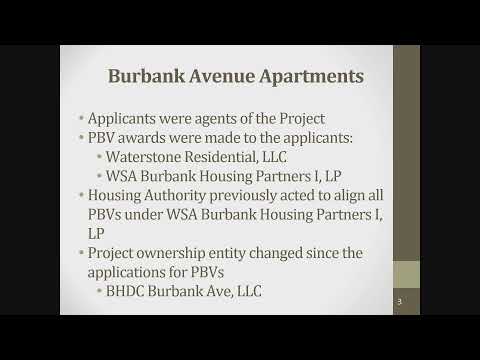
Commissioners pressed staff on how applicants sign up for PBV waiting lists, whether applying to a PBV site removes someone from the main HCV list (it does not), and how special-population set-asides work. Anthony said the authority manages 12 active PBV sites and described examples: South Park Commons (30 dedicated PBVs, leasing up), Cannery at Railroad Square (33 PBVs), Del Nido (8 rehabbed units transitioning to PBVs), Burbank Avenue Apartments (16 PBVs forthcoming), and 10 VASH PBVs at Heritage in Petaluma. She said PBVs come from the authority’s overall voucher allocation, and the housing authority’s HCV allocation is capped at 1,925 vouchers.
Staff explained HUD limits on project-basing: a housing authority may set aside up to a baseline percentage (generally 20%) of its allocation for PBVs for the general population, and the authority reported it is authorized to set aside up to 25 percent overall with additional allowances reserved for special populations such as seniors, veterans or homeless households. For individual projects HUD rules cap the share of units that can be PBV-funded (for many projects the limit is 25 percent of the complex or 25 units, whichever is less; some specialized projects may meet higher thresholds). Anthony said PBV contract terms historically have been 15–20 years with allowable renewal options; HUD regulations permit PBV HAP contracts up to 40 years in certain cases.
On the FSS program, staff described the voluntary, five-year (with an allowable two-year extension) program that links participants with a coordinator to create an Individual Training Service Plan (ITSP). As a participant’s earned income rises, a portion of the household’s rent increase is deposited into an interest-bearing escrow account; when program goals are met the family graduates and receives the accumulated escrow. HUD-mandated requirements for graduation include seeking and maintaining suitable employment, meeting goals in the ITSP, compliance with HCV rules and being free of TANF cash assistance prior to graduation (staff noted HUD’s final rule changes effective June 1, 2022 that clarify timing of the TANF restriction).
Staff said roughly 40 families are enrolled in the local FSS program (an increase from mid- to high-20s a year earlier). Since June 1, 2022 the authority reported 12 FSS graduates, with total escrow disbursements of about $251,000 and the highest earning graduate reaching just over $61,000. The housing authority receives a separate federal grant to administer FSS (staff cited approximately $134,000 annually), and staff said interim disbursements from escrow are allowed for expenses that support a family’s employment or training goals (for example, vehicle repairs or education technology).
Commissioners asked how long PBV waiting lists are relative to the main HCV list; staff said wait times vary by development and by population served, and noted some PBV buildings (for example those serving seniors or people with disabilities) can have low turnover and longer waits. Commissioners also asked about equity of access and whether a household can apply to multiple PBV site wait lists; staff confirmed applicants may apply for multiple open PBV site listings and remain on the main HCV list simultaneously.
Staff emphasized that PBVs are often attractive to developers because a long-term PBV contract (for example, 15–20 years) provides predictable revenue that strengthens project financing. Commissioners requested more data on lease-up timelines and participant outcomes; staff said it can provide additional statistics and follow up on requested participation numbers and other metrics.
Ending: Commissioners did not take any formal votes during the study session. The presentation closed with questions and staff noting they would report back with additional pipeline and budget information in the executive director update.