Get Full Government Meeting Transcripts, Videos, & Alerts Forever!
Get email alerts on the Traffic Safety topic
No spam. Unsubscribe anytime.
Dallas committee hears Vision Zero update as city reports fewer crashes but more fatalities in some incidents
Summary
The Transportation and Infrastructure Committee received the Vision Zero annual update, which reported a decrease in total crashes but some increase in fatalities in 2024 compared with 2023, outlined countermeasures and corridor studies, and discussed enforcement and data consistency across city dashboards and police records.
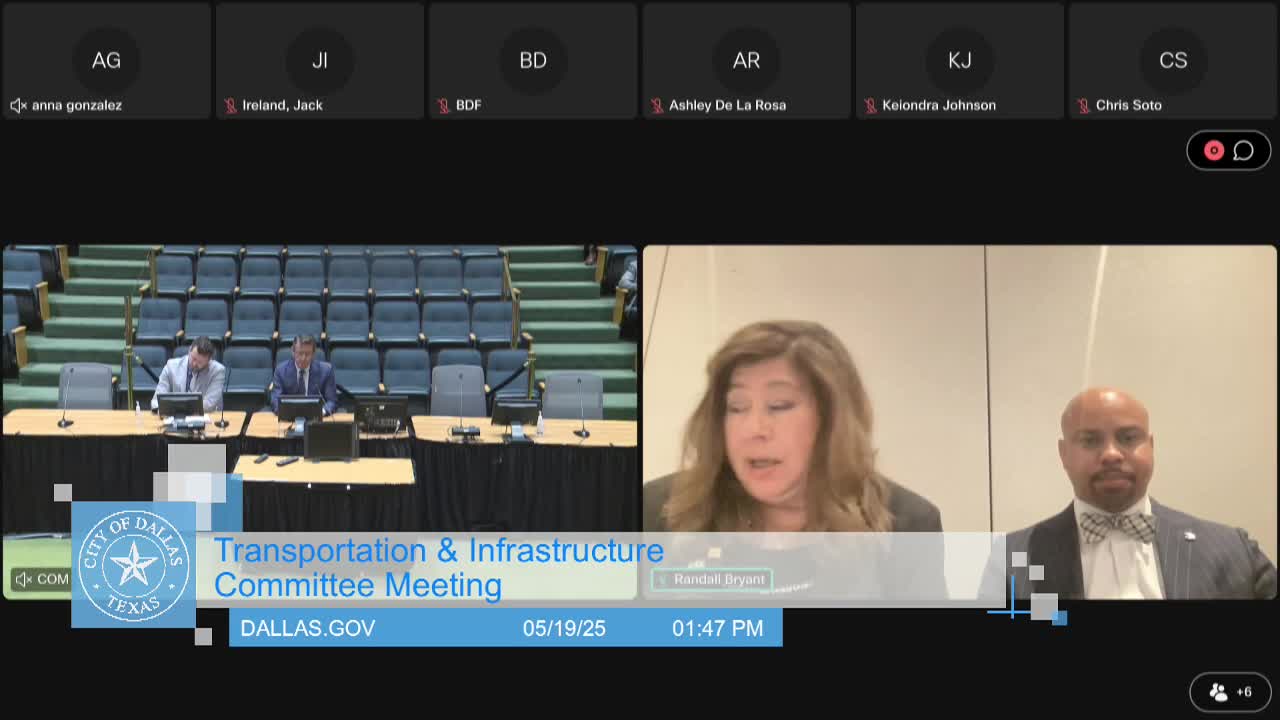
The City of Dallas Transportation and Infrastructure Committee received an annual update on the city’s Vision Zero traffic‑safety initiative on May 19, with city staff reporting declines in overall crashes but highlighting continued work to reduce deaths and severe injuries.
Department of Transportation and Public Works Director Dr. Gus Concarley told the committee that total reported crashes in Dallas fell from about 35,000 in 2023 to 28,000 in 2024. He said reported fatal crashes rose slightly from 201 in 2023 to 210 in 2024 and that severe injuries fell from 985 to 932 over the same period. Concarley noted that some 2024 incidents involved multiple fatalities, which affected the fatality totals.
City staff presented a high‑injury network inventory that shows roughly 7% of city street segments account for about 57% of severe crashes; the inventory lists 447 high‑injury segments and about 1,000 signalized intersections on that network. Concarley described ongoing corridor studies and engineering countermeasures — including back plates on signals, leading pedestrian intervals, pedestrian hybrid beacons, lane reductions, roundabouts, intersection lighting, median islands, rectangular rapid‑flashing beacons and speed cushions — and said the city is testing reflectivity of crosswalk enhancements.
The committee discussed data sources, enforcement and near‑term interventions. Assistant Director Malini Banerjee (Office of Data Analytics) said the Vision Zero dashboard draws from the Texas Crash Records Information System (CRIS), which aggregates crashes reported by multiple agencies; Major Eric Roman of the Dallas Police Department explained DPD’s enforcement and education roles and said traffic units deploy based on hot‑spot data and council complaints. Council members pressed staff to improve consistency between DPD records and the city dashboard and asked for more frequent briefings than the annual update. Several council members requested quarterly or near‑real‑time reporting and asked staff to present a clearer, consolidated action plan and budget implications.
On enforcement and resources, Major Roman described targeted speed operations, road‑racing enforcement and mobile analytics tools the department uses to deploy officers. Council members observed that, numerically, more Dallas residents die in traffic crashes than by homicide in recent reporting and urged treating Vision Zero as a public‑safety priority that combines enforcement, engineering and education. The committee also discussed a pilot for expedited speed‑cushion deployment in District 5 and a proposed FY26 base budget item of about $2 million for speed‑calming measures; Concarley said the Vision Zero line in the current year’s budget is approximately $1.6 million.
Staff summarized grant activity and partnerships: the city has applied for or received Highway Safety Improvement Program and Safe Streets for All grants, and is working with TxDOT, NCTCOG and FHWA on several corridor studies. Concarley said interim measures — temporary striping, pedestrian hybrid beacons and short‑term lane adjustments — allow staff to test concepts before committing major capital. Committee members asked how long engineering projects can take; staff said federally funded projects that include engineering can take 15 months to two years to reach construction and stressed the need for procurement and staffing flexibility.
Councilmembers asked for clearer public communication of Vision Zero actions and for the committee to receive more frequent status reports. The assistant city manager acknowledged progress and recommended continued coordination among departments and outside partners.
Why it matters: Traffic crashes remain a leading cause of preventable death; the committee’s review highlighted technical countermeasures and the need for coordinated enforcement, timely data and sustained funding to advance the city’s Vision Zero goal.
Outlook: Staff committed to follow up on data consistency between DPD and the city dashboard, to provide more frequent briefings on performance and to continue corridor studies and interim safety measures ahead of longer engineering projects.