Get Full Government Meeting Transcripts, Videos, & Alerts Forever!
Get email alerts on the Special License Plates topic
No spam. Unsubscribe anytime.
House transportation committee advances multiple license-plate bills, pauses new plate applications; advances driver-safety and property-lease measures
Summary
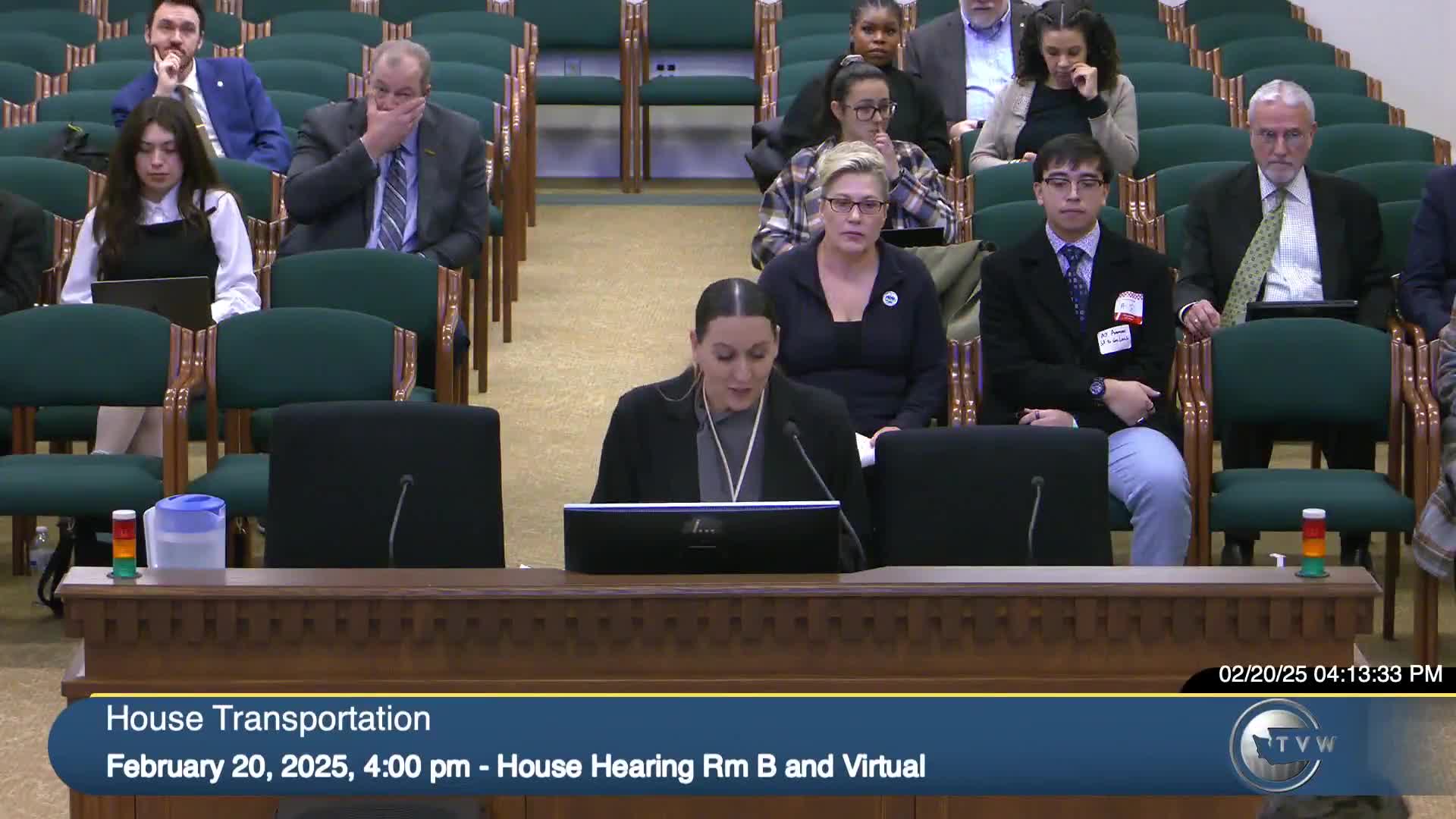
OLYMPIA — The Washington House Transportation Committee on Feb. 20 heard extensive public testimony on a package of special license-plate proposals and approved several transportation bills, including a driver-retraining alternative for certain moving-violation suspensions and rules allowing WSDOT to lease surplus property for community purposes.
OLYMPIA — The Washington House Transportation Committee on Feb. 20 heard extensive public testimony on a package of special license-plate proposals and approved several transportation bills, including a driver-retraining alternative for certain moving-violation suspensions and rules allowing the Washington State Department of Transportation to lease surplus property for community purposes.
The committee took public testimony on House Bill 1368, an omnibus bill that would create several new special license plates and designate recipients for proceeds, and on House Bill 1952, which would pause new special-plate applications and create a legislative task force to review the application and funding process. The panel also heard competing testimony on two bills that would redirect proceeds from existing team-branded plates to team-affiliated foundations — HB 1846 (Seattle Sounders/Ray Foundation) and HB 1931 (Seattle Seahawks Charitible Foundation) — with the Washington State Leadership Board urging the committee to reject planned revenue reallocations.
Why it matters: Special license plates generate small but recurring revenue streams for sponsoring organizations and administrative revenue for the Department of Licensing (DOL). Committee members and witnesses said some plates fund youth education, wildfire prevention and sports access; opponents warned that redirecting existing plate proceeds can reduce funding for other state youth programs at a time of tight budgets.
What was proposed and who testified
House Bill 1368 (omnibus special plates): Sandra Meyer, staff to the committee, summarized the bill and its fiscal assumptions. The bill would authorize multiple plates including Keep Washington Evergreen (for electric charging station support), LeMay America’s Car Museum, Mount St. Helens Institute, Nautical Northwest (Whidbey Island maritime resources), Smokey Bear (wildfire prevention funds to the Department of Natural Resources), a State Sport plate (proceeds to Seattle Metro Pickleball Association for dedicated courts), and a Working Forests plate for small forest landowners. Meyer explained DOL charges $40 for original issuance and $30 for renewals; DOL retains $12 of original-issuance revenue and $2 on renewals for administrative purposes. Meyer said initial implementation costs average about $30,000 and must be repaid by sponsoring organizations within two years, including a $6,300 startup payment credited to that total. She presented DOL estimates of plate-issue volumes and a DOL staffing and IT-cost fiscal estimate: about 0.9 FTE and roughly $412,000 in the 2025–27 biennium, with proceeds to sponsoring organizations projected at roughly $600,000 in 2025–27 on the forecast used.
Representative Matt Orcutt, sponsor of the omnibus approach, called the plates an efficient way to support causes from outdoor education at Mount St. Helens to wildfire prevention and pickleball-court construction, saying, "I run this bill as an omnibus bill, just to try and and be efficient with our time." Testimony supporting individual plates came from multiple organizations: Kate Van Ghent, vice president of the Seattle Metro Pickleball Association, urged support for the State Sport plate to fund courts; Alisa (Alyssa/Alisa in the record) Hoyt, co-executive director of the Mount St. Helens Institute, described the Institute’s education and stewardship programs at the monument; Michael Transsoon testified for the LeMay Museum on the museum’s workforce-education programs; Pat Sullivan of the Department of Natural Resources supported the Smokey Bear plate as both a funding and public-education tool; and Keith Townsend testified for the Washington Tree Farm program about working-forest benefits. Several sponsoring organizations noted some plates already had signatures or application steps completed, while others would require sponsor startup payments.
House Bill 1952 (pause and task force): Committee staff described DOL responsibilities and the proposed task force composition: two DOL members, and legislators from each major caucus (two each), at least one from transportation committees in each caucus. HB 1952 would pause new special-license-plate applications through June 30, 2029, except for the plates created in HB 1368, and would require the task force to report findings to the Legislature by Dec. 1, 2025. Representative Brandy Donaghy, sponsor, said the pause would let the Legislature review whether plates are financially sustainable and reduce legislative time spent processing many plate bills.
Plates tied to professional teams: HB 1846 (Seattle Sounders/Ray Foundation) and HB 1931 (Seattle Seahawks Charitable Foundation) drew contested testimony. Audrey Baker, executive director of the Washington State Leadership Board, testified in strong opposition to HB 1846, saying the board would lose about $34,000 per biennium and that the reduction would come as the agency anticipates across-the-board budget reductions; she described the board’s role providing youth civic leadership and mentoring programs. Chris Massey, chief legal officer for the Seattle Sounders, said the Ray Foundation’s mission ties more directly to soccer access and that redirecting plate proceeds would better align donors and fundraising, and offered to work with the Leadership Board to offset losses. Representative Addison Richards (sponsor of HB 1846) and Representative Drew Johnston for the Seahawks (testifying on HB 1931) emphasized alignment with team charitable activities and the potential for increased plate sales if proceeds flowed to team foundations. Representative Birnbaum briefly described HB 1931 as redirecting proceeds and noted the Seahawks' commitment to replace some funding to the previous recipient.
Driver-safety alternative (House Bill 1244): Representative Wiley moved and the committee adopted an amendment clarifying timing and probation requirements tied to early termination of a 60-day license suspension. The bill would allow DOL to end certain 60-day suspensions early for drivers with multiple moving violations if they complete a safe-driving course approved by DOL; the amendment (HJ 430) clarified that associated probation and proof-of-insurance and fee requirements still apply. Representative Wiley said the bill offers a safety-training alternative for people whose early driving mistakes could otherwise have long-term employment consequences; Representative Stevie (opponent in debate) said the measure risked weakening consequences for repeated speeding and urged a harder line.
WSDOT leases and community-purpose criteria (House Bill 1774): Representative Orcutt and others debated a bill allowing the Washington State Department of Transportation to consider social, environmental or economic benefits when determining adequate consideration for leases of certain WSDOT property to public agencies or community-based nonprofits. Committee members considered multiple amendments addressing right-of-repurchase or right-to-lease for original owners and protections to prohibit certain housing or shelter uses on highway right-of-way where public safety could be jeopardized. The committee approved a substitute with several amendments retained; proponents said surplus or unneeded highway property could serve parks, shelter or other community benefits if done safely and equitably.
Other technical/driver-work-zone measures: The committee approved a substitute for HB 1822, which would require applicants for new driver licenses under age 26 to pass a DOL-approved online course on work-zone and first-responder safety and require DOL to host or contract for the course; the effective date was moved from Jan. 1, 2026, to May 1, 2026, in the proposed substitute. The committee also moved HB 1823, a technical update to Transportation Improvement Board provisions.
Votes at a glance
- HB 1244 (driver-safety-course alternative; substitute incorporating amendment HJ 430): reported out of committee with a due-pass recommendation; recorded vote: 16 aye, 11 nay, reported by the clerk as "16 aye, 11 nay." (Amendment HJ 430 adopted orally.)
- HB 1774 (WSDOT leases allowing community-purpose consideration; substitute with adopted amendments): reported out with a due-pass recommendation; recorded vote: 21 aye, 6 nay.
- HB 1822 (online driver work-zone/first-responder safety course; substitute H-1356.2 with DOL contracting responsibility and May 1, 2026 effective date): reported out with a due-pass recommendation; recorded voice vote reported as 27 aye, 0 nay.
- HB 1823 (technical Transportation Improvement Board changes): reported out with a due-pass recommendation; recorded voice vote reported as 27 aye, 0 nay.
No final committee votes were recorded in the transcript for HB 1368, HB 1952, HB 1846 or HB 1931; those items received public testimony and remained pending at the end of the hearing.
Fiscal and implementation notes
Committee staff cited DOL estimates that implementing a new special plate costs about $30,000 on average and that sponsoring organizations must repay implementation costs within two years, after a $6,300 startup payment credited toward the total. Meyer said DOL estimated about 0.9 FTE and roughly $412,000 in the 2025–27 biennium for processing and IT changes tied to multiple new plates, and noted that proceeds to sponsoring organizations were projected by DOL at roughly $600,000 in 2025–27 under the forecast used. The Washington State Leadership Board told the committee it would lose about $34,000 per biennium if HB 1846 were enacted as written.
What’s next
The committee adjourned to caucus and said it planned to return at 5:15 p.m. for executive action; members moved multiple bills out with due-pass recommendations. HB 1368, HB 1952, HB 1846 and HB 1931 were left in public testimony status and may return to committee for executive action in coming weeks. The HB 1952 task force (if enacted) would be required to report back to the Legislature by Dec. 1, 2025.
Reported quotes (from the hearing record)
"I run this bill as an omnibus bill, just to try and and be efficient with our time." — Representative Matt Orcutt, sponsor of HB 1368
"Pickleball license plate celebrates Washington's ... state sport and its roots in the Evergreen State." — Kate Van Ghent, vice president, Seattle Metro Pickleball Association
"Wildfire prevention and preparedness is a critical part of the work that Latino Community Fund does." — Christina Gonzales, director, Latino Community Fund
"If this funding is taken away, it's not just being redirected, it's cutting off an opportunity for our next generation of leaders." — Audrey Baker, executive director, Washington State Leadership Board
Ending
The committee moved forward with a mix of procedural reforms and programmatic bills: it advanced a driver-safety retraining alternative and several technical and policy measures, and it set a multi-year pause and review of new special-license-plate applications as a pending policy question. Sponsors and opponents said they expect continued work and amendments in coming weeks to refine who benefits from plates and how proceeds are allocated.