Get Full Government Meeting Transcripts, Videos, & Alerts Forever!
Get email alerts on the Student Assessments topic
No spam. Unsubscribe anytime.
District assessment shows mixed gains, notable declines in sixth grade and some high school math scores
Summary
The board received spring 2024–2025 FAST assessment results showing improvements in several grades and subject areas, but declines in sixth grade and a sharp drop in math at one high school were noted; district grade is trending to a B.
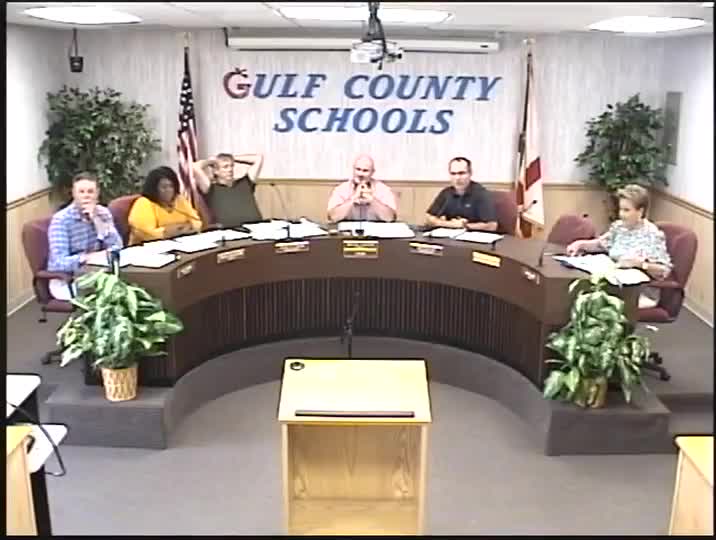
Gulf County School Board members reviewed the district’s spring 2025 assessment report on June 3 and heard that results vary widely by grade and school, with several gains but also concerning declines in sixth grade and in high school mathematics at one campus.
Miss Tracy, who presented the data, said the report compares spring 2024 to spring 2025 FAST progress-monitoring (PM3) results. She highlighted an 18-point gain in kindergarten at Port St. Joe Elementary (from 50% at level 3 or higher in 2024 to 68% in 2025) and said overall the district’s results often exceeded the state average in several tested grades.
But Tracy and board members noted declines in some grades. Sixth-grade reading and math scores fell at both Port St. Joe and Wewahitchka campuses; Port St. Joe High School’s sixth-grade fast-reading percentage dropped from about 60% in 2024 to about 48% in 2025, and Wewahitchka showed a smaller decline. Tracy flagged a particularly large fall in one high‑school math result: a campus that had 62% scoring level 3 or higher in a prior administration showed only 21% in the most recent math administration, a drop the presenter said would be addressed.
There were also strong gains: seventh-grade civics rose from 64% to 86% at one campus, and several end-of-course (EOC) results improved — for example, Algebra I at Port St. Joe showed an increase from 51% to 65% scoring level 3 or higher between administrations.
Board member questions focused on sixth grade. Miss Bowers asked whether the sixth-grade declines could reflect the transition from elementary to middle school. Tracy said she and assessment coordinators were reviewing possible causes but that testing format and administration were consistent across PM1–PM3 and did not change the test format.
Tracy said preliminary district and school letter grades were forthcoming from the state and that current trends indicate the district is likely to be graded a B when official grades are released at month’s end. No board action was taken; the presentation was informational.
The board’s superintendent and staff said they are continuing professional development and intervention planning to address declines, including summer and early-year teacher training and a reworked approach to tiered interventions.