Get Full Government Meeting Transcripts, Videos, & Alerts Forever!
Get email alerts on the Sign Code topic
No spam. Unsubscribe anytime.
Planning board approves text amendments to Port St. Lucie sign code
Summary
The City-initiated update to Chapter 155 of the sign code clarifies exemptions, adjusts freestanding-sign allowances for large developments, and modernizes permitting submittal requirements; the Planning & Zoning Board recommended approval and advanced the amendment to City Council.
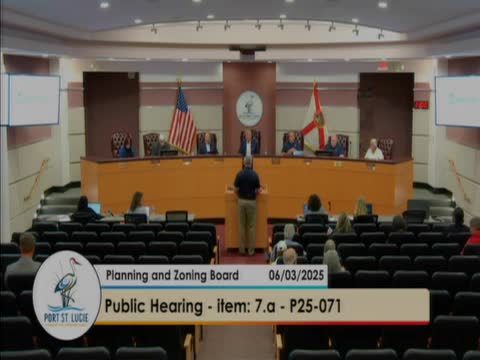
The Port St. Lucie Planning & Zoning Board on June 3 voted to recommend approval of a city-initiated text amendment to Chapter 155 of the city sign code (file P25-071).
Daniel Robinson, Planning and Zoning staff, told the board that “Staff has updated the sign code to provide class clarification on exemptions, correct a correct a Scribner's error, and provide additional freestanding sign for larger developments.” He said staff clarified that “public signs are exempt of not only the permitting process, but of all other aspects of the sign code,” updated rules for freestanding signs on larger commercial sites, and removed the requirement for printed copies because the city now accepts digital submittals.
The amendment makes several specific changes to section numbering and text in Chapter 155. Among the edits Robinson highlighted: a clarification that temporary signs do not require a permit but must meet setback and size requirements in the chapter; a statement that certain tenant-panel changes on existing permitted signs are governed by section 155.04; removal of a duplicated exemption reference for public signs; codifying that credit-card signs do not count toward façade-area calculations; and updating permitted square-footage thresholds so table entries and text align.
Staff recommended the amendment as consistent with the city comprehensive plan. With no public comment, a board member moved to approve the city-initiated amendment (file P25-071); the motion carried on the board’s voice vote and the recommendation will proceed to the City Council for final action.
The board’s approval was procedural: it forwarded the text amendment with a favorable consistency finding to City Council; the council will adopt an ordinance before the changes become effective.