Get Full Government Meeting Transcripts, Videos, & Alerts Forever!
Get email alerts on the Community Development topic
No spam. Unsubscribe anytime.
Ogden council approves reallocation of unspent CDBG‑CV funds to public improvements
Summary
On June 10 the Ogden City Council adopted a resolution amending the 2020–25 Consolidated Plan and the FY2021 Annual Action Plan to shift unspent CDBG‑CV dollars originally earmarked for small-business loans to public‑improvement projects tied to pandemic preparedness.
Ogden City Council on June 10 unanimously approved a resolution amending the city’s 2020–25 Consolidated Plan and the FY2021 Annual Action Plan to reallocate unspent Community Development Block Grant–Coronavirus (CDBG‑CV) funds from small‑business lending to public‑improvement projects aimed at pandemic preparedness.
The change, presented by city staffer Jeremy, moves money that HUD originally approved for loans to businesses into projects such as trail and sidewalk improvements, Americans with Disabilities Act ramps and other public works that the U.S. Department of Housing and Urban Development deems eligible for pandemic response and preparedness. Jeremy said those uses were recommended by HUD after the city found demand for business loans had declined and the remaining funds could not be spent under the original activity description.
Why it matters: HUD requires that any activity funded under a Consolidated Plan be listed in that plan. Moving the unspent CDBG‑CV funding into a new eligible activity requires a formal amendment, public outreach and HUD sign‑off; council approval sends the amendment to HUD for final review.
City staff described the dollar shifts in detail. The original CDBG‑CV allocation for the fiscal year totaled $947,104: $426,197 for microenterprise loans, $426,197 for small‑business loans and $94,710 for administration. Staff said $380,904 of the microenterprise loan money had already been spent. Under the proposed amendment the remaining small‑business loan allocation would be reprogrammed: $500,000 would go to public improvements and $66,200 to administration, keeping the total at $947,104.
At the June 10 public hearing, resident Theresa Bramwell said she owns commercial property on 20th Street and said she had not known of the loan program and that the loan structure would not suit property owners who do not want additional debt on their buildings. "I own a commercial property at 20 Fifth in Monroe… it was burned by homeless people in 2021," Bramwell said, asking whether the funds could be used for park‑strip or exterior property work. Jeremy responded that CDBG‑CV activities must tie back to preparing for or responding to COVID‑19 (or a future pandemic) and that façade work would be difficult to justify. He listed eligible public‑improvement examples HUD has accepted: trail and sidewalk expansions that improve outdoor access and social distancing, ADA ramps and similar infrastructure, and said sidewalks intended for pandemic‑related social‑distancing improvements often must be at least six feet wide.
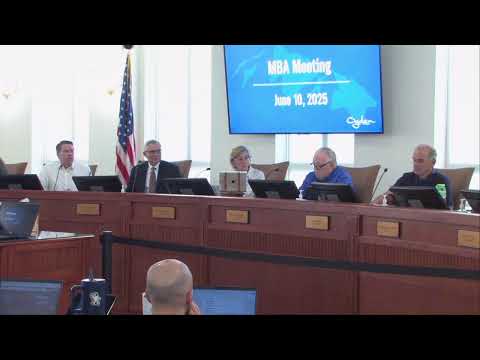
The council voted by roll call on a motion by Council Member Ritchie, seconded by Vice Chair Hyer, adopting proposed Resolution 2025‑11. Council Members Blair, Jaberka, Graff, Myers, Ritchie, Vice Chair Hyer and Chair White all voted in favor.
Next steps: City staff said the city completed a 30‑day public comment period that ended June 7 and planned to submit the amendment to HUD the day after the council vote for HUD review and approval.