Get Full Government Meeting Transcripts, Videos, & Alerts Forever!
Get email alerts on the Public Works topic
No spam. Unsubscribe anytime.
Elbert County reviews proposed construction standards, turn-lane criteria, culvert rules and developer fee schedule
Summary
Public Works and county engineering staff presented proposed amendments to Elbert County construction standards and a draft fee schedule for developers, including lane-design criteria tied to traffic counts, culvert maintenance clarifications and a pavement-design table for private and public roads.
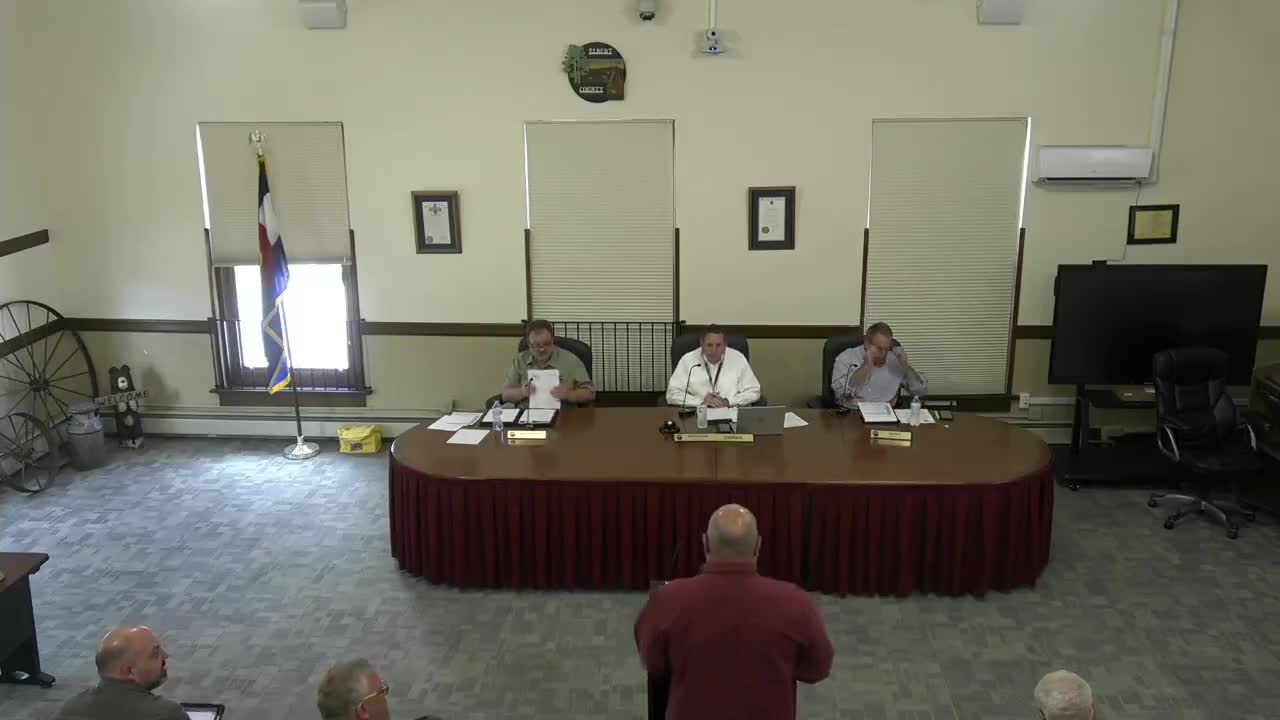
Elbert County Public Works and county engineering staff presented proposed amendments to the county's construction standards and a draft fee schedule during the Board of County Commissioners meeting. The presentation covered proposed developer fees, lane-design criteria tied to traffic counts, culvert ownership/maintenance language and a pavement-section table for private and public roads.
Monty Hankins, Elbert County Public Works Director, and Dale Gillum, county engineer, said the fee schedule would formalize plan-review and consultant costs that are currently incurred by the county and are intended to be charged to developers. "The fee schedule you're looking at was developed using current and competitive fees that are in line with surrounding counties and municipalities," Gillum said. He added that the county currently may contract private consultants "at the cost of the developer" per the construction standards already, but staff believed enforcement and clarity were needed.
Commissioners discussed the lane-design criteria, with one commissioner concerned about whether criteria would apply to small parcel splits or only to larger developments. Gillum and Hankins said lane and turn-lane triggers are tied to traffic-count thresholds and that, under current counts, only two county roads (County Road 13 and County Road 166) would meet the threshold in the county.
On fees, Gillum estimated the county currently absorbs some engineering review costs and that implementing the fee schedule could recoup "a few hundred thousand dollars a year" (estimate provided by staff). The board debated whether to move fees forward separately from regulatory changes; one commissioner suggested splitting the fee schedule from the broader regulation package so the county could adopt fees sooner while continuing to refine design criteria.
Staff also proposed clarifying culvert ownership and maintenance for private driveways, noting the county has historically not enforced culvert maintenance and that any enforcement would be a code-enforcement matter. The proposed pavement table was offered to establish minimum industry-standard pavement sections for future private and public road construction.
No final regulatory vote was held on the construction standards at the meeting; commissioners asked staff to return with further details and discussed scheduling a work-study session to review the proposals.