Lifetime Citizen Portal Access — AI Briefings, Alerts & Unlimited Follows
Council committee reviews Public Service Commission $20.8M FY2026 budget, probes gas electrification plans
Loading...
Summary
The D.C. Council Committee on Business and Economic Development heard the Public Service Commission present its FY2026 operating budget and answered questions about pipeline safety, electrification policy and rate-case timing.
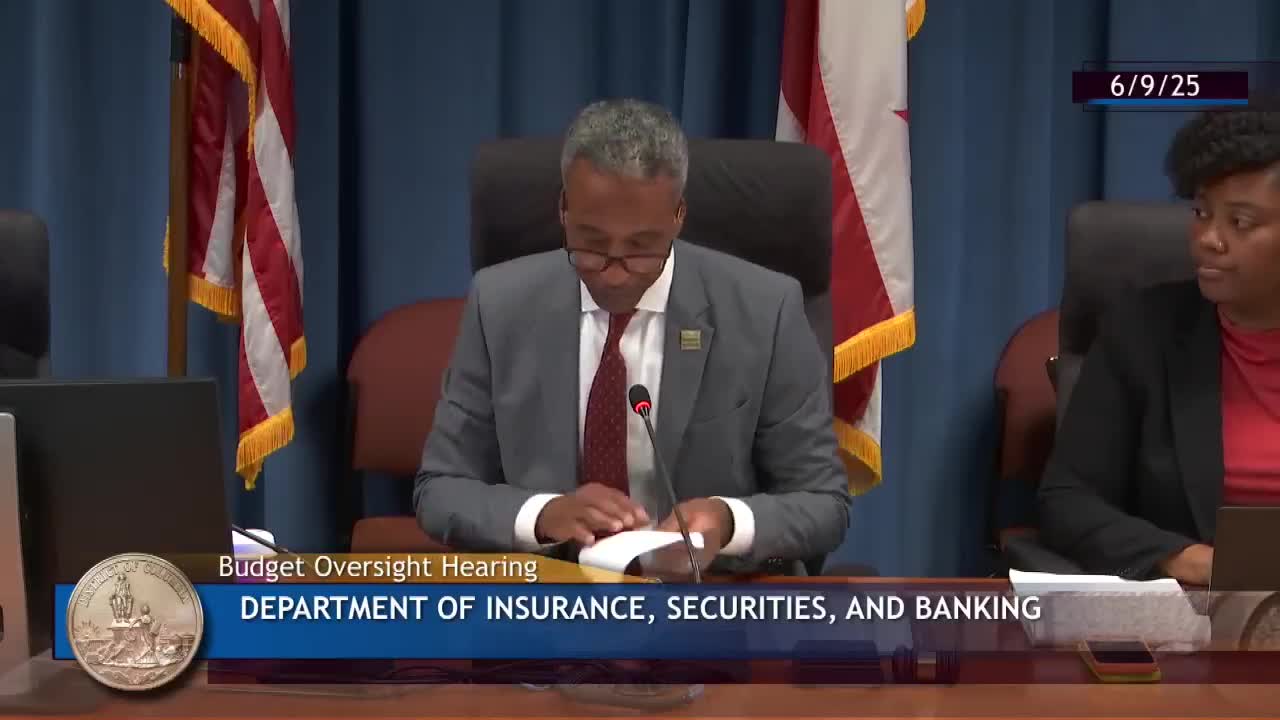
Kenya McDuffie, At-Large Council member and chair of the Committee on Business and Economic Development, convened a June 9 budget oversight hearing where the D.C. Public Service Commission outlined its fiscal year 2026 operating request and regulatory priorities.
Neil C. Thompson, chairman of the D.C. Public Service Commission, told the committee the mayor's proposed FY2026 operating budget for the commission is $20,792,531 and funds 93.6 full-time equivalent positions. He said the commission expects $0 in local funds, about $20,147,704 in special-purpose revenue, $631,000 in federal grants and $14,000 in private donations.
The hearing focused on how the commission will use those funds amid constrained city revenues and ongoing utility-sector changes. Thompson said the commission remains funded primarily through assessments on regulated utilities and competitive suppliers, and that the D.C. Code requires the commission's agency fund be used exclusively for commission expenses. "I am pleased to appear before this committee to provide testimony in support of the mayor's fiscal year 2026 budget request for the commission," Thompson said.
Members questioned the commission about how it can encourage electrification while Washington Gas retains a federal charter to sell natural gas in the District. Thompson said the commission is limited from ordering the company's exit from the gas business but can use regulatory tools to encourage electrification. He described several current regulatory efforts: a gas investigation into leak and repair practices; a notice of inquiry on the "future of gas" proceeding; and a separate notice of inquiry to standardize metrics for measuring greenhouse-gas emissions from WGL's gas system. Thompson cautioned the commission must be "circumspect" in a future-of-gas proceeding because other jurisdictions have faced legal and practical challenges.
Committee members also asked about rate-case timing and customer impacts. Thompson explained the commission handles multi-year electric rate cases and one-year gas cases; both are often litigated and can change procedural schedules due to filings by parties. He said regional market conditions in PJM are contributing to higher standard-offer electricity prices and described his role with the Organization of PJM States, which advocates at FERC on market rules. Thompson warned customers could see sustained price pressures and noted an average residential standard-offer increase of about $20 effective June 1.
On pipeline safety funding, Thompson said the proposed FY2026 budget shows a small reduction in the pipeline safety program (a movement from 4.85 to 4.8 FTE in rounding terms and about $34,000 in PS reductions), but he told the committee the change reflects rounding and was not expected to reduce safety monitoring. Thompson said the commission currently lists eight vacant FTEs in its testimony and that the agency is operating under the mayor's hiring freeze (Mayor's Order 2025-53), though he described staffing as stronger than in past years.
Thompson also described the commission's consumer services office, which fields billing and service complaints and coordinates with the Office of the People's Counsel. He confirmed there are no proposed cuts to the Office of Consumer Services in FY2026.
McDuffie closed the PSC portion of the hearing by seeking any additional follow-up items and noting the committee will request updated schedule documents when necessary. Written testimony was accepted through June 18, 2025.