Get Full Government Meeting Transcripts, Videos, & Alerts Forever!
Get email alerts on the County Budget Fy2026 topic
No spam. Unsubscribe anytime.
Multnomah County adopts FY2026 budget after hours of public testimony and votes on amendments
Summary
The Multnomah County Board of Commissioners adopted the fiscal year 2026 budget June 3 after extended public testimony and votes that restored funding for multiple frontline programs while setting property tax levies and financial policies.
The Multnomah County Board of Commissioners adopted the county—s fiscal year 2026 budget June 3 after extended public testimony and a multi-hour public vote that passed a package of board and department amendments.
The board adopted the library district and county budgets, set property tax levies and approved associated financial policies and fee schedules. Chair Vega Peterson and the four commissioners approved the package in a final roll call following votes on individual amendments and budget notes.
Why it matters: The adopted package sets spending limits, tax rates and program priorities for the county and the Multnomah County Library District for the coming fiscal year. Deliberations focused on restoring frontline services while balancing a forecasted shortfall; commissioners debated funding for housing placements, legal services, peer navigators/case management, public-safety task forces and arts grants.
Most important actions and outcomes
- The board adopted the Multnomah County Library District FY2026 budget, setting an appropriation of $131,000,000 for the library district fund and $76,700,000 for the capital fund and levying property taxes for the district at $1.22 per $1,000 of assessed value (R1–R4 adopted). Library leaders said the budget will staff new branches and support equity-centered services.
- The board adopted the Multnomah County FY2026 budget and made appropriations (R5 adopted). The county—s general levy for the year was set at $4.34 per $1,000 of assessed value and the local option levy at $0.05 per $1,000; the board also authorized $58,900,000 in general obligation bond debt levy for library bond debt service.
- The board adopted multiple board amendments (Attachment A, Section 1) and department amendments (Attachment A, Section 2). Notable restorations or funding actions included: school-based mental health, expanded employment programs and housing placement services in East County, restorations to legal services and peer navigators, funding for public-safety task forces and funding support for Old Town InReach partners. Some proposals failed or were tabled after debate.
Public testimony and recurring themes
Public testimony ran both in-person and online across two formal hearing segments and included employees, case managers, community-based organizations, artists and service providers.
- Labor and county workers: Hillary Zust, a human service investigator and "vice president of ASME Local 88," urged the board to avoid layoffs and to seek alternatives such as cutting executive contracts or reallocating capital funds: "We wanna be clear that our union strongly believes that layoffs can and should be prevented." Zust and other county staff said frontline workers keep county services operating.
- Housing, case management and peer navigation: Multiple staff from Metropolitan Public Defender and other agencies urged restoration of program 25131 (peer navigators/case managers). Sierra Carlson, a case manager, said the work connects clients to shelter, treatment and housing and cited outcomes for dozens of clients; Caitlin Hoof Nagle and other peer navigators offered similar testimony in support of continued funding.
- Legal services and civil-rights investigations: Stacy McCurley, a CIU investigator, warned that eliminating the Civil Investigations Unit (CIU) would increase trauma, delay investigations and increase legal costs: "It's shortsighted to cut CIU to save $700,000 when this decision could cost the county millions of dollars in damages and legal fees." The board ultimately restored funding to CIU through amendment changes.
- Arts funding and RACC: Several speakers urged the board to retain county support for the Regional Arts & Culture Council. Greg Netzer argued the $300,000 allocation supports jobs and leverages private funds: "Multnomah County support for RACC isn't about art for art's sake. It's about jobs, education, belonging, and our collective future." Artists described RACC grants as enabling work that reaches underserved neighborhoods.
- Office of Sustainability: Nikisha Nathan of Neighbors for Clean Air urged the board not to cut the Office of Sustainability, arguing the office secures federal and state funds and advances climate justice work and clean-air projects that reduce energy bills and keep people housed.
Key contested items and vote dynamics
- STI clinic: A motion to restore sexually transmitted infection (STI) clinic services (amendment 46) failed in an initial vote. Later the board reconsidered, accepted a substitute offset (a vacant position funded through a program swap tied to House Bill 4002 implementation) and the amended restoration passed.
- Fee increases and health department impacts: Commissioners debated proposed health inspection fee increases (and other fee changes). Some members expressed concern that fee offsets intended to balance the budget would require drawing on mission-critical positions in the Health Department and that cuts to vacancies would create programmatic impacts.
- Balancing technical fixes: During the hours of amendments the budget office made math and offset corrections to keep the package balanced; Christian Elkin, the county budget director, said the board's process allowed members to vote no on individual amendments while adopting an overall balanced budget.
Votes at a glance
(Selected formal resolutions voted the same day; full list is in the attachments the board adopted)
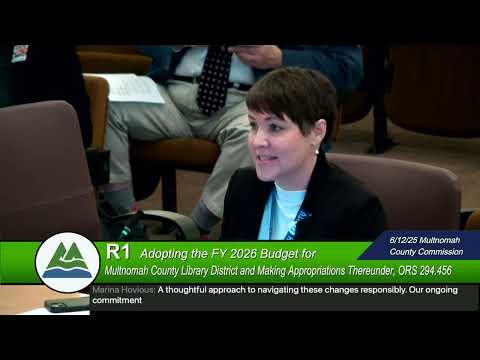
- R1: Resolution adopting FY2026 budget for Multnomah County Library District; appropriation $131,000,000 (library district fund) and $76,700,000 (library capital fund). Motion: Commissioner Abram (Brent) Edwards moved; Commissioner Jones Dixon seconded. Result: Adopted (roll call: Commissioners Singleton, Brent Edwards, Jones Dixon and Chair Vega Peterson voted yes; Commissioner Moyer was not yet present for this vote).
- R2: Resolution levying ad valorem property taxes for the Multnomah County Library District at $1.22 per $1,000. Result: Adopted.
- R3: Resolution adopting library district financial and budget policies. Result: Adopted.
- R4: Resolution defining the funds to be used by the library district in FY2026. Result: Adopted.
- R5: Resolution adopting FY2026 budget for Multnomah County and making appropriations (county general fund and departmental budgets and attachments). Motion: Commissioner Bridal (Brent) Edwards moved; Commissioner Singleton seconded. Result: Adopted (final roll call included Commissioner Moyer; package passed after approval of many board and department amendments).
- R6: Resolution levying county ad valorem property taxes for FY2026 (general levy $4.34 per $1,000; local option levy $0.05 per $1,000; authorized library general obligation bond debt levy $58,900,000). Result: Adopted.
- R7: Resolution adopting financial and budget policies for FY2026 (updated to include budget monitoring). Result: Adopted.
- R8: Resolution adopting the county—s investment policy for FY2026 (includes a new evaluation element for corporate bonds tied to ESG considerations). Result: Adopted.
- R9: Resolution defining funds to be used in FY2026 (minor name change to reflect JOSH capital fund IGA). Result: Adopted.
- R10: Resolution authorizing non-represented employee salary adjustments (2.4% COLA for non-represented staff). Roll-call votes varied; Commissioner Moyer recorded a no vote on R10; majority approved. Result: Adopted.
- R11: Resolution approving the county fee schedule for FY2026 (minor technical corrections in health and sheriff fee lines; significant planning- and health-related fee changes discussed). Result: Adopted.
What the board directed staff to do
- Christian Elkin and the budget office were directed to finalize technical offsets and produce the final appropriation schedule and supporting attachments. Elkin told the board the adoption set the upper limits on departmental spending and that the board could adopt decreases or increases up to statutory limits.
- The board also adopted multiple budget notes (Attachment C) that direct departments to perform follow-up analyses, to report back on contract transparency, and to continue work on fee review and equity-centered program designs.
Select quotes from the record
- "We wanna be clear that our union strongly believes that layoffs can and should be prevented," said Hillary Zust, a Multnomah County human service investigator and vice president of ASME Local 88.
- "Case managers are direct resources for unhoused clients to find shelter and secure housing resulting in less individuals living on the streets," said Sierra Carlson, a case manager at Metropolitan Public Defender, urging continuation of program 25131.
- "It's shortsighted to cut CIU to save $700,000 when this decision could cost the county millions of dollars in damages and legal fees," said Stacy McCurley, a CIU investigator and attorney, describing risks if internal investigation capacity is cut.
- "The board may incorporate amendments that decrease the budget by any amount or increase any fund up to 10%," said Christian Elkin, the county budget director, explaining the mechanics of the adoption and amendments process.
Ending
The adopted FY2026 budget sets policy and spending priorities for Multnomah County and the Library District for the coming year and includes a bundle of restorations and reductions negotiated in public by the board. Commissioners said they expect further work this year to monitor implementation, to track the effects of restorations and cuts and to return with additional recommendations if state or federal funding changes require further adjustments. The county—s adopted package includes the appropriation schedule, policy updates and fee schedule needed to implement operations beginning July 1, 2025.