Get Full Government Meeting Transcripts, Videos, & Alerts Forever!
Get email alerts on the Gubernatorial Appointments topic
No spam. Unsubscribe anytime.
Senate committee fails to report SJR 6001 after dispute over required joint subcommittee and nominee fitness
Summary
The Senate Privileges and Elections Committee voted 4-8 on May 30 to not report SJR 6001, a slate of the governor’s appointees to several university boards, after senators debated whether a joint House-Senate subcommittee required by Virginia law had been convened and whether some nominees were fit to serve.
The Senate Privileges and Elections Committee voted 4-8 on May 30 in Richmond against reporting SJR 6001, a slate of gubernatorial appointees to university boards and other bodies, after members debated whether a joint House–Senate subcommittee required by state law had been constituted and raised questions about the nominees’ fitness for some university boards.
The motion to report SJR 6001 was introduced during the committee’s hearing on the governor’s conforming appointments, but several senators argued that Virginia Code §2.2-107 requires a joint subcommittee of House and Senate Privileges and Elections committees to review resumes and statements of economic interest before the committee proceeds. Senator Sturdivant (Senator, Senate Privileges and Elections Committee) said the code “says there shall be a joint subcommittee … appointed to review the resumes and statements of economic interests of all gubernatorial appointees,” and asked whether that subcommittee had been constituted and had met.
That procedural question formed the core of the hearing. The chairman of the committee (Chairman, Senate Privileges and Elections Committee) acknowledged the committee’s role overseeing gubernatorial appointments and asked the committee attorney for clarification. The attorney indicated he was not aware that the joint subcommittee had been formed. Senator DeStef (Senator) emphasized that the statutory language is mandatory, saying, “This isn’t a may, this isn’t a, you can ignore this, this is a shall,” and argued the committee had not completed the required step before moving forward.
Other senators framed the dispute differently. Senator Evan (Senator) urged a no vote on the motion partly on grounds of nominee suitability, saying, “The nominees, in my opinion, fail to meet the expectations and standards that we hold for these boards,” and criticized certain recent conduct by a board of visitors at George Mason University: “Starting in the spring of 2024, there’s been a disturbing pattern of conduct … the previously civil climate at the university has devolved,” he said, and added allegations that some board members had used hostile or demeaning language during meetings. He also referenced similar concerns about governance at the Virginia Military Institute and expressed particular reservations about one replacement nominee for the University of Virginia.
By contrast, Senator DeStef (Senator) and Senator Sturdivant defended the nominees’ qualifications. DeStef argued the slate included individuals “super highly qualified” with business and community experience who could help institutions “get it back on track,” while Sturdivant listed the nominees’ credentials — including former senior government officials and decorated veterans — and said there was no basis to consider them unqualified.
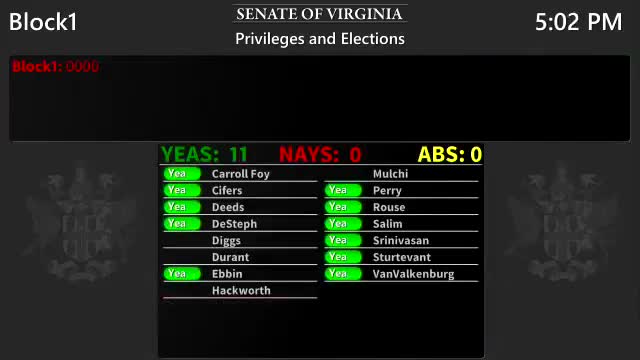
A motion to report the bill was made and seconded; the committee opened a roll call. The clerk announced a tally of “ayes 4, noes 8,” and the chairman stated that the bill failed to report out of the committee. No individual roll-call votes by name were given in the hearing transcript.
The contested matters at the hearing therefore were twofold: (1) whether the committee could proceed in the absence of the joint subcommittee described in Virginia Code §2.2-107, and (2) substantive objections from some senators to several nominees’ fitness to serve on the boards of George Mason University, the Virginia Military Institute and the University of Virginia. The committee’s failure to report SJR 6001 leaves the slate without committee approval pending further action by the General Assembly or additional procedural steps.
The committee record shows SJR 6001 was the agenda item under consideration on May 30, 2025; the hearing transcript does not record follow-up assignments or a directive to convene the joint subcommittee.