Get Full Government Meeting Transcripts, Videos, & Alerts Forever!
Get email alerts on the Budget topic
No spam. Unsubscribe anytime.
Wake County adopts FY26 budget after hours of debate; 6–1 vote approves $2.17 billion plan with small tax increase
Summary
The Wake County Board of Commissioners adopted the county FY26 budget and related ordinances Tuesday after a 6————to———1 roll-call vote on an amended package that raises the county————property tax rate slightly, increases funding for Wake County Public Schools and delays a new $1 million housing land-acquisition contribution and 12 EMS hires.
The Wake County Board of Commissioners adopted the county————y2026 operating and capital ordinances Tuesday after a lengthy public meeting and commissioner debate, approving the amended budget package by a 6————to———1 roll-call vote.
The board voted to adopt the manager————recommended budget with adjustments that increase the county—————school operating appropriation and raise the county property tax rate slightly to cover that change. Commissioner Adamson moved the amendment that the board approved, which reduced a new housing capital acquisition set-aside by $1,000,000, delayed 12 EMS frontline hires (approximately $780,000), increased Wake County Public School System operating support by $5,300,000 (to $742,907,316), and raised the overall FY26 property tax rate from the manager————suggested 51.6————cent to 51.71————cent per $100 of assessed value. "I move that the Board of Commissioners adopts the FY 26 General Fund operating budget, except for appropriations for Wake County Smart Start," Adamson said in making the motion.
Nut graf: The vote settles months of budget work and public comment. Commissioners and speakers framed the debate around competing priorities————school operating needs, affordable-housing investments and emergency medical services staffing————and whether local taxpayers should shoulder gaps left by the state and federal governments.
What the package includes - Total recommended FY26 budget (manager): $2,165,555,000, as presented by Budget Management Director Michelle Venditto. The adopted general fund budget after the amendment was described in the motion as $2,168,946,000. - Property tax rate: manager recommendation 51.6————cent per $100 (split 36.6————cent operating, 15————cent for long-term debt/capital). Amended rate: 51.71————cent. - Wake County Public Schools operating increase in the motion: +$5,300,000, bringing the county operating appropriation to $742,907,316 annually, as stated during the motion. - Housing: reduction of $1,000,000 to the manager————suggested transfer to a housing capital acquisition fund (the motion described this as a delay of an additional contribution to a new program; the county retains existing housing CIP funds). - EMS: delay/hold on 12 frontline positions in the EMS expansion ($780,000) that staff said could be deferred within year-one hiring and training constraints.
Debate highlights Commissioner Thomas opposed the amendment and framed the vote as an unacceptable trade-off. "You can't set yourself on fire to keep others warm," Thomas said, arguing the change would weaken housing and emergency response capacity to fill a school funding gap.
Commissioner Waters, who supported the amendment, described her decision as grounded in lived experience and a priority to protect students, saying local investment in education is "a statement of our values." Commissioner Stallings also supported the amendment and emphasized the board's long-standing collaboration with the school system and the statutory funding gap left by the North Carolina General Assembly.
Vice Chair Miao, Chair Susan P. Evans and Commissioner Jackson also voted in favor; Commissioner Thomas voted no. Clerk-recorded roll call recorded the final tally as 6————yes, 1 no; the clerk read each member's vote aloud.
Process and next steps The motion adopted the county————s operating and capital ordinances, personnel authorization and associated special revenue project ordinances. Commissioners said revenues and spending will be monitored during the year, and members who supported the amendment said they would seek to restore the delayed housing and EMS items if additional revenue becomes available.
Separate Smart Start vote and recusal Earlier in the meeting Commissioner Jackson disclosed a potential conflict of interest related to Wake County Smart Start and asked to be recused from voting on that item. The board approved a motion to recuse Jackson from the Smart Start funding vote. After the main budget ordinances passed, the board separately voted to appropriate the recommended funds for Wake County Smart Start operations as captured in the manager————recommended budget; that motion carried on a voice vote after a motion by Commissioner Adamson and a second by Commissioner Waters.
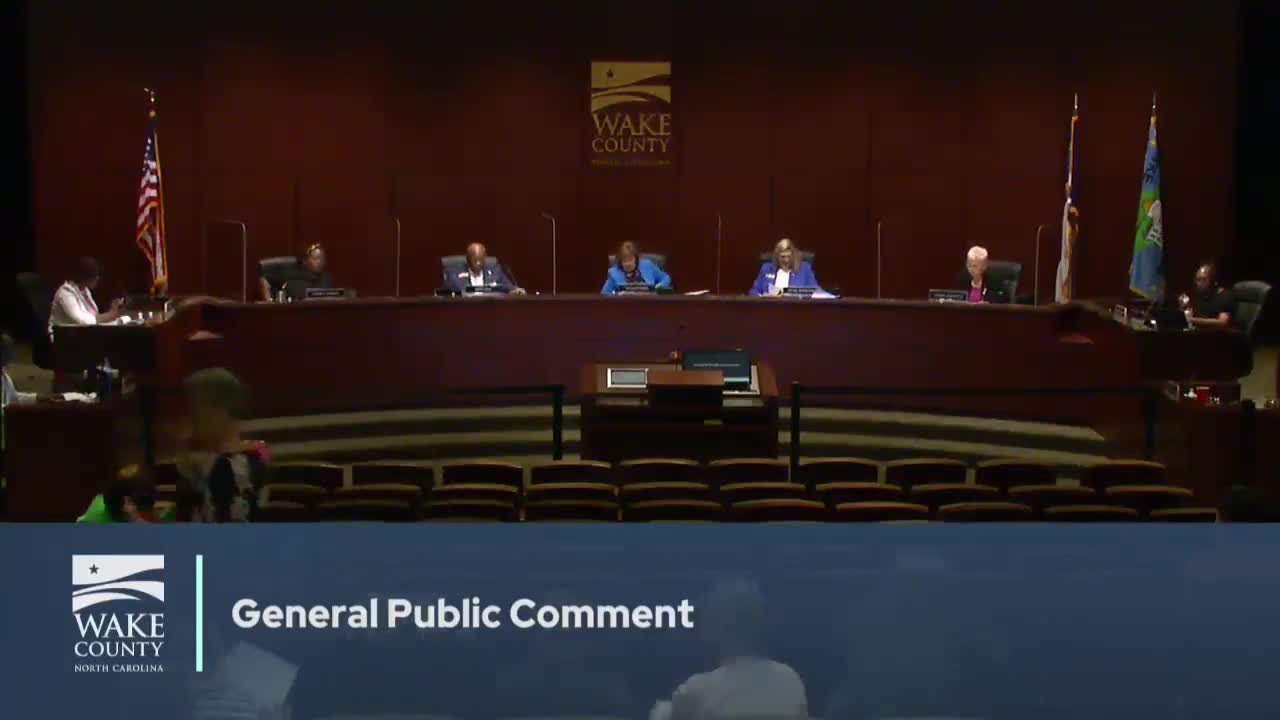
Public comment and context Public speakers during the general comment period urged the board to preserve affordable housing programs and to avoid property-tax increases. Representatives of housing-advocacy groups including 1 Wake asked the board to retain the Homeowner Care Fund and other affordability investments. Commissioners and staff repeatedly said the county is absorbing state and federal shortfalls, and that state and federal policy changes (discussed separately in the meeting) could shift costs to counties.
What the vote means: officials' framing Supporters framed the amendment as a careful compromise to respond to urgent school needs while delaying a new housing land-acquisition tranche and some hires into later fiscal years. Opponents said the pattern of using local dollars to cover recurring school operating gaps is unsustainable and risks erosion of core county services.
The board approved the bundle of FY26 ordinances 6————to 1; the separate Smart Start appropriation subsequently passed by voice vote after a previously approved recusal.
Ending: The budget ordinance adopted Tuesday sets Wake County————spending and priorities for FY26 subject to routine monitoring; commissioners said they will revisit the delayed housing and EMS items if revenue improves and continue to press state and federal officials about funding responsibilities.