Get Full Government Meeting Transcripts, Videos, & Alerts Forever!
Get email alerts on the Fire Funding topic
No spam. Unsubscribe anytime.
Hernando County approves 5.75% annual increase to residential fire assessment for up to five years
Summary
After months of review and a public hearing, the Hernando County Commission voted 3-2 to adopt a phased increase to the county's residential fire assessment (MSBU) capped at 5.75% per year for up to five years to fund personnel, equipment and planned station upgrades.
The Hernando County Board of County Commissioners voted 3-2 on June 10 to adopt a plan to increase the county's residential fire assessment by up to 5.75% per year for up to five years, a measure county leaders say is intended to fund staffing, equipment and future fire station needs.
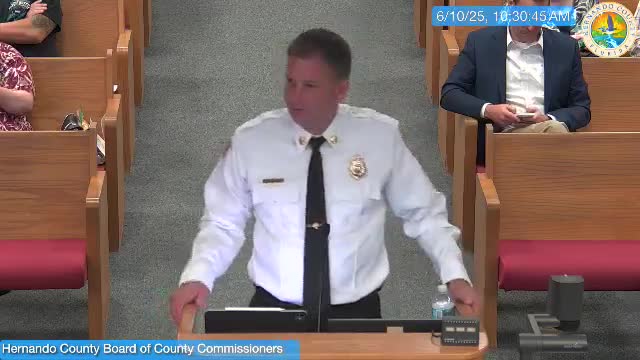
The vote follows a months-long review, a consultant's funding study, and a public hearing that drew more than a dozen speakers, including the county's fire chief and union leaders. Fire Chief Paul Hassemeyer told the commission the increase would help fund planned station staffing, equipment, and a multi-year program to bring service capacity in line with recent population growth.
Commissioners and staff said the adopted limit is intended to balance public-safety needs against taxpayer concerns. Chief Hassemeyer and county budget staff presented a range of options at the hearing: the consultant's initial models included double-digit increases, but staff and the chief narrowed the recommendation to lower annual increases after further review. The board-approved maximum of 5.75% was presented as the level needed to maintain the department's projected service plan, including phased staffing for future stations while keeping general fund impacts manageable.
Why it matters: Hernando County's fire and emergency medical services are funded in part by a dedicated assessment on properties to pay for emergency service capacity that scales with local development. Commissioners said the increases respond to sustained call-volume growth, rising personnel and benefits costs, and the expense of apparatus and facilities. Public commenters both supported better-funded fire services and pressed the board to limit tax and fee growth.
Details and debate: Chief Hassemeyer described the department's capital and staffing plan, including two future stations, and said the county's current staffing and apparatus were strained by population growth. He and staff explained that some costs, such as new apparatus and construction, require multi-year planning; other costs, like negotiated salary increases, are locked in by collective bargaining and drive near-term budget pressure.
Commissioner discussion focused on the trade-offs between raising the assessment and using other revenue sources, and on whether reserve balances and new-development revenue should be tapped before raising household fees. Several commissioners urged caution and proposed lower increases; others said the county had to address public-safety gaps now to avoid larger costs later. A proposal to cap increases at 3% was moved earlier in the hearing but not adopted.
Public hearing: County staff mailed notifications to property owners before the hearing; commissioners and the fire chief noted that residents had limited public response to the mailers this year compared with prior rounds, but the public hearing drew numerous in-person speakers. Representatives of the county firefighter local said a modest phased increase would help maintain response times and support firefighter health and safety programs. Residents voiced both support for funding safety and strong opposition to fee increases.
Outcome and next steps: The board adopted the assessment increase program on a 3-2 vote. The resolution sets the advertised maximum rate path and requires the county to return to the board each year as part of the budget process before raising the actual assessment for the next fiscal year. County staff said they will finalize the resolution language, publish the updated assessment schedule, and continue yearly budget reviews before implementation of each year's increase.
The administration said that if economic conditions or growth rates change, the board retains authority to set a lower increase at subsequent budget hearings. Chief Hassemeyer and budget staff said they will return with further budget details and monitoring reports during the fiscal-year budget cycle.