Get Full Government Meeting Transcripts, Videos, & Alerts Forever!
Get email alerts on the Parkland Dedication topic
No spam. Unsubscribe anytime.
Dallas staff recommend simplified parkland-dedication rules, lower fees for many multifamily projects
Summary
Dallas Park and Recreation presented a proposed development-code amendment on June 2 to implement recent state law changes limiting how the five largest Texas cities may require parkland dedication from developers.
Dallas Park and Recreation presented a proposed development-code amendment on June 2 to implement recent state law changes limiting how the five largest Texas cities may require parkland dedication from developers.
The department recommended simplifying the ordinance, reducing seven geographic “nexus” zones to five, setting per-unit fees tied to a percentage of median family income (a 2%/1% methodology staff described during the briefing), and removing unused credit mechanisms from the current code. Staff said they would rarely require land dedications because the law limits dedication to no more than 10% of a developable site and requires the city to pay fair market value for any portion acquired.
Why it matters: The change will alter when and how the city collects parkland dedications and fees from multifamily and hotel-motel developments — uses the state law governs — and could affect how quickly the city can accumulate funds to buy new parkland in areas with the greatest need.
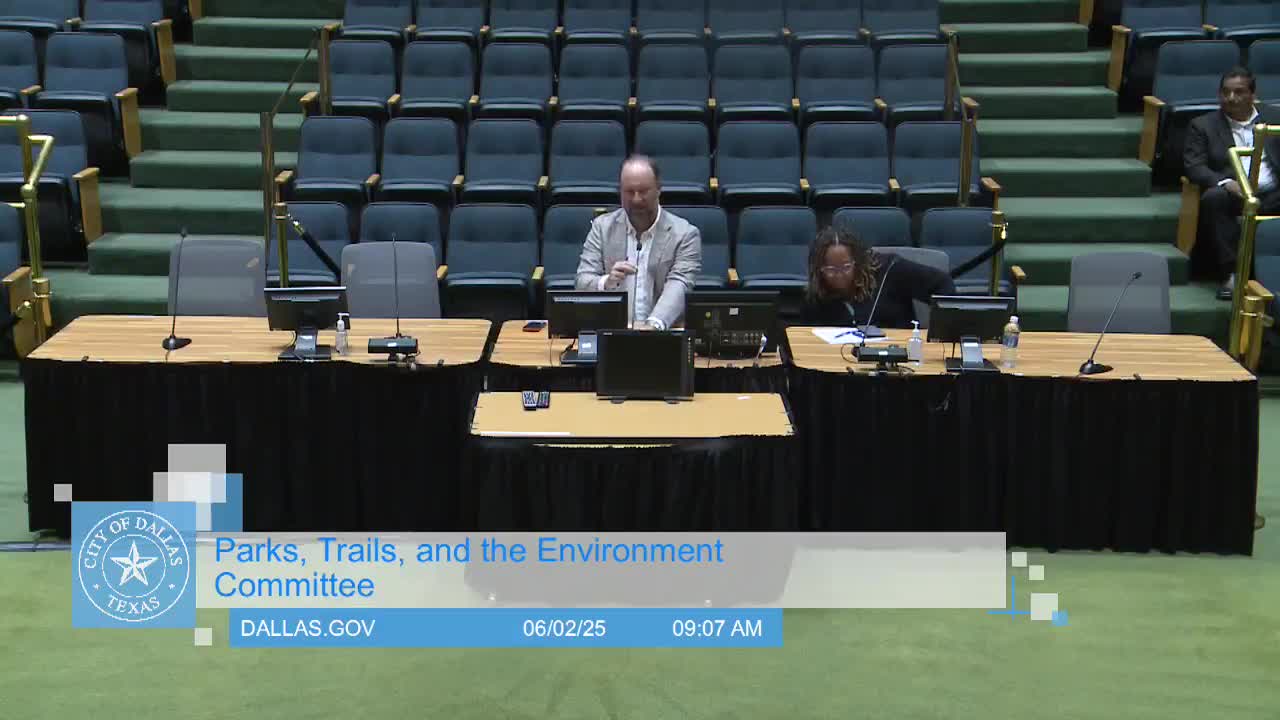
Ryan O’Connor, identified in the meeting as representing Dallas Park and Recreation, told the committee the proposal responds to a bill affecting the five largest Texas cities and is intended to simplify a complex existing ordinance that began in 2019. "Our original ordinance was somewhat complicated…there were all sorts of credit mechanisms, and it could be a little confusing," O’Connor said. He described staff’s preferred fee approach as a “2% for single-family / 2% for two-bed-plus multifamily / 1% for one-bed multifamily / 1% for hotel-motel” methodology based on median family income, which staff said they calculated using a five-year-average figure for Dallas ($65,400 in staff materials).
Key recommendations and constraints - Change nexus zones from seven to five (the CBD remains its own zone) so fee receipts can accumulate faster across larger geographic areas. - Use the percentage-of-median-income method contained in state law (staff presented a 2%/1% split by unit type); staff’s recommended dollar amounts were higher than the Plan Commission’s recommendation, which cut staff-recommended fees roughly in half. - Eliminate seldom-used credit mechanisms from the existing ordinance. - Continue to exclude affordable housing units from the fee/dedication requirement using the ordinance’s existing definition tied to the city’s "reserved dwelling unit" definition in Chapter 51A. - If the city requires land dedication, the law caps it at 10% of the developable site and requires payment of fair market value; fees and dedications must generally be satisfied before certificate of occupancy, shifting the timing later in the development process compared with the current model tied to building permits.
Plan Commission changes and likely impacts O’Connor said the Plan Commission (CPC) made two notable amendments in February: a 50% fee credit for developers who provide a trailhead tied to a project, and an across-the-board reduction of staff-recommended fees by 50%. Staff warned that lower fees and fewer nexus zones could slow accumulation of fee revenue and make it harder to buy property in a timely way; developers can request refunds if fees sit unused for 10 years. O’Connor said the city may need to consider alternative funding sources — for example, future bond programs — to support acquisitions.
Process and authority questions Committee members pressed where responsibility would lie for deciding when to require a land acquisition on a development site. O’Connor said the director of parks would make that determination and that state law requires a written process so developers can request a determination at the front end of the process. Several council members urged more transparent, objective criteria or a mutual decision-making process between the director and the developer to avoid surprises later in permitting.
Procedural concerns raised by committee members included why fee calculations reached the Plan Commission (a land-use body) rather than being handled solely by budget or legislative bodies. Daniel Moore of the City Attorney’s Office confirmed the historical practice has been for CPC to opine on zoning provisions; he said fees in Chapter 51A have typically been handled separately, and council members requested future fee changes avoid asking CPC to evaluate broader budgetary impacts.
Legislative context and timing Staff said council consideration could occur as soon as later this month, subject to additional direction. Committee members flagged parallel activity at the state legislature: Jake Anderson of the Office of Government Affairs said he believed a separate measure (identified in the briefing as House Bill 2974) was in conference committee and could affect how the city finances certain projects; staff committed to follow up with clarification.
What was not decided The committee did not take a final vote. Members asked for follow-up written memos on (a) which affordable-housing tools and definitions would exempt projects from the requirement, and (b) data on whether parkland dedication fees have driven development to suburban jurisdictions. Several council members said they supported staff’s goal of simplifying the ordinance but asked staff to return with clearer language on the decision-making process for site acquisitions and additional fiscal analysis.
Next steps and staff requests O’Connor and department staff said they would continue stakeholder conversations with developers, CPC and council, provide additional written information on affordable-housing exemptions and funding impacts, and return with refined ordinance language and timing. Committee members signaled differing preferences on fee levels: some favored staff’s higher recommended figures for certain unit types while others supported CPC’s lower fees to avoid potential impacts on housing production.
Ending: The committee concluded the briefing with direction for staff to refine the ordinance language, produce follow-up memos requested by council members, and return with a timeline for council consideration.