Get Full Government Meeting Transcripts, Videos, & Alerts Forever!
Get email alerts on the Charter Schools topic
No spam. Unsubscribe anytime.
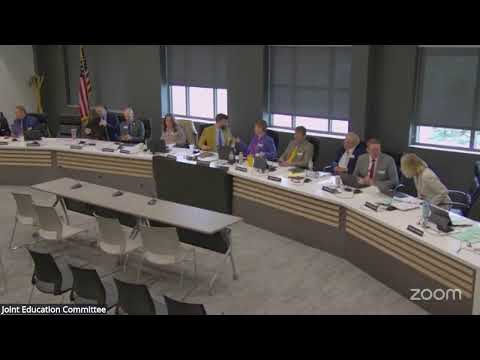
Committee hears overview of charter law and funding; districts raise ADM and funding‑flow concerns
Summary
Legislative staff and the state charter authorizing board briefed the Joint Education Committee on charter statutes, funding entitlements and application processes; district leaders flagged how state‑authorized charter ADM can create budget cliffs for resident districts.
The Joint Education Committee received a high‑level review of Wyoming’s charter school statutes, funding entitlements and authorizing practices, and heard district testimony about how charter enrollment growth can affect resident districts’ average daily membership (ADM) funding.
Tanya Heitrick of the Legislative Service Office told the committee the statutes governing charter schools include Wyoming Statutes 21‑3‑301 through 21‑3‑314 and that charter schools are public schools operating either under local district authorization or the Wyoming Charter School Authorizing Board (WCSAB). Heitrick noted the authorizing board was created in 2023 and that recent legislative changes removed prior caps on the number of state‑authorized charter approvals.
Matt Wilmarth, senior school finance analyst with LSO, reviewed how the education resource block grant model funds schools and explained that charter schools will be entitled to 100% of both school‑level and a pro‑rata share of central‑office resources beginning in the next school year; LSO provided an estimated proxy that totaled roughly $17.7 million in school‑level state funding for current charter schools and about $1.4 million in proportional central‑office funding, for an approximate $19.1 million entitlement if the change were applied to the reviewed year.
Why it matters: several committee members and district witnesses described a practical problem when a state‑authorized charter operating within a district’s boundaries grows while the resident district’s enrollment declines. Platte County School District No. 1 Superintendent John Weigel and Prairie View Community School CEO Christian Winger told the committee that aggregated ADM can make a shrinking district appear stable and expose the district to a sudden funding drop when charter counts change.
Weigel described a “financial cliff” the district faces in preliminary budgeting, saying the combined accounting made the district appear to be growing when its non‑charter enrollment is falling, and estimated the gap at about $360,000 for the next fiscal year. Winger and other charter leaders asked the committee to consider statutory fixes so state‑authorized charters are treated consistently with the legislative intent that created an independent authorizing pathway.
The committee also heard from WCSAB staff: John Waller, executive director, described the board’s work to develop an accountability framework, standardized evaluation tools and regular oversight practices. The authorizing board has approved three state‑authorized charter schools and one additional applicant planning to open in fall 2026, and it assessed a half‑percent administrative fee to state‑authorized charters for the current year, LSO reported.
Committee discussion covered several oversight and operational items: - Application timing and review workload: WCSAB and LSO noted the current application packet and review timelines were drafted for district‑authorized charters and that review of state applications — including community hearings and capacity interviews — is resource‑intensive. WCSAB recommended the department be allowed rulemaking flexibility to set application windows without statutory timeline constraints. - Financial oversight and start‑up funding: Waller and department staff suggested stronger fiscal review tools and resources for first‑year operating needs because charter schools often begin operation with limited reserves and may rely on lease or modular costs. LSO reported the Legislature appropriated about $1.9 million for charter school lease reimbursement in the 2024 session and $4.2 million for the current biennium in lease funding. - Entitlement and fund flow: LSO and WDE staff explained that current statutes cause student counts for state‑authorized charters to be included in the resident district ADM; the Department said its statutory interpretation requires that counting and that a statutory clarification would be required to change the flow.
Representative Kelly and Senator Scott expressed concern about preserving quality while scaling authorizing capacity if the state approves more charter schools. WCSAB said it is preparing to “scale up” processes but emphasized a focus on quality over speed.
Public testimony from Platte County and Prairie View highlighted the practical impact of the present flow of funds through districts and asked the committee to consider statutory or administrative remedies so ADM and budgeting reflect the separate legal status of state‑authorized charters.
Ending: The committee did not take formal action on charter law or funding during the session excerpted. LSO, WDE and the WCSAB indicated willingness to work with the committee to produce statutory options on funding flow, application timelines and oversight resources for future consideration.
Direct quotes in this article are taken from committee testimony and the public record in the meeting transcript.