Get Full Government Meeting Transcripts, Videos, & Alerts Forever!
Get email alerts on the K 3 Literacy topic
No spam. Unsubscribe anytime.
Wyoming committee reviews K–3 literacy law and finds gaps in implementation and monitoring
Summary
Legislative staff and the Wyoming Department of Education reviewed the statute requiring K–3 screening, individualized reading plans and professional development; lawmakers and parents urged stronger enforcement, training for educators and better use of allocated funds.
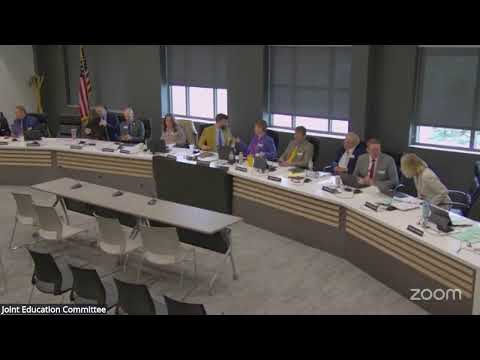
The Joint Education Committee reviewed Wyoming's K–3 literacy law, hearing a statutory overview from Legislative Service Office staff and implementation updates from the Wyoming Department of Education on screening, individualized reading plans and professional development for kindergarten through third grade.
Tanya Heitrick, operations administrator with the Legislative Service Office, said the memo in committee materials “is intended to provide a summary of the statute that governs this program,” and noted the statute currently requires districts to implement a multi‑tiered, evidence‑based reading assessment and intervention program for all students in K–3. Heitrick said the statute, cited in the session materials as Wyoming Statute 21‑3‑401, has been amended multiple times since its 2001 enactment.
The committee heard that districts must screen students three times a year with a tool approved by the state superintendent and must develop an individualized reading plan for students who do not demonstrate grade‑level competency; an individualized education program under federal IDEA can satisfy that requirement. The statute includes an 85% proficiency goal measured by the statewide summative English language arts assessment; Senator Scott told the committee, “The 85% basically came out of thin air,” saying the number originated in early bill drafting after consulting one district's estimate of students able to learn to read.
Why it matters: committee members and public witnesses said the law's requirements have not translated into consistent practice statewide. Department of Education officials told the committee they collect district reports through a WDE 6‑26 K–3 literacy plan and data collection and that rules (Chapter 56) to implement the 2022 statutory adjustments are in place. But lawmakers and several parents said reporting has not been matched with sustained monitoring or capacity to provide corrective support.
Department of Education chief academic officer Shelley Hamill said the agency required districts to submit professional development plans aligned with rule criteria and that districts filed approved plans by summer 2023. She described a stakeholder process that produced criteria to identify approved screeners, minimum professional‑development requirements for educators K–3 and criteria for appropriate PD materials; the agency received 64 applications and selected approximately 19 committee participants to draft the rules.
Committee members pressed the agency about follow‑up and enforcement. Representative Kelly asked who verifies district reports and whether districts simply file plans without implementation; Hamill replied that at present the department does not have dedicated, ongoing staff or funding for a statewide literacy monitoring team since federal COVID funding that supported such a team has ended. She said the department provided free professional development funded by ESSER during the initial three‑year cycle, but those resources may not persist without new funding.
Parents and specialists told the committee school compliance gaps are causing long‑term harm. Megan Hesser, a Laramie County parent and later identified in testimony as a tutor, described her son's multi‑year struggle with reading and said teachers lacked training to read and act on screener data: she told the committee the teacher did not know how to respond when “the dot turns red” on a progress‑monitoring chart. In separate testimony, Shandel Pine identified herself as a parent who lost her son and said failures of identification and intervention were a factor in his death; she urged lawmakers to treat literacy as a right, not a privilege.
Dyslexia specialists emphasized training for educators. Carrie Roden, who described herself as a dyslexia specialist and former classroom teacher, said research‑aligned structured literacy programs work and called for expanded training pathways and on‑the‑job micro‑credentials so teachers and special‑education staff can deliver evidence‑based instruction without returning to a four‑year degree program.
Specific implementation points discussed in committee: - The statute and rules require screening three times a year with state‑approved screeners; the WDE said six screeners are currently approved and additional tools were reviewed but did not meet the committee's criteria. - Since school year 2022–23 districts and all K–3 reading instructors must complete PD in literacy instruction; the WDE collects those PD plans through the 6‑26 data collection, which reopens June 2 and closes June 27 for 2024–25 reporting. - The Legislature appropriated $300,000 for district professional development tied to the program; LSO staff said districts were required to expend the amount the education resource block grant model already allocated for PD before accessing the supplemental $300,000, and LSO reported those supplemental funds were not expended and have reverted.
What lawmakers flagged as problems: committee members and public witnesses identified four recurring gaps — uneven teacher preparation on science‑of‑reading practices, weak use of diagnostic follow‑up after screeners flag students, lack of sustained department capacity to monitor implementation, and insufficient attention to administrator training so principals can select appropriate PD.
Next steps: Senator Scott and other legislators asked whether the committee could draft bills to strengthen enforcement and create pathways for teacher micro‑credentials; the committee indicated time would be set during subsequent meetings to propose bill drafts. Department staff and LSO pledged to work with the committee to provide data and statutory options.
Ending: The committee did not take formal votes on statutory changes during the session excerpted; members asked staff to assemble options for possible bill drafts and to provide updated WDE 6‑26 data after the collection closes in late June.
Quotes used in this article are drawn verbatim from committee testimony and public comment recorded in the meeting transcript.