Get Full Government Meeting Transcripts, Videos, & Alerts Forever!
Get email alerts on the Municipal Finance topic
No spam. Unsubscribe anytime.
Chino Hills projects $2.2 million general-fund shortfall, council weighs sales-tax option
Summary
City staff presented a preliminary fiscal 2025–26 budget showing a $2.2 million general-fund gap, robust reserves that will fall under current trends and discussion of a possible voter-approved 1% sales-tax measure to plug structural revenue shortfalls.
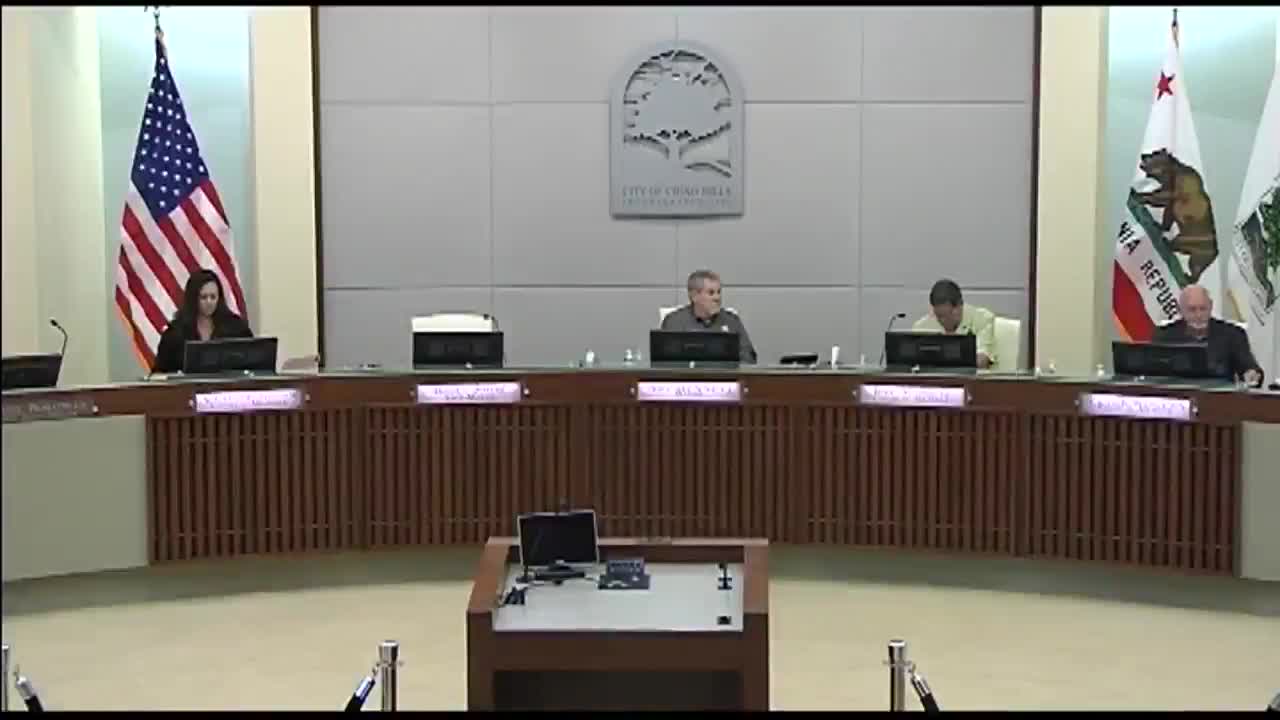
Chino Hills City Manager Ben Montgomery told the City Council at a May 27 budget workshop that the city is proposing a fiscal year 2025–26 budget that spends about $2.2 million more in the general fund than it expects to receive in revenue.
Montgomery said the proposed all-funds budget totals about $148 million in revenues and roughly $150 million in expenditures. The city projects a general-fund revenue of $56.4 million against proposed general-fund expenditures of $58.6 million, leaving a gap Montgomery described as “a planned draw on reserves.” He said unrestricted reserves would remain sizable — roughly $34.9 million — but would decline over a five-year projection if current revenue and spending patterns continue.
The council and staff emphasized that property tax and sales tax are the city’s two largest general-fund revenue sources and that both are effectively constrained. Finance staff warned sales-tax receipts are projected to fall about 2 percent next year and noted the city receives roughly 4 cents of every property-tax dollar collected in the county and about 13 cents of each sales-tax dollar collected by the state. Krista (Finance Director) and consultant HDL briefed the council on revenue drivers and the limits of local control.
Why it matters: Council members framed the budget as a structural issue — rising operating and contract costs, multi-year contract escalators, aging infrastructure and higher energy costs have outpaced modest revenue growth. Staff said the city can cover the shortfall this year from reserves but that continuing to do so will reduce the city’s financial cushion over time and could force program cuts or new revenue measures.
Council members focused discussion on options to increase revenue. The most-discussed option was a voter-approved local sales-tax measure (an additional 1 percentage point), which staff estimated could raise roughly $10 million to $12 million a year for the city once fully realized. Councilmembers noted nearby cities adopted similar measures, and staff said local control of a sales-tax increment would let Chino Hills set spending priorities. Several council members said they expect to pursue public outreach and education before advancing any ballot measure.
Other revenue issues and limits: Montgomery and other staff detailed federal and state uncertainties that have already trimmed expected funding. Staff said several federal earmarks — including $2 million for electric resiliency, $2 million for recycled-water support and $1.8 million for fire-risk reduction — were delayed by the federal budget process and did not flow to the city as expected. On the state side, staff noted the governor’s May revision showing a large state shortfall and warned some grant programs such as the Community Development Block Grant (CDBG) are uncertain.
Expenditure drivers and reserves: Staff called attention to rising personnel costs, multi-year contract escalators, deferred maintenance on parks and facilities and higher energy and water costs. The finance presentation showed total reserves (restricted plus unrestricted) at about $46.9 million, equal to roughly 81 percent of operating expenditures; the unrestricted portion was about $34.9 million (about 60 percent of operating expenditures). Staff modeled that without revenue increases or further cuts the combined reserve balance could decline markedly over five years.
Landscape and lighting subsidy, community services fund consolidation: Staff highlighted two recurring budget pressures. First, the city is subsidizing the landscape and lighting (L&L) district by about $3.8 million because assessments have not been raised since the early 1990s and roughly half the city’s parcels participate in the district. Second, staff has proposed consolidating the separate Community Services Fund into the general fund for administrative clarity; that accounting change reduces the appearance of community-services spending in year-over-year comparisons but does not reduce the actual level of investment in parks, events and recreation services.
Capital projects and staffing: Public Works Director Daniel Bobadilla summarized the capital-improvement program (CIP), including carryover projects and $12.2 million in proposed new CIP requests for parks, streets and water/recycled-water infrastructure. Finance staff noted the all-funds budget includes a $12.3 million CIP program and the water utility represents the largest share of CIP funding. Citywide authorized full-time positions are proposed at 156, a net increase of two positions, plus several reclassifications and two new positions in the public-works water division.
Next steps: Staff said the council will revisit and (if ready) adopt the budget at an upcoming council meeting. Montgomery and councilmembers said staff will continue public outreach, update five-year projections quarterly and bring back specific options — including analysis and outreach plans for a potential sales-tax ballot measure — for council consideration.
Ending: The council did not adopt the budget at the workshop; staff will bring a proposed budget for formal action at a future council meeting after additional review and outreach.