
H+H leaders tell City Council House-passed Medicaid changes could cost 'hundreds of millions' and force service cuts
Get AI-powered insights, summaries, and transcripts
Subscribe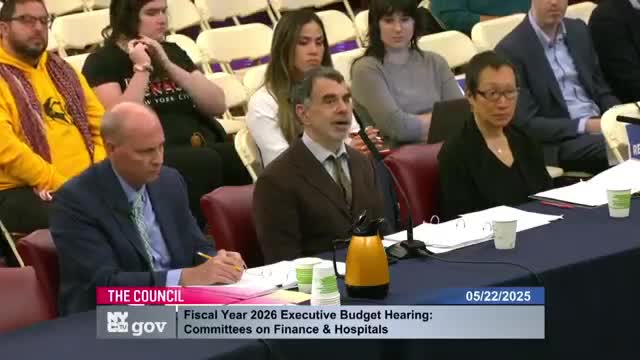
Summary
New York City Health + Hospitals (H+H) told the Council finance and hospitals committees that a House-passed bill could remove hundreds of millions in federal Medicaid funding, threatening services and prompting contingency planning that would likely prioritize emergency and primary care.
New York City Health and Hospitals President and CEO Dr. Mitchell Katz told the City Council's Committee on Finance and the Committee on Hospitals on May 1, 2025, that a bill passed by the U.S. House of Representatives could cut “hundreds of millions of dollars” from Medicaid funding to the system and would force H+H to constrain services if the cuts hold.
Katz framed the testimony as a warning. He said the executive financial plan for fiscal 2026 is based on current federal funding levels, and that sudden reductions — including provisions discussed in the House bill such as work requirements, shortened enrollment periods and cuts to the federal share of Medicaid — would reduce revenue that H+H depends on. “Overall, that bill could result in hundreds of millions of dollars,” Katz said. He later added an illustrative range, noting staff-level estimates in the hundreds of millions: “300, 4 hundred, 5 hundred million dollars.”
The warning matters because the city subsidy for H+H is relatively small compared with the system's total operating budget. H+H's proposed FY 2026 city subsidy in the executive plan is $1.7 billion, roughly 1.5% of the city's total budget, and most H+H revenues come from state and federal sources and patient-care reimbursements. Katz told council members H+H closed FY 2025 with $598 million in cash on hand (about 20 days), but said the system could not run the same array of services if it lost “hundreds of millions” of federal dollars.
Council members pushed for clarity on contingency plans and timing. Committee members emphasized the need for modeling of exact dollar impacts and asked whether the city or the Office of Management and Budget had asked H+H to prepare detailed plans; H+H said advocacy had been the first response and that precise contingency planning requires a clear number and an understanding of how much the state will absorb versus push down to providers. John Uhlberg, H+H chief financial officer, described a one-time $614.3 million cash accounting adjustment in the executive plan that is intended as a bridge depending on the timing of state-directed payment approvals, but he and Katz both said that accounting maneuvers would not cover ongoing loss of federal reimbursement.
Katz described the general approach H+H would take if the cuts materialize: prioritize life-and-limb emergency services and primary care where possible, and consider constraining specialty or nonessential services if necessary. He emphasized H+H's advocacy work with the city's delegation and the state and said the system would seek to limit administrative cuts that would hamper operation. “You'd have to look at all of the services we're providing and then figure out which are the ones that are more essential than others,” Katz said.
The council members present — including Council Member Justin Brannan, chair of the Committee on Finance, and Council Member Mercedes Narcisse, chair of the Committee on Hospitals — pressed for more granular contingency plans and closer coordination between H+H, the City and the state. Multiple members asked H+H to return with concrete scenarios for specific facilities and service lines once the state and federal impacts can be quantified.
For now, Katz and H+H staff said their primary response has been advocacy with the federal delegation and ongoing conversations with the city and state. They cautioned that without federal funds the system will face service constraints and possible reductions, and they asked the council to prepare for follow-up hearings or budget actions if the federal situation changes.
Katz: “There is no way that the system could be the same if we lose hundreds of millions of dollars,” and he said the system would “have to constrain services” if such cuts are enacted.
Ending: Council members said they will press H+H and the administration for scenario planning and for updates as legislative developments progress. H+H said it would continue advocacy and will return with more detailed fiscal impact numbers once the state and federal positions are clarified.