Get Full Government Meeting Transcripts, Videos, & Alerts Forever!
Get email alerts on the Medicaid Budget topic
No spam. Unsubscribe anytime.
Idaho Medicaid budget rises as committee considers $376 million forecast adjustment and $190 million hospital-assessment request
Summary
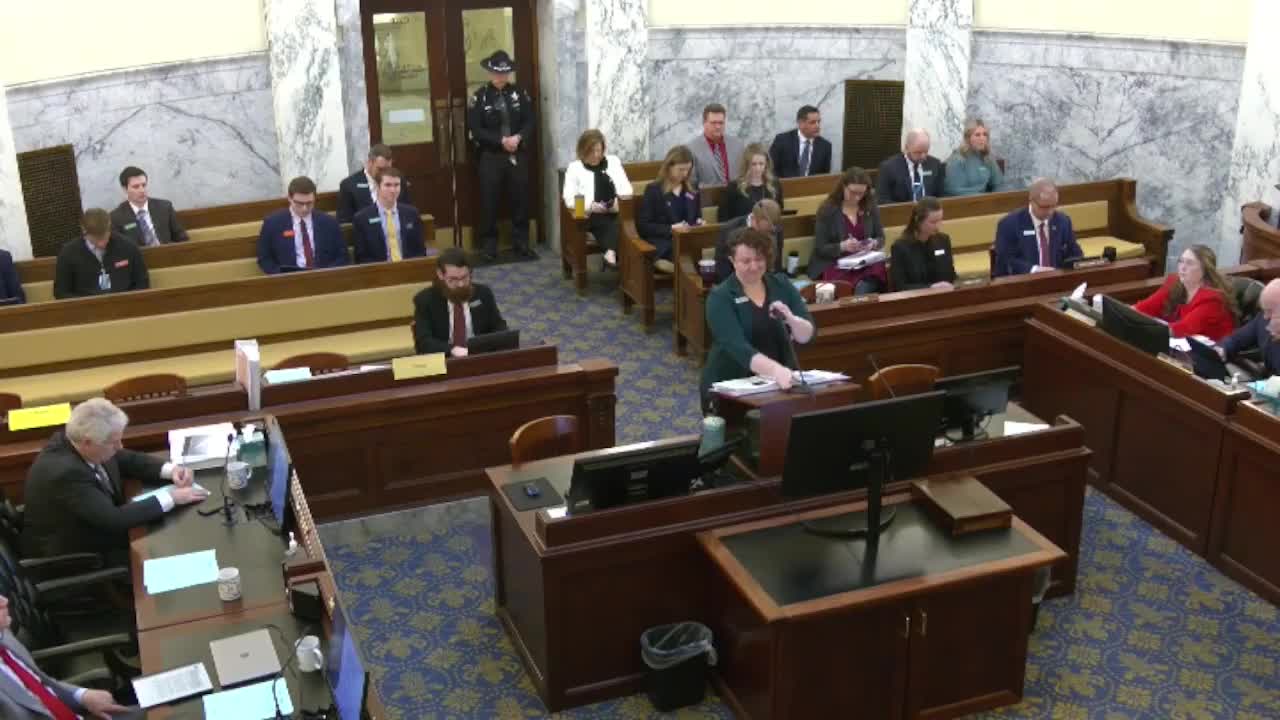
The Joint Finance-Appropriations Committee reviewed the Division of Medicaid’s budget on Feb. 26, hearing that state and federal factors have pushed Medicaid spending well above earlier forecasts and prompted multiple supplemental and ongoing requests.
The Joint Finance-Appropriations Committee reviewed the Division of Medicaid’s budget on Feb. 26, hearing that state and federal factors have pushed Medicaid spending well above earlier forecasts and prompted multiple supplemental and ongoing requests.
Alex Williamson, budget and policy analyst with Legislative Services, told the committee the division expended about $4.27 billion of the roughly $4.56 billion appropriated for fiscal 2024 and that a $367 million population-forecast adjustment is in the governor’s 2026 enhancement package. "These populations are assumed to be in average health with average levels of disease," Williamson said, explaining variation in per-enrollee costs across plan types.
Why it matters: Medicaid is an entitlement and the state has limited discretion over eligibility and required services. The committee heard multiple one-time and ongoing supplemental requests and enhancements intended to meet federal requirements and to reflect updated hospital assessment and utilization calculations.
Most significant requests and drivers - Hospital assessment supplemental and ongoing request: $190,000,000 (trustee/benefit payments); transcript breakout shows $77,000,000 from the dedicated hospital assessment fund and $113,000,000 from federal funds. The department said changes resulting from 2022’s Senate Bill 1350 altered methodology for upper payment limit (UPL) calculations and increased assessments hospitals must remit to access federal matching dollars. - Population forecast adjustment (ongoing enhancement): $367,000,000. Williamson said this number includes caseload growth, cost-based pricing, mandatory pricing (affecting FQHCs, rural and tribal clinics), Medicare rates for dual eligibles and utilization changes; part of the total reflects about a $45,000,000 shift from federal funds to the general fund tied to FMAP changes. - Capitation rate increase (one-time supplemental): about $108,800,000 federal funds (split across plans; Williamson gave a breakout: roughly $33,000,000 to expansion, $1,900,000 to coordinated, $14,800,000 to enhanced and $58,000,000 to the basic plan). - Managed information system (MMIS) procurement (year 3 of 5): state share ~$11,700,000 and federal share ~$105,000,000 (total reflected in the enhancement request for 2026). - External quality review (EQR) for managed care plans: the department requested roughly $1.3–1.35 million after two RFPs failed to attract vendors at historical rates, the analyst said. Committee members and department officials noted a typo in the budget book marking the EQR amount as one-time when it should be ongoing. - Actuarial services: an ongoing request of about $1,100,000 to expand contract hours for rate-setting and managed-care actuarial needs. - Transfer of extended employment services (EES) into Medicaid: a requested transfer of 3 FTP and about $3,500,000 (net zero to the department overall because it is offset in the DD division).
Federal match, expansion and forecasting Williamson and Director Alex Adams emphasized that some cost movement flows from federal factors. "The forecasts were based on what we call the Milliman Report," Williamson said, noting the original projection predated the COVID-19 pandemic and later provider rate changes. Adams described the program as a joint state–federal enterprise and said he submitted a maintenance-oriented budget: "I submitted as close to a maintenance budget as I could submit. I didn't ask for any policy adjustments. I didn't ask to expand any benefits. I didn't ask to adjust any provider rates."
Adams warned that changes in the federal medical assistance percentage (FMAP) and any future adjustments to the expansion match would materially shift state costs. He said a return to a traditional match (roughly 68% federal/32% state) from the current enhanced split would shift more than $200 million to the state if applied immediately.
Forecast volatility and supplementals Department and analyst testimony explained that Medicaid forecasting has inherent uncertainty. The department recommended publishing range-based forecasts (baseline/optimistic/pessimistic) and now issues a monthly Medicaid transparency report to give legislators earlier indications of variance. "There's one guarantee with the Medicaid budget: it's wrong," Adams told the committee, explaining that the agency may need supplementals if actual expenditures exceed the appropriation and that reversion or stabilization funds apply if the appropriations exceed expenditures.
Clarifying details and committee follow-up Committee members repeatedly asked for written follow-ups and additional detail, including: - A breakdown of postpartum coverage services and out-of-state service coverage (requested from Williamson and the department). - A clearer explanation of how the hospital-assessment monies are applied and whether statutory or policy changes could direct the funds differently (Williamson: policy changes would be required to repurpose assessment proceeds). - Documentation and the department's plan for publishing multi-scenario forecasts and monthly transparency updates.
The committee did not take a vote on any of the requests during this hearing. Department staff and legislative analysts said they would provide additional documentation and follow-up briefings.
Ending note: the department emphasized that many of the largest requests were tied to federal requirements or court settlements (for example, the KW litigation regarding DD services), not discretionary expansions. "These are needs not wishes and things, to follow, federal law," Director Adams said.