Get Full Government Meeting Transcripts, Videos, & Alerts Forever!
Get email alerts on the Planning Legislation topic
No spam. Unsubscribe anytime.
Planning staff reports ordinance changes for MUO district and updates on appeal for 1310 project
Summary
Planning Department legislative affairs staff summarized a proposed ordinance amending Mixed Use Office (MUO) district rules for health service uses and recapped a Board of Supervisors action on appeals for a maintenance facility project at 1310 (as reported).
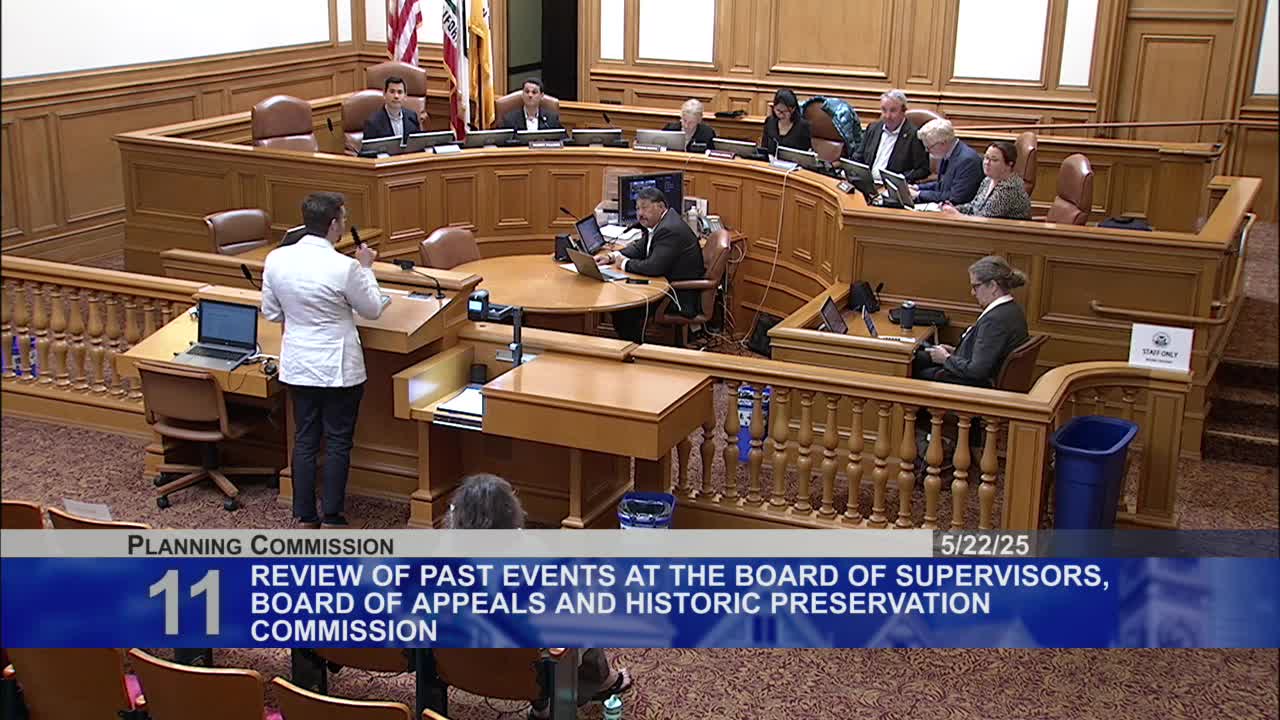
Aaron Star, manager of legislative affairs for the San Francisco Planning Department, briefed the commission on recent land-use developments including an ordinance under consideration by the Board of Supervisors to amend controls for health service uses in the Mixed Use Office (MUO) district.
Star said the proposed ordinance would eliminate retail use size limits and retail-ratio requirements for health services and reproductive health clinics within the MUO district, and that the commission previously recommended three modifications: add reproductive health clinics to the exemption, remove the retail-ratio requirement within the MUO, and limit exemptions to east of Seventh Street. The supervisor incorporated the reproductive-health-clinic recommendation and applied the retail-ratio removal east of Seventh Street; the ordinance was amended to eliminate use-size limits for health service and reproductive-health clinics within MUO east of Seventh. The land use committee continued the item to June 2 because supervisors considered the amendments substantive.
Star also reported on two appeals considered at the full Board of Supervisors for a project at 1310 (reported in the record as "1310 Hanipero Sarah Boulevard"), which sought to construct a maintenance facility on the grounds of the San Francisco Golf Course. Star summarized that the department found no legal basis to sustain the CEQA and conditional-use appeals, but that discussions between parties and Supervisor Melgar's office led to an applicant-appellant agreement with additional conditions (limits on construction activities, dust mitigation and an external alarm system). Because both appeals had been noticed, the board held a hearing and voted to amend the previous commission motion (denying conditional-use approval and adopting the negotiated additional requirements); the project as amended was approved by the board.
Star said the Planning Department previously continued the project multiple times for additional review; commissioners had visited the site and the department hosted meetings between the parties. He concluded his report by inviting questions from commissioners.