Get Full Government Meeting Transcripts, Videos, & Alerts Forever!
Get email alerts on the Airport Development topic
No spam. Unsubscribe anytime.
Planning commission opens public hearing on SFO draft environmental impact report amid air-quality and noise concerns
Summary
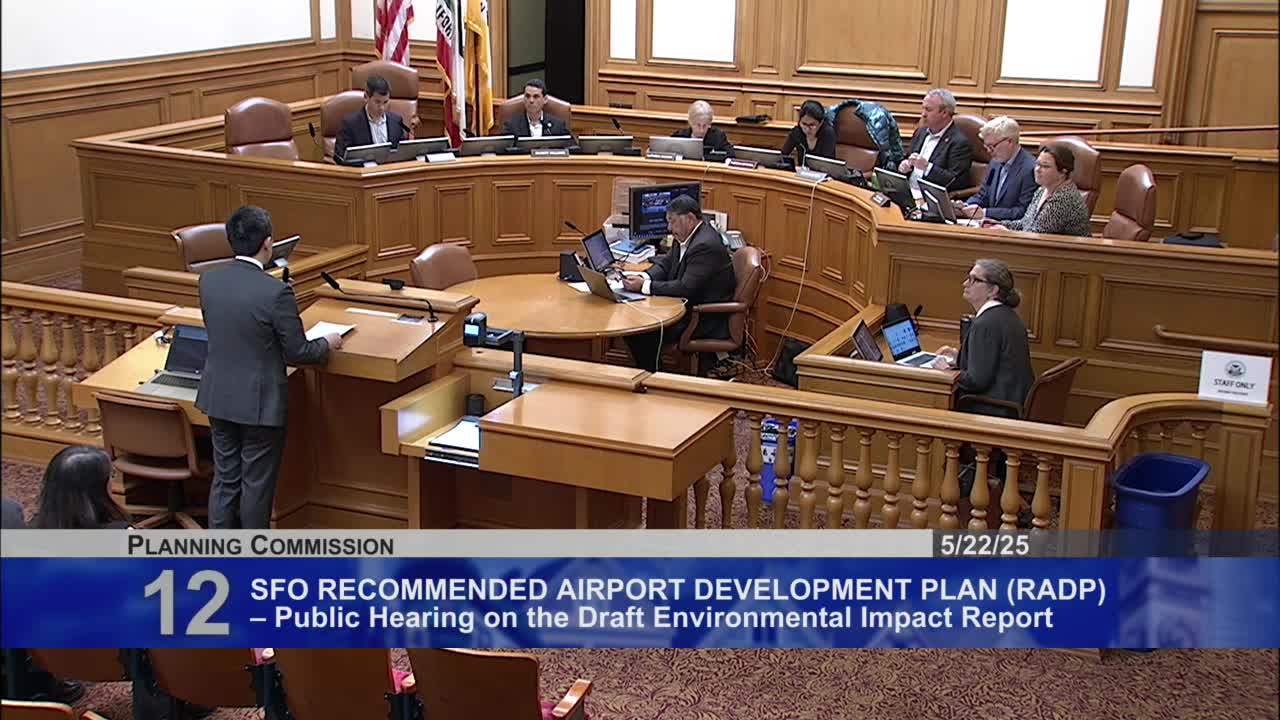
The San Francisco Planning Commission on May 22 opened a public hearing on the San Francisco International Airport's Recommended Airport Development Plan draft EIR, taking public comments on CEQA adequacy and outlining next steps for written submissions.
The San Francisco Planning Commission on May 22 opened a public hearing on the San Francisco International Airport's Recommended Airport Development Plan (RADP) draft environmental impact report (EIR), taking verbal comments and outlining next steps for written submissions.
Planning department environmental case coordinator Kei Zushi told the commission the draft EIR was published April 16 and the public review period runs through 5 p.m. June 2, 2025; written comments should be sent to Kei Zushi at 49 South Van Ness Avenue or cpc.sforadp@SFGOV.org. Zushi said the planning department expects to publish responses to comments in fall 2025 and then bring an EIR certification hearing "shortly after." The hearing was explicitly limited to CEQA adequacy, accuracy and completeness; staff said no certification action was requested at this meeting.
The airport's environmental affairs manager, Audrey Park, described the RADP as a long-range, land-side plan to accommodate future passenger demand without changing SFO's runway configuration or flight paths, which she said are under FAA authority. Park highlighted representative projects including a new Boarding Area H with passenger boarding bridges and a secure corridor to reduce reliance on remote hardstand gates; a replacement central hub to integrate multimodal ground transportation and public parking; and a potential aircraft maintenance hangar. Park noted RADP projects would be funded by airport revenues and said SFO paid about $56 million in annual service payments in fiscal year 2024.
Planning staff summarized the draft EIR's findings: with mitigation, certain impacts (cultural resources, tribal cultural resources, air quality, noise and vibration, biological resources) would be less than significant; however, the draft EIR identified some operational air-quality impacts as significant and unavoidable for the proposed project. Staff described three CEQA alternatives analyzed (no-project; reduced development; and Boarding Area H only) and said those alternatives reduce or eliminate the significant operational air-quality impacts with additional mitigation.
Members of the public raised concerns about the draft EIR's scope and methodology. Resident Liz Lopez said the project will "inevitably increase the amount of flight traffic, noise pollution, and chemical pollution" and asked the city and SFO to disclose the larger pipeline of projects that could induce passenger demand. An unnamed resident urged the commission to modernize the EIR methodology, saying it used "standards from the disco era" and arguing international airport metrics and modern big-data analysis should be incorporated. Leo Martin, president of the Mothers Fathers Committee, Bayview Hunters Point, said his neighborhood already suffers high rates of pollution and cancer and that the project's cumulative impacts would worsen health harms.
Commissioner Brown said she appreciated the draft EIR's acknowledgement of significant and unavoidable air-pollution impacts and looks forward to reviewing responses to comments. Commissioner Imperial asked about tribal and historical resources mitigation and requested the department use the most recent traffic, pedestrian and circulation data available rather than relying on older graphs.
Kei Zushi and Audrey Park reiterated that comments made at the hearing would be transcribed, responded to in writing in the response-to-comments document, and that staff are not responding to substantive comment content live during this hearing. The commission accepted public testimony and closed the hearing portion of the item to begin its review and comment phase.
Written comments must be received by 5 p.m. June 2, 2025. The planning department anticipates publishing responses to comments in fall 2025 and returning to the commission for EIR certification thereafter.