Get Full Government Meeting Transcripts, Videos, & Alerts Forever!
Get email alerts on the Budget Creeks topic
No spam. Unsubscribe anytime.
Creeks advisory committee recommends City of Santa Barbara adopt FY2026–27 creeks budget; supports raising reserve target to $4 million
Summary
The Creek Citizen Advisory Committee voted 4–0 to recommend the City Council approve the Creek Division’s proposed FY2026–27 budget, which staff say is consistent with Measure B spending guidelines. The budget reflects increased staffing costs, new street-sweeping program expenses, project maintenance needs and recommended reserve increases.
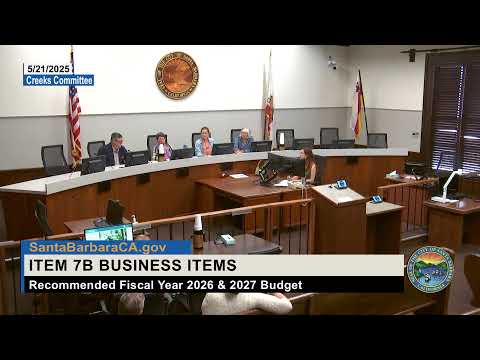
The Creek Citizen Advisory Committee on May 21 voted to recommend the City Council approve the City of Santa Barbara Creeks Division’s proposed fiscal year 2026–27 budget, a staff presentation showed.
The committee voted 4–0 to forward the two-year budget proposal to Council. The motion as read at the meeting was: “the committee recommend approval of the proposed Creeks division fiscal year 2026–2027 budgets to the city council.” The item passed after the committee’s budget subcommittee had reviewed the proposal in April and supported staff’s recommendation.
Why it matters: The Creeks Division is funded by Measure B, a voter-approved 2% transient-occupancy-tax allocation dedicated to stormwater and creek projects. The division does not receive general-fund dollars; its revenue projections drive maintenance contracts, capital projects and monitoring programs.
Creeks Manager Erin Markey told the committee “the proposed budget this year is consistent with the Measure B funding guidelines, which were last reaffirmed by the committee in January of 2010.” Markey outlined key changes driving cost increases: anticipated filling of staff vacancies and related salary/benefit growth; addition of the street-sweeping program (added mid‑2025) into the division’s operating budget; higher rental costs as the department expands office space; and increased maintenance allocations for specific sites.
Staff called out several line items in the proposal: a roughly $20,000 expected increase to the Creek cleanup contract; added operations funding for the Andrea Clark Bird Refuge following an initial two‑year maintenance inclusion in the construction contract; additional funds for estuary maintenance and targeted planting work; and higher operating supplies and services tied to the newly managed street‑sweeping program.
On capital budgeting, Markey said city policy now asks departments to budget expected near‑term capital expenditures rather than maintain long-term “savings accounts” for projects. That change, staff said, increases year‑to‑year volatility in capital allocations and is a reason staff recommended raising the division’s reserve target from $3,000,000 to $4,000,000.
Budget specifics discussed at the meeting included staff proposals to draw $300,000 from reserves in FY2026 and a prospective $1.5 million draw in FY2027 tied to planned project implementation. Committee member Chris Cline asked whether the proposed $4,000,000 reserve target would be a technical part of the two‑year budget or a separate strategic target; Markey replied it was a staff recommendation for committee consideration and not currently embedded in the funding guidelines.
Staff updates given to the committee noted recent hires and outreach: a newly hired water quality analyst, Laurie (in her fifth week), and an offer accepted for a project planner, Evan Hobson, who is scheduled to start June 16. Markey also noted the Urban Creek Trail Walk held May 6 had strong attendance.
The committee moved and seconded staff’s recommendation and recorded the 4–0 vote in support of recommending Council approval. The committee recorded no abstentions or opposing votes.
Votes at a glance: - Approval of minutes from March 19, 2025 — motion carried (unanimous); formal vote recorded as passed during the meeting. - Recommendation to City Council: Creeks Division FY2026–27 proposed budget — motion moved and seconded; outcome: recommend approval to City Council (vote 4–0).
The committee’s recommendation will be transmitted to City Council for final consideration.