Get Full Government Meeting Transcripts, Videos, & Alerts Forever!
Get email alerts on the Emergency Communications topic
No spam. Unsubscribe anytime.
Milwaukee 911 answer times improved to roughly 99% in Q1 2025, officials say
Summary
A quarterly report presented May 20 shows Milwaukee 911 answer-time targets were exceeded in the first quarter of 2025; staff cited new technology, added telecommunicators and an ongoing shift to universal call takers as drivers of improvement.
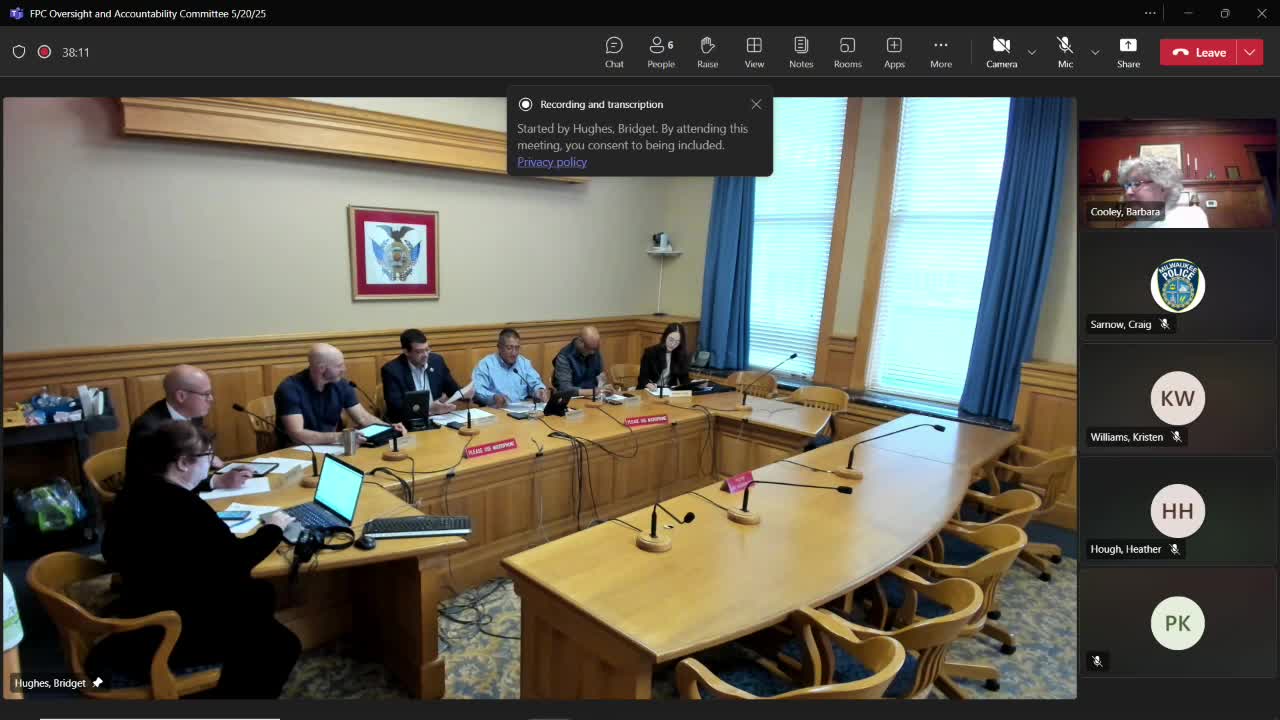
Barbara Cooley, FPC research and policy analyst, told the Fire and Police Commission Oversight and Accountability Committee on May 20 that Milwaukee met and exceeded the city’s 9-1-1 call-answer targets in the first quarter of 2025. “We are doing quite well with meeting those standards now,” Cooley said.
The report responds to a council footnote that requires quarterly reporting after earlier performance problems. Cooley said the city implemented a Solacom 9-1-1 system and increased staffing; those steps, combined with expedited hiring and a pay increase begun in early 2022, produced steady improvements in answer times.
The Q1 2025 figures in the report show roughly 99% of MPD emergency calls were answered within 15 seconds and about 99.2% within 20 seconds; Milwaukee Fire Department (MFD) calls reached about 98.8% within 15 seconds and roughly 99% within 20 seconds. Cooley told commissioners the quarter’s average staffing level was 66 telecommunicators and emergency communications officers (ECOs).
Cooley described a transition to universal call takers (UCTs), who will be trained to handle both police and fire calls. She said UCTs began taking both MPD and MFD calls on March 28 and that only a small number (about 15–20) had completed that training at the time of the report. The goal is for all call takers to be UCT-trained by the end of the third quarter of 2025; once training is complete, the report will combine MPD and MFD call statistics rather than reporting them separately.
Commissioners asked about related metrics and next steps. Cooley said the quarterly report covers call-answer times only, and that dispatch and on-scene response times are tracked in a separate semiannual report. She also said it takes about eight weeks to fully train a new telecommunicator and that a recent recruitment cycle had about 48 candidates scheduled for interviews with an anticipated class start in August.
On language access, Cooley said the department has a number of bilingual Spanish-speaking call takers and uses a third-party language line for other languages; she acknowledged that interpretation adds steps and time to calls and said the department plans to recruit additional multilingual call takers. Cooley noted the city’s school system shows more than 30 languages spoken locally and offered to pull data on the most common non-English languages for commissioners.
Several commissioners asked for future updates on workplace culture as the call-taking function consolidates and for public education about what callers should expect. Cooley said the department recently began recognizing call takers through an internal awards ceremony and that leadership focused on call-taking should support a single-team culture.
The committee received the report; no formal vote was recorded. The director and staff said a dispatch-time and on-scene performance update will be presented in a future meeting.