Get Full Government Meeting Transcripts, Videos, & Alerts Forever!
Get email alerts on the Ems Services topic
No spam. Unsubscribe anytime.
DeKalb County receives EMS update: unit hours up, wall time improving but still above national goal
Summary
County EMS staff reported improvements in unit deployment and response times, described programs intended to reduce unnecessary transports, and outlined changes included in an RFP for future ambulance contracts. Commissioners asked about hospital turnaround ("wall time"), staffing and maintenance, and directed continued monitoring.
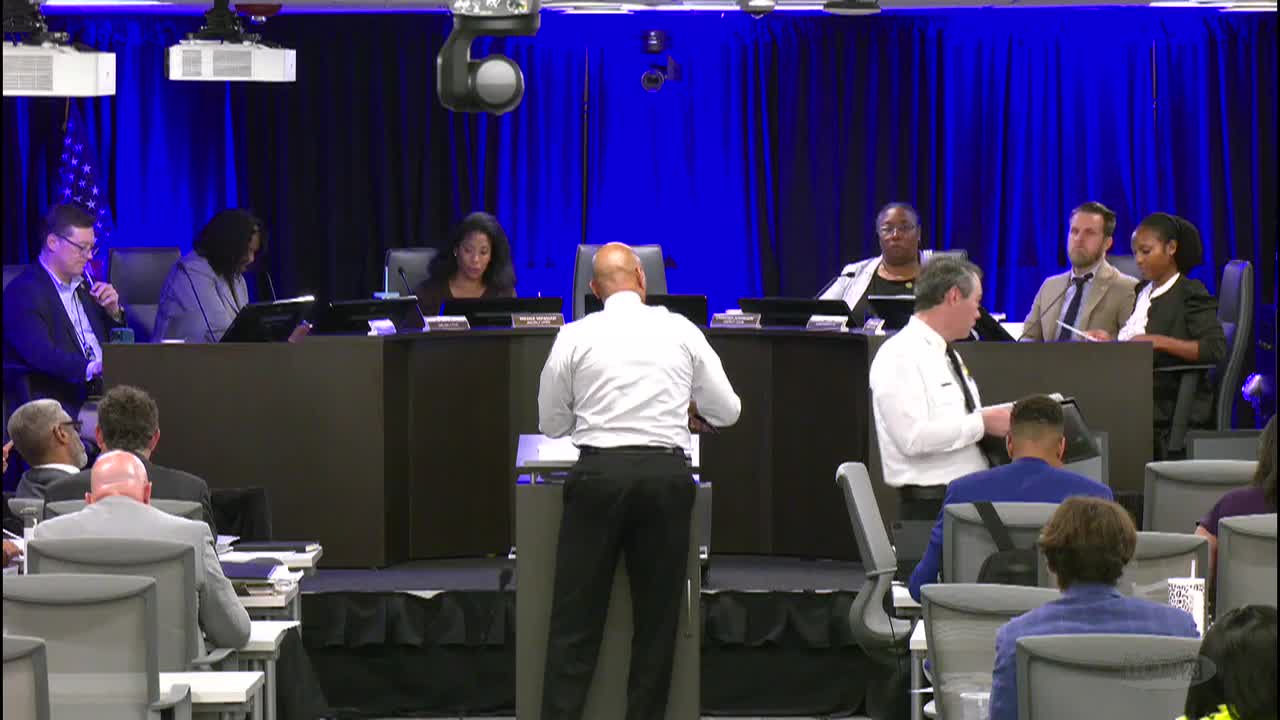
DeKalb County IRPS Committee received a detailed update on EMS operations and the ongoing RFP process for ambulance services during a committee meeting.
The county’s EMS chief summarized an operational assessment performed in 2024 (the Fitch Associates report), noting that the county provided 2019–2023 data to the consultant. Since late 2024 and early 2025 the county increased its in-house ambulance capacity by placing five county-owned ambulances in service and is averaging between six and eight DeKalb County units on the road some days. The chief said AMR (the contracted ambulance vendor) averaged about 564 unit hours per day in April; the contract required a minimum of 548 unit hours after an increase that took effect April 1 and is projected to rise again (presentation referenced a future 568-hour target).
Committee members heard that hospital “wall time” — the time an ambulance and crew wait at a hospital to transfer a patient — remains above the national turnaround goal. The chief said the county’s average wall time has come down to just under 50 minutes but the national target is about 20 minutes. The county has a monthly hospital focus group, is negotiating operational changes with major receiving hospitals (the chief discussed Emory as a principal receiving system), and is exploring whether state-level standards or statutory measures could help reduce wall times.
Staff reviewed service-quality initiatives intended to reduce unnecessary transports and ambulance utilization: a nurse navigator program (a live nurse available via 911 transfer to advise callers and reduce avoidable transports) and a Mobile Integrated Health (MIH) program called HEALS (Healthcare, Education and LINC Services) that makes targeted outreach to frequent users and referrals to community resources. The chief said those programs have produced measurable diversion from transports and help reduce demand on ambulances.
The presentation also described changes in the RFP for next ambulance contract(s): proposers are asked to submit capability for different service-delivery intervals (unit hours) so the county can choose a level in the awarded contract; the county will permit bidders to request a subsidy but will set billing limits; and the county has increased liquidated-damage/penalty language to hold contractors to committed unit-hour levels. The county’s current contract extension with AMR runs through June 30 (extension details were discussed) and the county currently pays an annual subsidy in that extension (presentation cited a subsidy figure of about $4.9 million). The template used for evaluation will place more emphasis on service quality in addition to response time targets.
Performance data presented to commissioners showed a rebound in call volume since 2021 after early COVID reductions and an improving utilization rate (unit-hour utilization fell from about 80% in 2023 to about 60% in the most recent reporting period). The chief said lower utilization and more units on the road support better posting across the county and reduce crew overload and wear on vehicles. Penalty/credit line items on the contract reports have fallen in recent months; the presenter noted April penalty/credit amounts were materially lower than earlier months and expressed the county’s desire to see those numbers approach zero.
Commissioners asked questions about how much the county can influence hospital turnaround times (the chief noted some hospitals and states have issued guidance or recommendations around 20-minute turnaround time targets and that state-level policy could be a lever), the cadence of the unit-hour increases built into the extension (no further automatic increases beyond the scheduled one were included; future requirements will be set in the new contract), the number and condition of county ambulances (five new ambulances are in service and several earlier purchases are aging), and workforce capacity in fire/EMS (the chief said the fire/EMS ranks had active recruitment and a current cohort of recruits in training; the department cited about 80 fire vacancies but several hiring classes and a federal SAFER grant had provided temporary funding for positions).
Ending: Committee members thanked staff for the forward-looking approach and directed continued monitoring of unit hours, hospital wall times, RFP progress, and staffing, and requested follow-up data in future committee updates.