Get Full Government Meeting Transcripts, Videos, & Alerts Forever!
Get email alerts on the Rezoning Ndd topic
No spam. Unsubscribe anytime.
Planning commission backs Neighborhood Design District rezoning, asks staff to protect existing M‑1 businesses
Summary
The Planning Commission voted to recommend approval of two rezoning ordinances creating Neighborhood Design District (NDD) zoning for several northern Winchester neighborhoods and directed staff to revise the NDD text to preserve expansion rights for existing M‑1 industrial users.
The Winchester City Planning Commission voted to recommend two rezoning ordinances—one covering parcels in the Cedar Valley area and another covering the Cider Hill/North Cameron/Fairmont area—to reclassify those parcels into a Neighborhood Design District (NDD) zoning designation and forwarded both items to city council. Commissioners also accepted a friendly amendment directing staff to amend the NDD text to allow expansion of existing M‑1 uses consistent with what is allowed in the M‑1 zoning district.
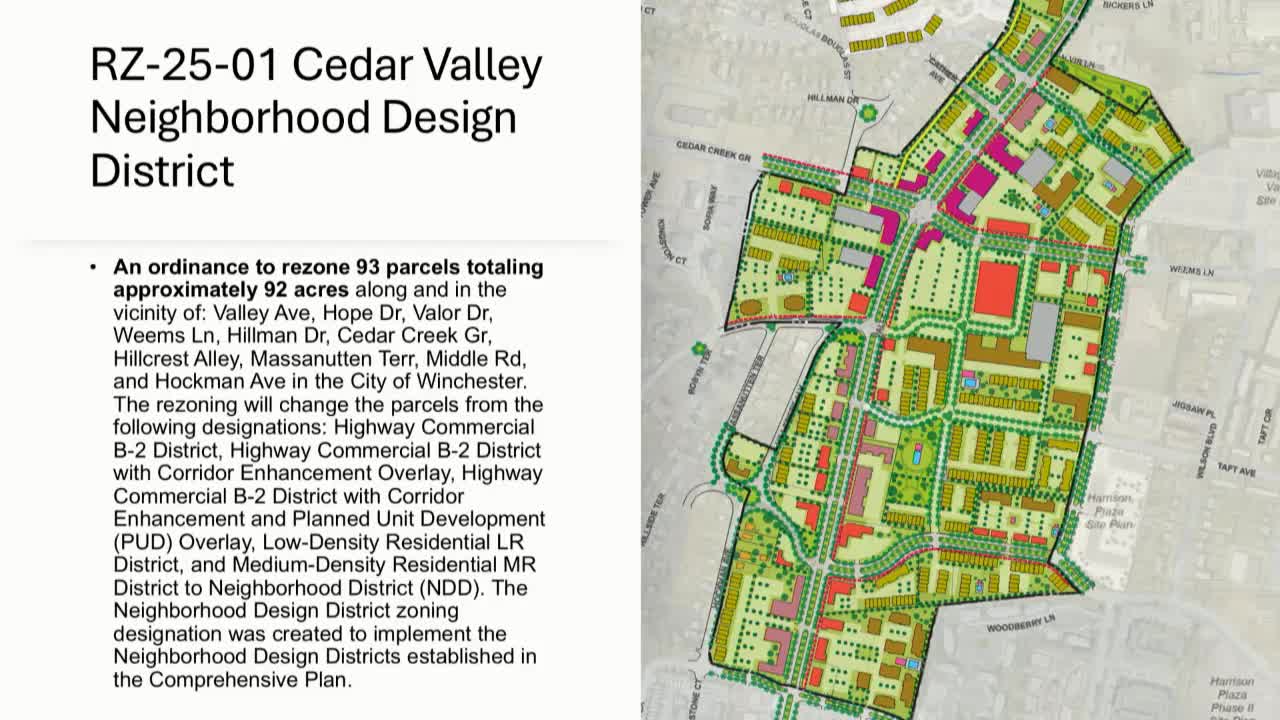
Planning staff presented the rezoning as the implementation step following a neighborhood design district committee, a comprehensive plan amendment and prior zoning text changes. The Cedar Valley rezoning affects a block of parcels along Valley Avenue, Cedar Creek Grade and Williams Lane; the other rezoning covers larger industrial and mixed parcels near North Cameron, Braddock and Fairmont Avenue.
Several property owners and business representatives spoke at the public hearings. Tom Willis, counsel for National Fruit Co., told commissioners: “It's been in business in this city since 1913. National Fruit employees, depending on the year, between 152 persons, and so there are dozens of families in this community dependent on this business for their livelihood.” Willis and other business spokespeople expressed concern that the NDD would make their existing industrial uses legally nonconforming and limit future expansion, potentially reducing property value and operational flexibility.
Staff replied that existing, legally established industrial uses would become legally nonconforming but could continue to operate; adaptive reuse is encouraged under the NDD rules and the ordinance provides the planning director discretion to grant waivers to development standards to enable reuse of existing structures. Mr. Reddy (planning staff) summarized that the NDD “doesn't necessarily deal with access management” now and emphasized the planning focus on adaptive reuse and future redevelopment.
Business owners asked whether interior changes or shifts in product (for example, different food processing uses) would trigger new approvals; staff said the use category for food manufacturing would be broad enough to allow changes in manufacturing without automatically requiring a new CUP, while exterior or footprint changes tied to redevelopment would be subject to development standards.
After extended public comment and commissioner discussion, the commission voted to forward the rezoning recommendation to the Planning and Economic Development (PED) Committee and city council, with the added directive that the NDD ordinance language be amended to allow the expansion of existing M‑1 uses as currently permitted in the M‑1 zoning district. The motion passed in a roll call where one commissioner recorded a no vote on the amendment; the rest voted in favor.
Commissioners said they want staff to draft clearer ordinance language before the council review so that incumbent industrial employers understand what redevelopment or expansion will be allowed. Staff indicated it would work with property owners to craft specific text changes and to flag any implications for pending PUDs, such as Fairmont Greens, which had approvals already in the area.
The rezoning items now proceed to the Planning and Economic Development Committee and then to City Council for public hearing and final action.