Get Full Government Meeting Transcripts, Videos, & Alerts Forever!
Get email alerts on the Data Centers And Crypto Mining topic
No spam. Unsubscribe anytime.
Edgecombe County delays UDO changes for data centers and crypto mining after public concerns; referral to planning board approved
Summary
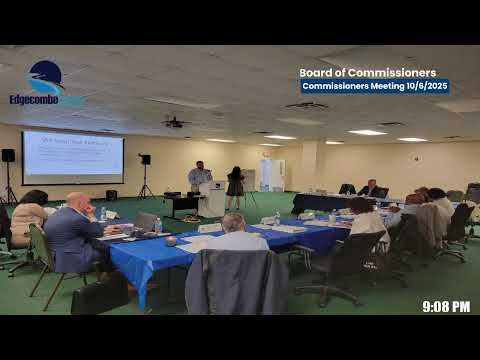
Edgecombe County commissioners on Oct. 6 heard staff and public testimony on a proposed amendment to the county's Unified Development Ordinance to add data centers and crypto mining operations, then referred the draft back to the planning board after a motion to adopt failed for lack of a second.
Edgecombe County commissioners on Oct. 6 heard staff and public testimony on a proposed amendment to the county's Unified Development Ordinance (UDO) to add data centers and crypto mining operations as regulated uses.
Planning Director Durbin Spell told the board the draft would allow data centers and crypto mining in the county's M-2 (general industrial) district. "Data centers and crypto mining operations will be permitted in the general industrial M 2 district in which data centers will be permitted by right and crypto mining operations will be permitted, after going through the conditional rezoning process," Spell said. He said both uses could also proceed through the planned development process and that the proposal adds a neighborhood meeting requirement and a newspaper advertisement at least 10 days before that meeting.
The draft circulated to commissioners included multiple development standards recommended by staff and the planning board. Those recommendations presented to the commissioners included: increasing the general setback to 100 feet and to 500 feet where a project borders a parcel zoned residential; requiring a minimum Type C buffer of 40 feet with additional landscaping as needed; daytime noise limits of 60 dB(A) at the lot line and 50 dB(A) at night where the project borders parcels with existing or approved dwellings, with "daylight hours" defined as 7 a.m. to 6 p.m.; lowering previously proposed 75 dB(A) limits to 60 dB(A) in nonadjacent areas; annual attestations of electrical and water capacity from public utility providers as part of the annual zoning compliance permit (the electrical attestation to be waived if the project generates its own electricity, but required to report needs if that generation stops); and a requirement that on-site generators be fully enclosed, meet relevant fire standards and obtain required state and federal permits.
Residents who spoke urged stronger protections. Robert Casanova, who identified himself as a retired aerospace engineer, said he supported job growth but urged more detailed noise controls and added frequency-based limits because "the low frequencies that tend to travel farther" can cause annoyance at long distances. He also urged the county to address night lighting and light pollution, citing darksky.org as a resource. "The technology for limiting light pollution is available," Casanova said. Jean Nash, a retired science teacher who said she lives near one of the proposed sites, said her "biggest concern is water" and asked whether the county had evaluated long-term water demand if multiple data centers locate in the area.
Commissioner Storm suggested the UDO's existing lighting standards be applied specifically to data centers in M-2 and asked staff to include downlighting/shielding language directly in the data-center paragraph rather than by cross-reference. Spell and other staff agreed they would identify the most appropriate place to reference or insert the lighting standards and noted Section 6.3.0.6(b) of the UDO already addresses shielding and fixtures for overhead lighting.
Planning staff said the planning board recommended approval of the draft with the changes described above. Commissioners discussed a consistency statement tying the amendment to the county's land-use/economic development policies; a motion to adopt the amendment including staff changes and the consistency statement was made but received no second and "died," the chair said.
A subsequent motion to send the amendment back to the planning board for further consideration (asking the board to take up lighting, structure height, and to hold community meetings specific to the proposed site) passed on a voice vote; the board "referred back to the planning board for further consideration," the clerk announced.
After the hearing and board action, staff also told the board a pending county offer to sell approximately 122 acres in the Kingsborough Business Park (property behind the former QVC facility) to a private buyer tied to data-center development had been delayed at the buyer's request because the draft UDO amendment had not been adopted. The buyer asked the county to table the sale to await further consideration of the ordinance changes.
Why it matters: The UDO change would create an explicit pathway for data centers to locate in parts of Edgecombe County currently zoned M-2 and set local development standards touching noise, lighting, buffers, utilities and neighborhood notification. Commissioners did not adopt the amendment on Oct. 6; they returned it to the planning board for additional refinement after public comment raised concerns about light pollution, water use and long‑range enforcement.
What happens next: The planning board will revisit the text amendment and return recommendations to the commissioners. Staff said applicants seeking rezoning outside M-2 would still have to go through standard rezoning processes, including a neighborhood meeting and public hearings.