Get Full Government Meeting Transcripts, Videos, & Alerts Forever!
Get email alerts on the Gateway Master Plan topic
No spam. Unsubscribe anytime.
Council adopts Gateway master plan with housing goals, environmental caveats and development safeguards
Summary
After extended debate and dozens of amendments, the Howard County Council approved CB 66, a 30-year Gateway master plan that sets a 20% moderate-income housing target, adds compatibility and infrastructure language, and includes repeated references to existing brownfield/EPA restrictions.
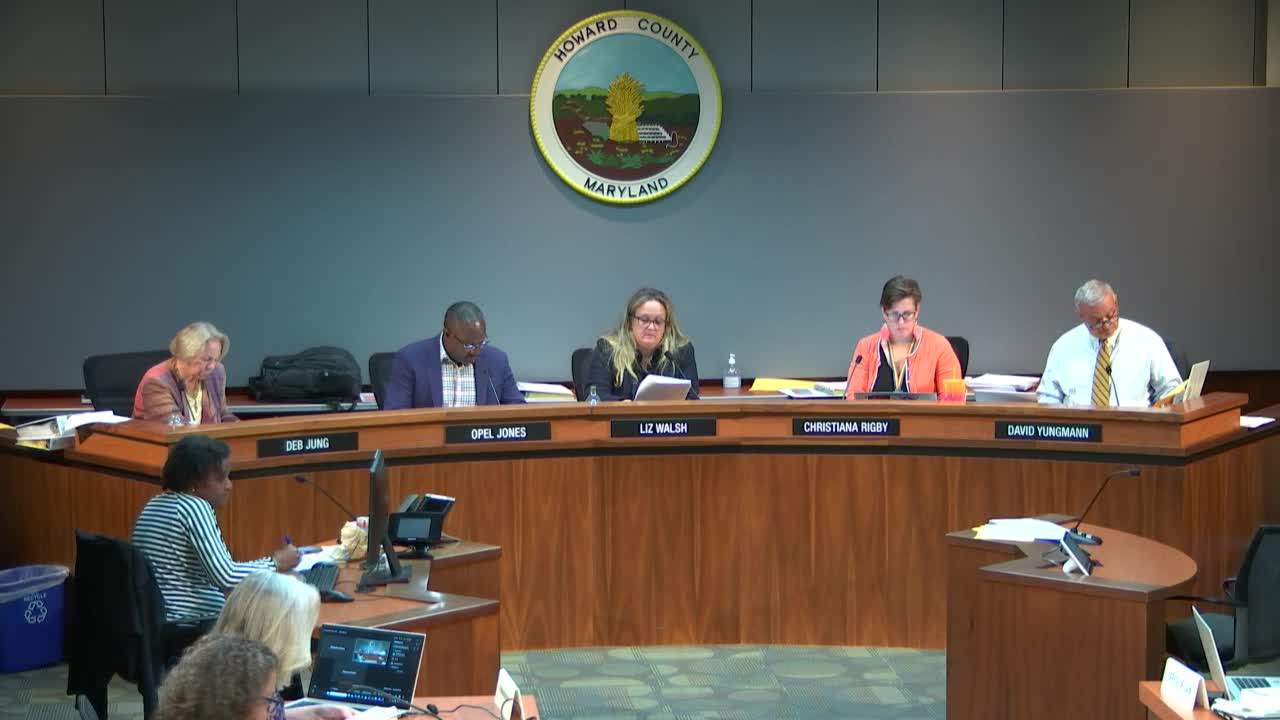
The Howard County Council passed Council Bill 66, the Gateway master plan general-plan amendment, after lengthy debate and multiple amendments addressing housing, environmental constraints and infrastructure.
The plan: CB 66 is a 30-year vision for the area known as Gateway that the Department of Planning and Zoning (DPZ) developed with property owners and public input. It envisions mixed-use redevelopment, new employment and housing opportunities, and major transportation and infrastructure investments.
Why it mattered in this session: The Gateway plan generated the meeting's most sustained debate. Councilmembers and public speakers focused on three recurring issues: (1) how to protect public health and safety where federal EPA covenants and brownfield restrictions exist; (2) how to ensure affordable housing is delivered (the council adopted a 20% moderate-income target for new units); and (3) how to preserve opportunities for research-and-development and industrial employment while making future residential development compatible with legacy uses.
Notable amendments and outcomes: - Housing targets: The council adopted language to target 20% moderate-income housing units for new dwelling units in Gateway (amendment 6 as amended). The text also encourages public/private/nonprofit partnerships, and includes a provision that at least 10% of new affordable units should be accessible to persons with disabilities. - Brownfields and EPA restrictions: Multiple amendments, many proposed and backed by Councilmember Young, inserted explicit references to brownfield sites and EPA covenants. The council added text noting parcels where remediation is required and that some contaminated parcels cannot support residential uses until remediation occurs. Several amendments strengthening that language passed; others failed, leaving some councilmembers critical that the plan did not go further. - Compatibility and industrial uses: The council debated whether to limit or require shielding for industrial and data-center generators. Several amendments inserted language that certain industrial uses should be "shielded by a structure" when near residences; some amendment language passed while others (that would more stringently limit research-and-development or certain uses) failed. - Infrastructure and funding: The council added language calling for planning for water, sewer and other infrastructure needs, and rejected an amendment that would have removed Tax Increment Financing (TIF) as a potential tool. Members explicitly discussed the need for coordination with State Highway and CSX for multimodal access.
Quotes from the floor capture the tension: "Some parcels are brownfields with EPA restrictions," Councilmember Natalie Young said, pressing for clearer protections; "houses should not be located next to brownfields," Young added. Council Chair Liz Walsh said the plan "is a great start" but acknowledged imperfections. Several council members urged DPZ and future councils to continue refining regulatory and remediation pathways.
Votes and outcome: After considering more than a dozen numbered amendments (many of them amendments to amendments), the council approved CB 66 as amended.
Community implications and next steps: The plan sets goals and a framework rather than immediate zoning changes. DPZ will develop implementing zoning regulations and will coordinate remediation, infrastructure planning and financing strategies. The council directed that responsible agencies be identified for strategic actions in the plan; the Office of Procurement and Contract Administration was named in one amendment as responsible for pursuing prevailing-wage or project-labor approaches where public financing is used.
Ending: Supporters described the plan as a long-term framework to bring jobs and housing to Gateway; critics said more concrete remediation commitments are needed before residential development is promoted adjacent to contaminated parcels.