Get Full Government Meeting Transcripts, Videos, & Alerts Forever!
Get email alerts on the Property Tax Credit Seniors topic
No spam. Unsubscribe anytime.
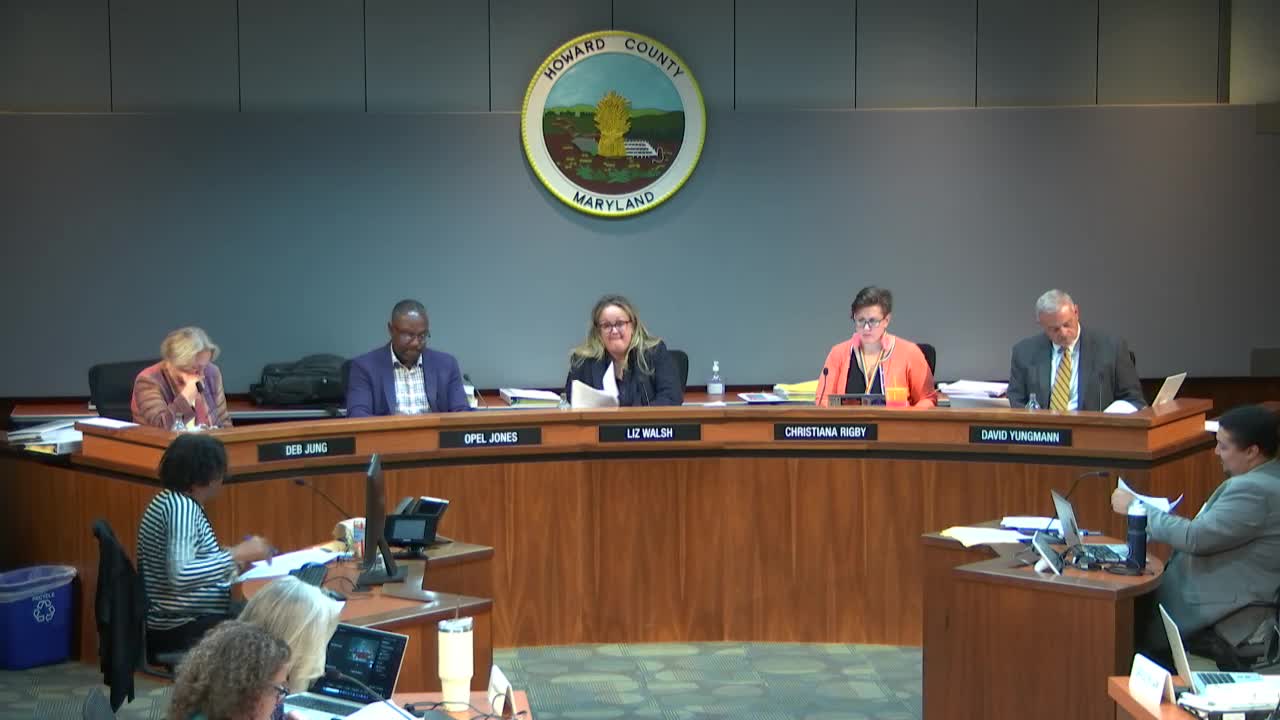
Council rejects one version and approves amended senior property tax credit after heated debate
Summary
Howard County Council rejected Council Bill 59, then passed a revised measure (CB 60) expanding the county's property tax credit for seniors and certain retired military, while adding administrative changes such as annual attestations and alignment with state law.
The Howard County Council voted down Council Bill 59 but later approved Council Bill 60, a revised measure that expands the county's aging-in-place property tax credit for seniors and certain retired military personnel.
Councilmember Deb Young introduced CB 59, saying the bill would lift the cap on the aging-in-place credit so seniors could better plan to remain in their homes. "My bill will provide seniors with some relief on their property tax bill, allowing them to stay in their homes as assessments and tax burdens rise," Young said during debate, noting more than 500 petition signatures in support.
Why it matters: The council's debate focused on balancing the goal of helping long-time residents remain in place against the cost to county services and the distributional effects of a property-based credit. Supporters framed the change as stability for fixed-income seniors; critics said the credit benefits a relatively small, often asset-rich group and shifts costs elsewhere in the budget.
What the council did: After extensive debate and several amendment votes, the council rejected CB 59 (the version Young initially offered) and then passed CB 60 as amended. The final CB 60 clarifies definitions to match state enabling law, extends the credit period beyond the county executive's proposal, and adds administrative provisions requiring annual re-affirmation (attestation) of eligibility rather than a full reapplication.
Key fiscal and program details mentioned in debate: - Current foregone revenue for the aging-in-place credit was cited by a council member as about $6.2 million; Young said lifting the cap would increase foregone revenue by roughly $1.3 million to $2.0 million depending on take-up. - Supporters reported that fewer than 50% of eligible homeowners currently apply for the credit, though the council did not adopt an enforcement or outreach model as part of CB 60.
Notable points of contention: - Eligibility and fairness: Amendment proposals sought to exclude owners of multiple residential properties and to require annual resubmission (to prevent trust or ownership changes from continuing a property-tied credit indefinitely). An amendment to bar owners of multiple residences failed; an amendment requiring annual resubmission (later clarified to an annual attestation) passed. - Scope of the benefit: Several council members and speakers urged shifting focus from a property-tied credit toward an individual-based senior tax credit or tax-deferral programs that would target need rather than property tenure. - Administrative burden and access: Council members expressed concern that annual attestation could be burdensome for older residents with mobility or technology barriers; they directed that Department of Finance offer paper and in-person assistance.
Votes and outcome (summary): - CB 59 (original version): failed on final vote after amendments. - CB 60 (as amended): passed (CB 60 as amended recorded as passed in the session).
Where the record leaves off: The final ordinance aligns some definitions with state law and requires an annual attestation process administered by Finance; the bill as amended was approved for enactment. Implementation details (forms, outreach, and specific workflow at Department of Finance) were discussed but left to administrative development.
Ending: Councilmembers said they expect follow-up work to refine outreach and the attestation process so eligible seniors can access benefits without undue burden. The council also signaled interest in studying complementary tools such as a senior tax credit or tax-deferral options in future work sessions.