Get Full Government Meeting Transcripts, Videos, & Alerts Forever!
Get email alerts on the Comprehensive Plan Update topic
No spam. Unsubscribe anytime.
Albemarle planning commission recommends approval of AC 44 comprehensive plan update
Summary
The Albemarle County Planning Commission voted unanimously on Sept. 30 to recommend that the Board of Supervisors approve CPA 20-21-2 (AC 44), the county's comprehensive plan update, forwarding a resolution with several commissioner-proposed edits and asking that staff carry those edits and additional public input forward to the board.
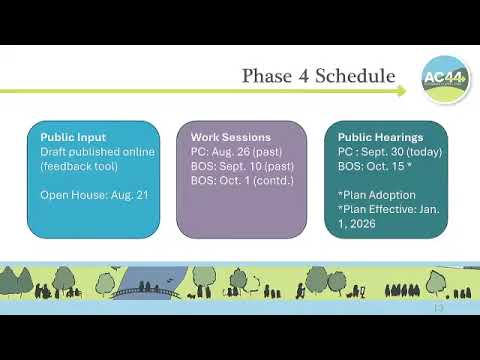
The Albemarle County Planning Commission voted unanimously on Sept. 30 to recommend that the Board of Supervisors approve CPA 20-21-2 (AC 44), the county's comprehensive plan update. The commission approved a resolution with several commissioner-suggested amendments and forwarded the plan to the board for its public hearing and anticipated adoption on Oct. 15, 2025; staff said the plan's proposed effective date is Jan. 1, 2026.
AC 44 is a countywide policy document that updates Albemarle's growth-management policy, consolidates land-use categories for the development areas, refines future land-use maps and identifies a set of implementation actions the county will pursue after adoption. Ben Holt, with the county's Long Range Planning Division, told the commission staff organized the document into four parts, reduced the main document from 406 pages in 2015 to 278 pages in the draft, and incorporated two buildout analyses (2022 and 2025), new emphasis on equity and climate action, and revised activity-center mapping. Staff said public engagement has included more than 40,000 website visitors and roughly 2,700 participants through surveys, meetings and other input.
Public commenters at the commission hearing expressed a mix of support and concern. Neil Williamson, president of the Free Enterprise Forum, said the plan is a missed opportunity and warned it would perpetuate the status quo and worsen housing affordability. Rob McGinnis, representing the Piedmont Environmental Council, asked for a clearer, more robust process for any future revisions that would swap land between development areas and the rural area and said such swaps are better considered through neighborhood master plans or a rural-area land-use plan. Christine Putnam, a member of the county's Natural Heritage Committee, asked the commission to add a specific action to require at least 80% locally native trees and shrubs on county-owned sites; staff and several commissioners agreed that language should be added to the environmental stewardship chapter.
Owners of a parcel identified as Parcel 7548 (represented by Doug Holliday and Payne, owners of Sweet Spot of Albemarle LLC) asked the commission to change their parcel's future land-use designation from industrial to community mixed use, saying the industrial designation dates from a prior prospective buyer and that mixed use would better align with adjacent properties and the county's plans for Hedgerow Park. Commissioners and staff said they were generally sympathetic to the land-use rationale but several commissioners raised concerns about process and public notice because the request arrived late in the hearing materials; the commission did not enact a map change at the meeting but recorded its concerns and the differing views in its recommendation to the board.
Commissioners spent substantial time discussing language in the growth-management chapter that describes criteria for 'removing underperforming areas' from development-area boundaries. Several commissioners and environmental commenters said the existing draft criteria were vague enough to risk unintended boundary changes. The commission agreed to amend the draft to describe the items as 'potential criteria for assessing removal of underperforming areas from the development areas' and to ask that any boundary-revision process include robust community engagement and a staff-prepared development-areas report with maps and order-of-magnitude cost estimates before any changes occur.
Other amendments the commission adopted as recommendations to the board include: adding an action in the environmental stewardship chapter calling for the county to use a minimum of 80% locally native trees and shrubs on county projects; adding a sentence that on-site (or nearby/local) stormwater best-management practices to treat runoff and improve water quality are preferred over purchasing off-site credits; and adding an implementation action encouraging the county to seek opportunities to add stormwater best-management practices in older neighborhoods that lack them. Staff told the commission these and other suggested edits would be folded into an amendment list that staff will forward to the board.
At the meeting the commission also discussed the public process for citizen-initiated comp-plan amendments. Ben Holt said staff and the board intend to bring back a citizen-initiated amendment process (previously removed) and that details will be developed as part of implementation work after adoption. Commissioners repeatedly emphasized that any criteria or process to revise development-area boundaries must be developed carefully with ample public outreach and should not be used as a way to retroactively change the plan without full analysis and notice.
A formal motion to adopt the resolution recommending approval of CPA 20-21-2 (AC 44), as amended by the commission's recommendations, passed on a roll call vote with all members present voting 'aye.' The motion and recommendation now go to the Board of Supervisors for further consideration and final adoption.
The board is scheduled to hold a continued work session on the draft and a public hearing on Oct. 15, 2025. If adopted by the board as recommended, staff said the plan would be effective on Jan. 1, 2026 and would guide subsequent work including zoning modernization, activity-center small-area planning and metrics for tracking implementation progress.