Get Full Government Meeting Transcripts, Videos, & Alerts Forever!
Get email alerts on the Ela Standards Pov Purpose topic
No spam. Unsubscribe anytime.
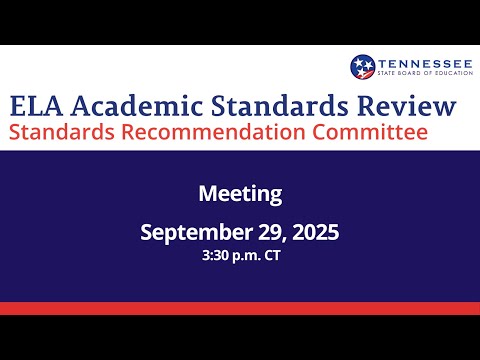
Tennessee committee narrows wording on point of view and author purpose across ELA grades
Summary
The ELA standards committee debated and revised language distinguishing 'point of view' from 'perspective' and how to treat author purpose across grade bands, endorsing grade‑specific phrasing intended to clarify progression from elementary through high school.
The Tennessee State Board of Education’s English Language Arts Standards Recommendation Committee revised draft language to make clearer how students should analyze narrator point of view and author purpose across K‑12 grade bands.
Committee members said the change is meant to make a clearer progression from early grades — where students learn basic narration types — through middle school and into high school standards that expect analysis of author choices.
Why it matters: Teachers and curriculum developers use the wording of standards to design lessons and assessments. Committee members said interchangeable use of terms such as “perspective,” “point of view” and “position” in the old draft caused confusion for both educators and materials-adoption reviewers.
The committee spent extended time on a sixth‑grade literature draft that originally read “explain how an author establishes and conveys the perspective of the narrator or speaker in a text.” After discussion — including feedback from Tennessee Department of Education (TDOE) staff that recommended using the term “point of view” when referring to narrator perspective — the committee approved a revised line: “explain how an author establishes and conveys the point of view of the narrator or speaker and the perspectives of characters in a text.”
Vice Chair Maestro Hilliard framed the shift as a progression in difficulty: “we’re kind of introducing the author's role in establishing point of view at the sixth grade level,” he said, urging language that emphasizes how authors craft narration rather than simply labeling narrator types.
Several committee members pushed for parallel, grade‑by‑grade language. Miss Dockery and others argued that earlier grades introduce perspective, then fifth grade asks students to compare effects of points of view, and sixth grade should move toward students explaining how authors intentionally craft point of view. TDOE staff reiterated that for informational texts the focus is often author purpose rather than narrator point of view.
The committee also standardized the draft wording where appropriate across reading informational (RI) and reading literature (RL) standards and settled on use of “and/or” in some RI standards to allow for texts where perspective and purpose are not mutually exclusive. For example, a revised RI draft reads: “determine an author's perspective and/or purpose in a text and explain how they are conveyed.”
Members asked that the committee record explanatory rationale in the standards guide so reviewers and teachers can see the intended progression; the committee agreed to include that rationale in the glossary/parking‑garage materials used to support the standards.
The committee did not take any action that would finalize the standards; the meeting recorded committee approvals of wording on a consensus basis to carry forward to the board’s recommendation packet.
Looking ahead: The committee said it will bring the refined language to the full State Board meeting for questions and potential adoption steps. As Chair Robert S. Eby told the group, “I look forward to seeing the recommendation, at our board meeting, and look forward to, many questions.”
Ending: The committee moved on after adopting the narrower phrasing; members asked staff to add clarifying examples and glossary entries so the distinction between point of view, perspective and purpose is explicit in guidance for teachers.