Get Full Government Meeting Transcripts, Videos, & Alerts Forever!
Get email alerts on the Charter Revision Land Use topic
No spam. Unsubscribe anytime.
CB2 committee urges clarity on mayoral charter land‑use proposals, warns against shortening review time
Summary
The Community Board 2 Land Use and Housing Committee reviewed mayoral and City Council charter‑revision recommendations on June 11, focusing on proposed changes to the city's land‑use review process that committee members said are too vague and risk reducing local input.
The Community Board 2 Land Use and Housing Committee on June 11 reviewed preliminary recommendations from both the Mayor's Charter Revision Commission and the City Council Charter Revision Commission that would change how land‑use reviews are handled in New York City. Committee members said the mayoral commission's proposals — which aim to "streamline" the Uniform Land Use Review Procedure (ULURP) by fast‑tracking some projects and shortening advisory timeframes — are too vague and risk reducing community input.
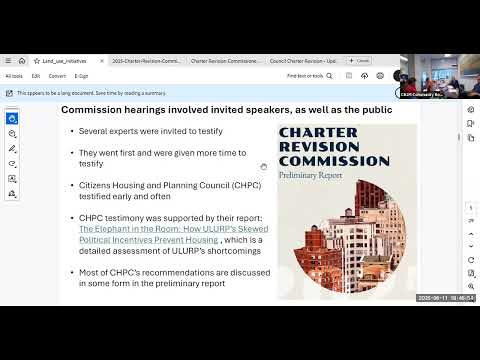
The committee, chaired by Eugene Yoo, discussed seven topic groupings summarized by staff presenter George Jing in a deck circulated to members. Members repeatedly flagged proposals to shorten advisory review (discussed in the reports as a move from a 90‑day advisory window to something closer to 60 days) and to create a new zoning‑administrator role whose authority, thresholds and public‑input procedures are not described in the draft language. The committee also debated reforms to the city map process, approaches to disposition/activation of public land, and proposals on member deference, fair‑housing planning and revisiting existing district designations.
Why it matters: committee members said the combination of shortened advisory time, an undefined administrative role that could disposition certain small projects, and proposals to centralize some map and disposition authority could effectively reduce the time and ways local community boards and locally elected officials engage in land‑use decisions. The committee noted a deadline for public comment and the Charter Revision Commission's last public meeting on July 7, 2025 (5–8 p.m.), and sought to draft feedback for the full CB2 board prior to that date.
Key discussion points and committee concerns
- Fast‑tracking and ULURP timing: The mayor's report frames a lead argument that high process costs discourage small residential rezonings; the draft recommends alternative, quicker paths for smaller projects and "categorically beneficial" projects (the report gives 100% affordable housing as an example). Committee members said the reports lack definitions (for example, what qualifies as “categorically beneficial”) and that fast‑tracking risks excluding useful pre‑ULURP community engagement. Staff materials noted the formal ULURP timetable is roughly seven and a half months but that much pre‑certification work can take years and is not governed by the charter language.
- Advisory window (90 → 60 days): Multiple members objected to shortening the advisory period, saying community boards already sometimes struggle to process complex applications within 90 days, especially during summer months when some boards do not meet. Committee members suggested instead calibrating review time to project complexity (shorter for very small, simple changes; more time for large or complex rezonings).
- Zoning Administrator: The mayoral draft proposes a zoning administrator to disposition certain small projects or minor variances (staff materials referenced illustrative thresholds such as projects up to about six dwelling units or 35 feet in height). The committee said the role is presented too vaguely: there is no clear description of whether community boards would receive notice, be allowed to hold hearings, or otherwise participate. Several members warned a new administrative pathway could be used by developers to break projects into parts to avoid fuller public review.
- Member deference and overrides: The proposals raise changes to the roles of the Speaker, Borough President and City Planning Commission that some members read as an effort to weaken member deference (the customary practice by which a local council member's position carries special weight). Committee members described member deference as an important local voice and disputed language framing it as primarily a development obstacle.
- Public land disposition and "other uses": The mayor's report recommends streamlining disposition for some city parcels to activate public land for housing or other uses. Committee members asked for explicit limits and suggested a square‑footage cap or stronger public‑use and affordable‑housing tests so that large publicly owned sites could not be diverted to private market uses without robust review.
- City map modernization and centralization: The reports propose digitizing and centralizing city map management (currently maintained by borough offices). Committee members supported digitization but questioned centralization of map control at the Department of City Planning (DCP), warning it could reduce local borough president oversight and local staff familiarity with fine‑grained map data.
- Fair housing, comprehensive planning and 197‑a: The City Council commission language would expand community planning and fair‑housing obligations (including district‑level housing targets and assistance for community‑board planning under Charter Section 197‑a). Committee members said that community boards would need additional staff and paid technical support to take on that work and urged that targets be developed in consultation with each community board.
- Revocable consent and public realm: Staff notes in the report mention reforming rules for revocable consent (an authorization city agencies grant for private use of public right‑of‑way). Committee members cautioned against loosening revocable‑consent rules in ways that would privatize or commercialize public space without clear transparency and community review.
HPD letter and MIH payment at 43 Bleecker Street
Committee members reviewed a letter from the Department of Housing Preservation and Development (HPD) and the Law Department regarding an application at 43 Bleecker Street. The letter stated that HPD and the Law Department had reviewed project documents and that, if the project qualifies for Mandatory Inclusionary Housing (MIH) obligations, it would be allowed to satisfy those obligations by payment into the city Affordable Housing Fund; HPD’s position, as paraphrased to the committee, was that certain MIH‑triggering conditions are treated as “as‑of‑right” under current rules. Members said the letter did not answer all of the board’s questions about unit eligibility and noted this was the first project the agencies had indicated might pay into the Manhattan Affordable Housing Fund under MIH rules.
Next steps and committee direction
The committee asked staff to draft written comments for CB2 focusing on (1) opposing shortening the advisory review without clearer, objective thresholds and resource guarantees for community boards; (2) requiring explicit definitions and public‑input standards for any proposed zoning‑administrator authority; (3) adding square‑footage caps or explicit affordable‑housing prioritization to any public‑land disposition shortcut; and (4) preserving meaningful borough president and community‑board roles if map management is modernized. Those comments will be circulated for the full board's review and a formal CB2 resolution before the July 7 public hearing, if possible.
Members who spoke at length in the discussion included Chair Eugene Yoo and committee vice chair Katie Bortonaro; other committee members present included Susan Wittenberg, Donna Raftery, Parker Booth, Stella Fitzgerald, Arturo Fernandez and Valerie Dela Rosa (participating remotely). A public commenter (identified as Pete) urged caution about changes driven by commissioners who have publicly criticized community‑board roles and questioned the citywide growth assumptions underlying the mayoral proposals.