Get AI Briefings, Transcripts & Alerts on Local & National Government Meetings — Forever.
Minn. House passes transportation bill after debate over transit cuts and Anoka bridge mandate
Loading...
Summary
The Minnesota House passed House File 14, a transportation budget and policy bill, after debate over transit funding cuts, metro sales-tax changes and a failed amendment that would have removed a mandate requiring Anoka County to use sales-tax revenue for a pedestrian bridge project.
The Minnesota House passed House File 14, a transportation finance and policy bill, by a roll-call vote of 78 ayes to 55 nays after floor debate over transit cuts, local sales-tax allocations and a challenged mandate tied to an Anoka County bridge project.
The bill funds state transportation operations and projects while shifting some cuts onto transit programs. Representative Cagle, the bill’s author, told colleagues that the measure "is the result of a broken deal" and said it preserves operating adjustments and specific project funding while reflecting changes agreed during negotiations earlier in the week.
The bill includes several line items discussed on the floor: a $10,000,000 appropriation for the Duluth airport; a $40,000,000 named project for Lakeville; a $2,700,000 appropriation for Crookston through an "empowering small communities" fund; and a stated reduction to Greater Minnesota transit of $22,000,000 in the upcoming biennium. Sponsors and supporters noted that some larger regional capital proposals — including a previously discussed $400,000,000 regional bond concept for bus rapid transit (BRT) buildout — did not survive the final negotiations.
Floor debate included repeated warnings that the package places heavier charges on transit users. Representative Cagle said members were "balancing the transportation budget on the backs of transit riders," and Representative Jones described the deprived transit investments as a loss for people who rely on transit for work, groceries and medical access.
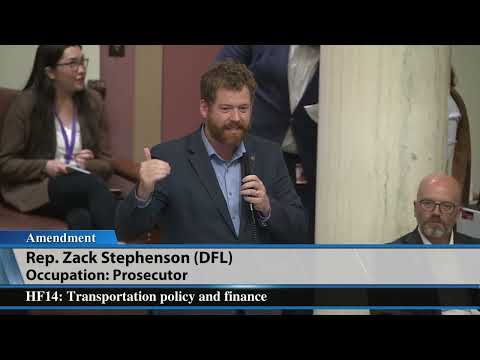
An amendment (coded A2), offered by Representative Niska, sought to strike language that would direct Anoka County to dedicate a portion of its sales-tax receipts toward a pedestrian bridge across the Rum River dam. Representative Niska described the provision as a "mandate on Anoka County to spend a portion of its sales tax money on something that was never a bill that was presented to the legislature," and urged colleagues to restore local control. Representative Stevenson, speaking in opposition to the amendment, said the project "is an introduced bill. It received a hearing in the transportation committee" and said the funding approach is consistent with other direct appropriations in the bill.
The amendment was called for a roll call and failed (62 ayes, 67 nays). The bill was read for final passage and was approved later the same day, 78 ayes to 55 nays; its title was agreed to.
The bill also makes changes to electric-vehicle fees (adjusted by vehicle MSRPs) and creates a working group to study kilowatt-hour charging as a possible future fee approach, according to remarks on the floor. Members said the bill protects the greenhouse-gas mitigation law enacted in 2024 and maintains trunk-highway and MnDOT capital funding priorities while adjusting some metro sales-tax allocations that had drawn attention during weekend negotiations.
Floor speakers repeatedly criticized the process used to reach the final agreement. Several members said leadership spreadsheets and jointly signed working-group documents had been altered late in the process; Representative Bliss urged more time for public input and debated procedures. Supporters argued the bill kept Minnesota’s transportation system funded and averted deeper, permanent cuts.
The House earlier invoked Article IV, Section 19 of the Minnesota Constitution to suspend rules and declare urgency so House File 14 could receive an immediate reading and final passage vote.
Votes at a glance: the A2 amendment to HF14 (Anoka County pedestrian bridge language) failed on a roll call, 62 ayes to 67 nays. House File 14 then passed final passage, 78 ayes to 55 nays.