Get Full Government Meeting Transcripts, Videos, & Alerts Forever!
Get email alerts on the Sb 540 Pathways topic
No spam. Unsubscribe anytime.
Committee reviews Pathways Initiative (SB 540) that would enable a Western regional electricity market
Summary
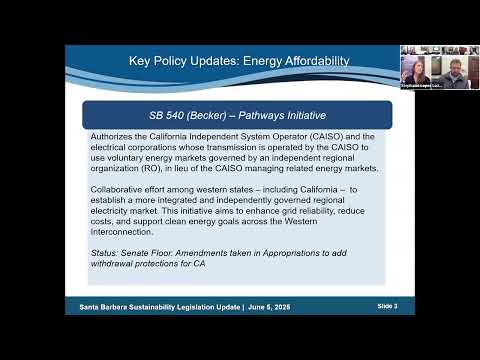
Townsend briefed the Santa Barbara City Sustainability Committee on SB 540 (the Pathways Initiative), which would authorize CAISO to run a Western regional electricity market to expand resource procurement and potentially lower costs.
Townsend public affairs representatives briefed the Santa Barbara City Sustainability Committee on SB 540, known in the briefing as the Pathways Initiative, which would authorize the California Independent System Operator (CAISO) to operate a regional electricity market across Western states.
Townsend's presenter described the policy’s core aims: expand the footprint from which California load‑serving entities can procure power, improve grid reliability by enabling resource sharing across a broader geographic area, and—arguably—reduce costs. Committee members and staff discussed potential benefits for statewide energy affordability and the practical limits for Santa Barbara, noting Santa Barbara’s bucket‑1 procurement requirements that prioritize in‑state resources.
Why it matters: For many California agencies the bill could expand access to diverse resource types at different times of day (for example, importing midday solar from other states). However, committee members and staff flagged that opponents worry the regional market could weaken California’s procurement standards and allow the regional operator to select resources that do not meet the state's climate goals.
Discussion and details: Staff said the bill passed the Senate floor with amendments intended to protect California’s procurement standards and to create an oversight body (a five‑member office including PUC and California Energy Commission leadership and legislative committee chairs). Committee members asked whether the regional market would disincentivize CAISO (or investor‑owned utilities) from investing in local grid upgrades; Townsend's federal representative Joseph said investor‑owned utilities’ revenue models generally still incentivize generation investment but that the policy dynamics are complex and would likely be litigated.
Local effect: Staff noted that Santa Barbara’s load‑serving entity (SBCE) may not directly benefit because bucket‑1 requirements restrict procurement to in‑state resources; nevertheless, the committee said the City could consider a position in coalition with CalCCA or other regional organizations depending on final amendments and guardrails.
Ending: The committee did not adopt a formal position and asked staff to monitor the bill’s amendments and any changes to the oversight structure and procurement safeguards.