Get Full Government Meeting Transcripts, Videos, & Alerts Forever!
Get email alerts on the International Justice topic
No spam. Unsubscribe anytime.
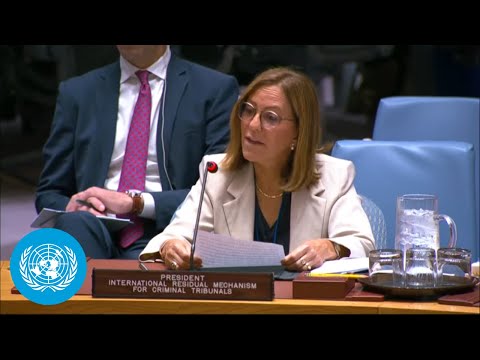
Mechanism president briefs UN Security Council on sentence enforcement, archives and lingering cases
Summary
Judge Graciela Gatti Santana, president of the International Residual Mechanism for Criminal Tribunals, briefed the United Nations Security Council on the mechanism’s recent work, including ongoing judicial activity, sentence enforcement, outstanding detention and relocation issues, and preparations tied to Resolution 2740 (2024).
Judge Graciela Gatti Santana, president of the International Residual Mechanism for Criminal Tribunals, briefed the United Nations Security Council on the mechanism’s recent work, including ongoing judicial activity, sentence enforcement, outstanding detention and relocation issues, and preparations tied to Resolution 2740 (2024).
Gatti Santana said the mechanism has continued active judicial work even as core crime trials and appeals have concluded. “During the reporting period, the judges of the mechanism issued over a 100 decisions and orders, nearly 90 of them pertaining to the mechanism’s continuous judicial functions,” she told the council. She also reported that about 30 decisions and orders related to access to confidential information and requests to vary protective measures, demonstrating the mechanism’s role in safeguarding witnesses and supporting national prosecutions.
The president described the mechanism’s limited but consequential use of contempt jurisdiction. She reported that in February 2025 a single judge charged a defence counsel with violating judicial orders in connection with possible review proceedings, and that another judge is considering whether to refer that matter to national authorities. She said the mechanism has generally exercised contempt jurisdiction narrowly and that the last two contempt cases were referred to states in line with the mechanism’s statute.
Gatti Santana addressed detention and sentence enforcement. She said that Ratko Mladić has recently sought release on humanitarian grounds and that the matter is pending adjudication; she added that detainees in the mechanism’s detention unit in The Hague receive multidisciplinary medical care and are closely monitored. She noted the detention unit also continues to house convicted persons including Jovica Stanišić and another convicted individual named in the briefing. The mechanism, she said, needs more states willing to enforce sentences to reduce its operational footprint and to eliminate prolonged uncertainty for convicted persons.
The president raised the case of an individual whose trial remains indefinitely stayed and who cannot be released because no state has accepted provisional transfer. She said an independent medical expert in April determined the individual was not fit to fly to the only state currently willing to receive him, and that the trial chamber has posed further questions to the expert and is awaiting responses.
Gatti Santana also described the situation of six acquitted or released persons relocated to Niger in December 2021, saying they had been denied rights and liberties guaranteed under an agreement between Niger and the United Nations. The registrar continues high-level engagement with Nigerien authorities, and a judge is considering whether the relocated persons can safely return to Rwanda as part of determining the mechanism’s obligations to provide continued financial assistance.
Looking ahead, Gatti Santana reviewed tasks coming from Resolution 2740 (2024), including a secretary-general report due by 31 December 2025 on administrative and budgetary aspects and on options for archives locations. She said the mechanism’s leadership has gathered information across organs and branches to inform the secretary-general’s assessment and offered preliminary reflections: some administrative aspects of sentence supervision could feasibly be transferred to states, but adjudication of applications for pardon, commutation or early release raises due-process and equality-of-treatment concerns that, in her view, argue for retaining that function at the international level.
To reduce resource-intensive proceedings, she said she submitted proposed amendments to the mechanism’s rules of procedure and evidence in May and issued a revised practice direction to streamline designation processes and expand engagement with potential enforcement states. “Justice is not a finite endeavor. It is a continuous commitment,” she told the council, urging member-state support for solutions to enforcement, relocation and archives challenges.
No formal decisions or votes on the matters she addressed were recorded in the briefing.