Get Full Government Meeting Transcripts, Videos, & Alerts Forever!
Get email alerts on the Budget topic
No spam. Unsubscribe anytime.
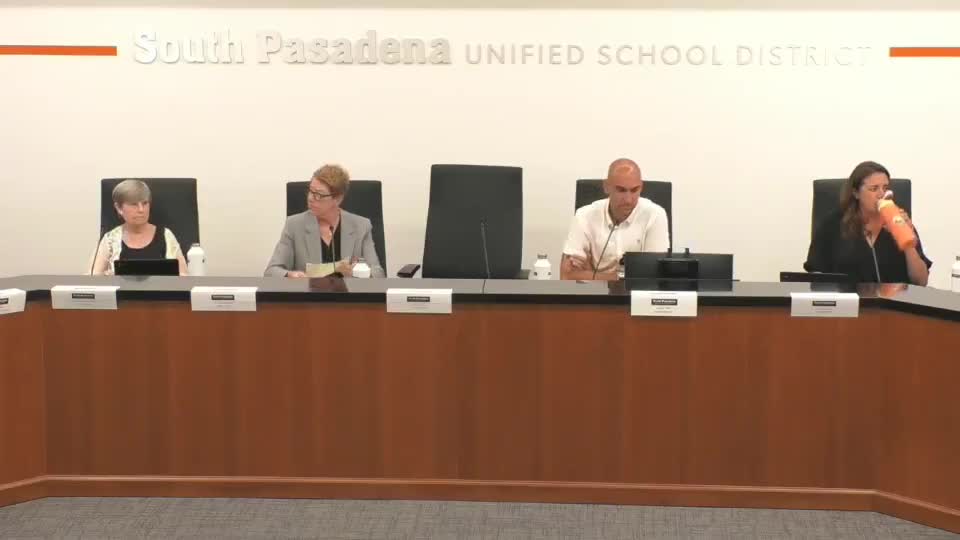
South Pasadena budget presentation warns of shrinking COLAs, multi‑year revenue loss and continued reliance on one‑time funds to avoid layoffs
Summary
District staff told the board the 2025‑26 adopted budget is fragile: state cost‑of‑living adjustments (COLAs) in revised proposals are lower than earlier assumptions, reducing expected revenue by roughly $2.8 million across recent cycles and forcing one‑time measures, FTE reductions and service changes to preserve a 3% reserve.
District staff presented the fiscal assumptions and multi‑year projections underpinning the 2025‑26 adopted budget, stressing that reductions in state cost‑of‑living adjustments (COLAs), declining enrollment and rising benefit costs have pushed the district into structural deficits.
Staff summarized how state budget revisions affected planning: when the district adopted its 2024‑25 budget it assumed a 4% COLA, but subsequent revisions reduced that to 1% for the year, creating an immediate revenue shortfall staff estimated at about $1.8 million. For the 2025‑26 adopted budget, staff reported the January proposal trimmed an assumed 3.94% COLA to 2.43% and the May revision further reduced it to 2.3% — a change staff said equated to approximately $1 million less than earlier projections. Over multiple years these reductions compound; staff placed the multi‑year revenue erosion in the millions.
To bridge current deficits staff outlined actions taken and planned: reductions to contributions for textbooks, deferred maintenance and retiree contributions (about $750,000), reductions in site and custodial staffing (0.8 FTE at secondary, 1.0 FTE custodial earlier; later reductions described as 0.6 administrative FTE, 2.0 elementary FTE, 1.0 secondary FTE and 2.2 custodial FTE across sites), reallocation of one‑time funds and reserve use, and new fees (athletic transportation and custodial charges to food services).
The district is required to show three‑year solvency for its adopted budget. Staff reported an average annual salary step and column increase assumption of 1.5% and an assumed health benefits escalation increased to 6.5% (from prior estimates near 4.5%) because of recent rate hits. Enrollment was projected to decline by about 40 students next year (an improvement from an earlier projection of an 80‑student decline), which slightly improved revenue forecasts.
Staff stressed two compliance points: state Proposition 98 guarantees funding floors for schools and can affect funding timing; and Senate Bill 858 requires the board to report why the district holds more than a 3% reserve (staff cited retirement and health‑benefit cost pressures, special‑education contributions and economic uncertainty as justifications). The district’s targeted 3% reserve, staff noted, is relatively small (roughly two to three weeks of payroll), and small districts typically keep larger relative reserves.
Why it matters: Reduced COLAs and ongoing cost pressures can force personnel cuts or program reductions because salaries and benefits constitute the majority of district spending. Staff said they used a mix of one‑time funds, reserves, and targeted reductions to avoid layoffs this year; without increased revenue or cost relief, further reductions may be required in coming years.
Next steps and public process: The presentation was informational; the adopted budget will be on the board’s agenda for formal adoption at the next meeting. Staff also noted that when the state releases a final budget, the district can amend assumptions and return to the board in September if needed.