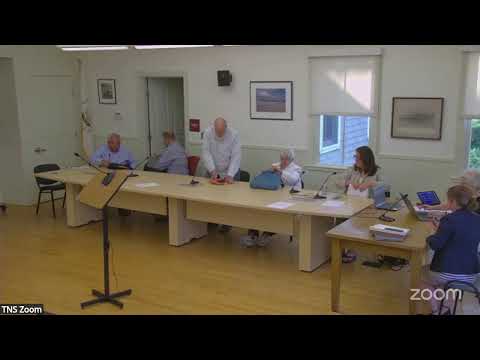
New Shoreham council asks police to collect property-line noise readings, to review outdoor-entertainment exemptions
Loading...
Summary
Town council members agreed to have the police department collect A- and C-weighted sound readings at or near property lines over the next month, including July 4 weekend, and to return to the council with data before pursuing ordinance changes that would narrow special-event or outdoor-entertainment exemptions in the noise code.
The New Shoreham Town Council agreed at a June 4 work session to have town police take A- and C-weighted sound measurements at or near the property lines of outdoor venues and report back to the council in mid-July, including readings taken over the Fourth of July weekend.
Council members said they want longitudinal data — not only anecdotal complaints — to show whether noise problems are episodic or persistent and whether readings differ by measurement location. Council members and residents raised concern about nighttime disturbance in downtown areas and asked staff, the police chief and property managers to work cooperatively to produce a report before the council considers formal ordinance changes.
The data request grew out of ongoing complaints about amplified music downtown and earlier discussions about lowering a numeric decibel standard (for example, from 70 to 65) and removing a 5% margin in the current rule. Chief Dean told the council the police department can take readings in both A and C weightings, and the council settled on a plan to collect data over a month and to include Fourth of July weekend measurements so the council has samples from busy summer weekends.
Residents who spoke urged tighter controls and clearer measurement rules. Sasha Crow, who identified herself as attending a symposium on wind energy, raised concerns about low-frequency noise and cited health effects listed in published guidance, saying, “Low frequency waves range increase in turbulent weather and during temperature inversions by at least fivefold.” Another resident, Marie Langdon of Calico Hill, told the council she was upset that a middle-school performance drew a complaint that required a police response.
Council members also asked staff and the town attorney to review a pair of ordinance cross-references that currently exempt activities conducted under a special-event license or an outdoor-entertainment license from certain provisions of the noise ordinance (referenced in the meeting as “12-50” and the outdoor-entertainment section). The council discussed clarifying whether those exemptions apply to the property-boundary prohibition, to the numerical decibel limit, or to both, and whether tents or temporary outdoor setups should remain exempt.
The council reviewed enforcement tools and noted the existing enforcement provision cited in the meeting, which the staff read as allowing fines and allowing the council to revoke an outdoor-entertainment license after notice and a duly advertised show-cause hearing (the transcript referenced “section 8-258” in that context). Members said they still want a data-driven approach: the police readings will be the official evidence for any formal complaint, while citizen meter readings may inform the discussion but would not substitute for the department’s certified measurements in enforcement cases.
The council requested that staff clarify three operational details before it drafts any ordinance change: (1) the measurement point (the group discussed taking readings from the sidewalk in front of an establishment or from the property line), (2) whether readings should be taken only after a complaint or on a scheduled sampling basis, and (3) whether readings should be in both A- and C-weighted scales. Chief Dean said the department can deliver both A and C measurements.
Council members asked the town attorney and police to return to the council with recommended drafting language and to schedule any ordinance change only after the department’s report. Several council members said they prefer to keep the issue on the council’s work-session agenda so the issue does not fade between busy summer meetings.
The council did not adopt an ordinance at the June 4 meeting; it directed staff and the police department to gather the agreed measurements and to report back at a future meeting.
Residents and business representatives told the council they are willing to cooperate in a trial data collection period and that some establishments already use onsite sound engineers or directional speakers; council members said those operational facts should be part of the report the police provide.
The council also asked its land-use attorney to review the outdoor-entertainment license and special-event provisions to determine whether the exemptions in the noise code should be narrowed or reworded so noise protections apply consistently across venues and permit types.