Get Full Government Meeting Transcripts, Videos, & Alerts Forever!
Get email alerts on the Education Technology Ai topic
No spam. Unsubscribe anytime.
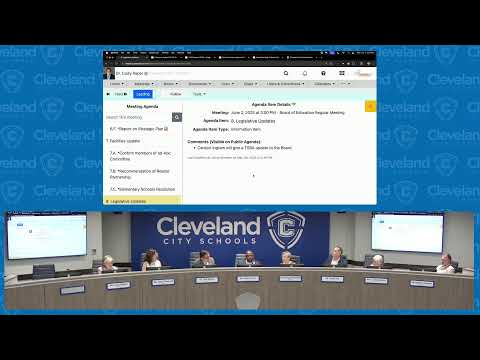
Board hears AI technology update; district lists approved tools, training and safeguards
Summary
Director of innovation Dr. Raper said Cleveland City Schools will provide an annual AI update to comply with state law and board policy 4.214, listed approved tools (including Magic School district‑wide), and outlined teacher and student training and monitoring measures. The district will report to the state by July 1.
The Cleveland City Schools board received an update on artificial intelligence use in classrooms and by staff on June 1 from Dr. Michael Raper, director of innovation and technology. Raper said Tennessee law requires yearly updates and that the district adopted Board Policy 4.214 to govern reporting and oversight; the district must report to the state by July 1.
Raper said the district provides beginning‑of‑year training for teachers on permitted uses, offers student training as part of Digital Safety Week, and is adding asynchronous and in‑person professional development for staff. He described a current list of approved AI tools: OpenAI (ChatGPT) is allowed in some configurations (district memo summarized grade‑level account rules), Google Gemini is restricted to staff use per Google’s terms, and tools used daily such as Canva and Kami were noted because many vendors add “AI” features. The district has invested in the service Magic School and “all teachers and all staff have access” to it; Raper described Magic School rooms that teachers control, and said the platform includes monitoring and automatic redaction safeguards when student names are inadvertently entered.
Raper said the district is encouraging teachers to use AI as a tool for efficiency—lesson planning and administrative tasks—while training students on ethical and appropriate uses. He also said the district uses its professional development platform to deliver AI learning modules to staff.
During follow-up comments a board member recommended the district consider Google NotebookLM for contained, document‑based AI use; Raper replied that NotebookLM content usage was covered under staff Google for Education policy and that administrators have access to a district NotebookLM collection for PowerSchool documents. Board members noted AI’s fit with STEM and project‑based learning and praised the district’s proactive approach.
Raper said the district will continue to review and vet tools to maintain compliance with board policy and administrative procedure.