Get Full Government Meeting Transcripts, Videos, & Alerts Forever!
Get email alerts on the Public Safety Wildfire Incarcerated Labor topic
No spam. Unsubscribe anytime.
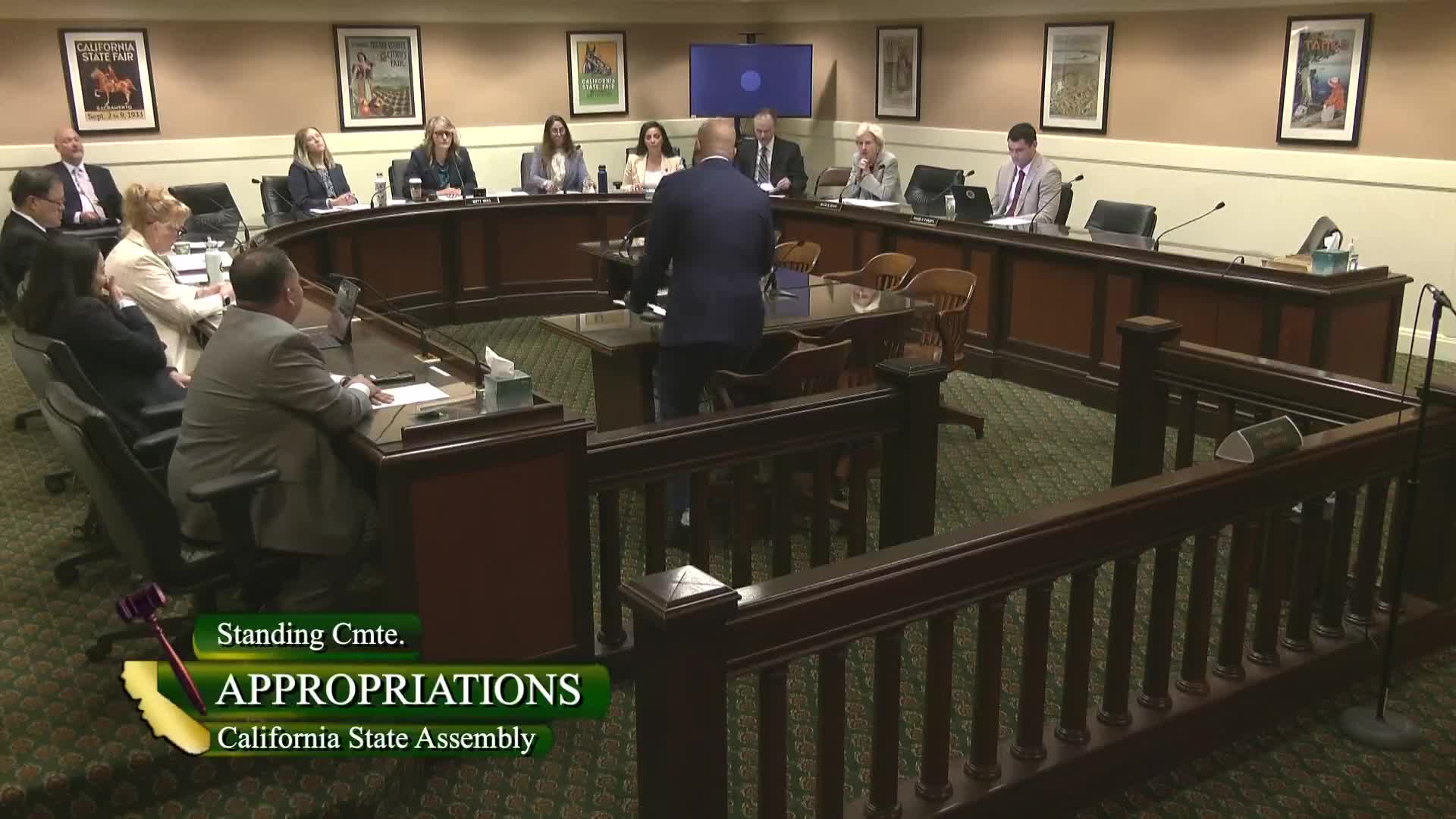
Assembly committee advances bill to pay incarcerated hand crews at least federal minimum wage
Summary
The Assembly Appropriations Committee voted 9-0 on June 3 to advance AB 247, which would require incarcerated hand crews fighting wildfires to be paid at least the federal minimum wage; members raised questions about cost, annual adjustments and effects on program size.
SACRAMENTO — The Assembly Appropriations Committee on June 3 voted to advance AB 247, a bill that would require incarcerated hand crew members who are actively fighting wildfires to receive pay at least equal to the federal minimum wage.
“AB 247 is a bill that will ensure incarcerated hand crew members who are actively fighting wildfires ... receive fair compensation for their essential role in protecting communities,” Assemblymember Bridal, the bill’s author, told the committee. “Essentially, it ensures that nobody fighting a wildfire gets paid less than the federal minimum wage.”
The bill drew broad support in committee but also questions about cost and how annual adjustments to pay would be determined. Committee members and the author described amendments made before the hearing that narrowed the measure’s cost impact and explicitly enumerated specific conservation camps, including the Pine Grove Conservation Camp.
Why it matters: Hand crews made up of incarcerated people perform physically demanding, often risky wildfire work. Supporters said paying at least the federal minimum wage would provide more equitable compensation for that work; some members and the bill’s author said the change also addresses moral concerns about very low existing pay.
What the bill would do: According to the author’s presentation, AB 247 raises pay for incarcerated hand crews from amounts that committee members described in testimony as being equivalent to a few dollars a day to at least the federal minimum wage. The author said the bill was amended after an initial appropriations estimate that modeled a $19-per-hour rate; the author said that figure was reduced in the current version to the federal minimum wage to limit fiscal impact while raising pay. The author also said the bill explicitly includes Pine Grove Conservation Camp.
Committee debate and concerns: Several members said they supported the concept but sought clarification on fiscal details and on who would determine annual adjustments to the pay rate. “How do we know how much it’s going to cost? ... How it will be adjusted annually is something we still want to continue conversations going into the second house,” Assemblymember Dixon said.
Assemblymember Tangapak asked whether constrained local or state budgets could shrink opportunities for incarcerated people to participate in hand crew programs if costs rose. The author responded that the state, not local municipalities, would absorb the cost through Cal Fire and that the bill is intended to raise active-fire pay to at least the federal minimum wage.
Members also described the current pay structure as very low. The author said current active-fire pay effectively amounts to a small bonus now and that AB 247 would raise active-fire pay to $7.25 per hour, the federal minimum wage. In debate the author also used strong language about the current system, saying the state is “saving significant money because we’re using slave labor” and arguing that the bill would provide “a resemblance of fair pay.” Those remarks were part of the author’s advocacy for the measure.
Procedure and outcome: The committee took a roll-call vote after a motion to “do pass.” The committee reported the bill out by a 9-0 vote; several members were recorded as not voting. The author said the bill would continue to be refined in the second house on issues including annual adjustment mechanics and any additional fiscal analysis requested after amendments.
What’s next: With the committee vote, AB 247 moves forward in the legislative process to the next house for further consideration and fiscal review.