Get Full Government Meeting Transcripts, Videos, & Alerts Forever!
Get email alerts on the Agency Finance topic
No spam. Unsubscribe anytime.
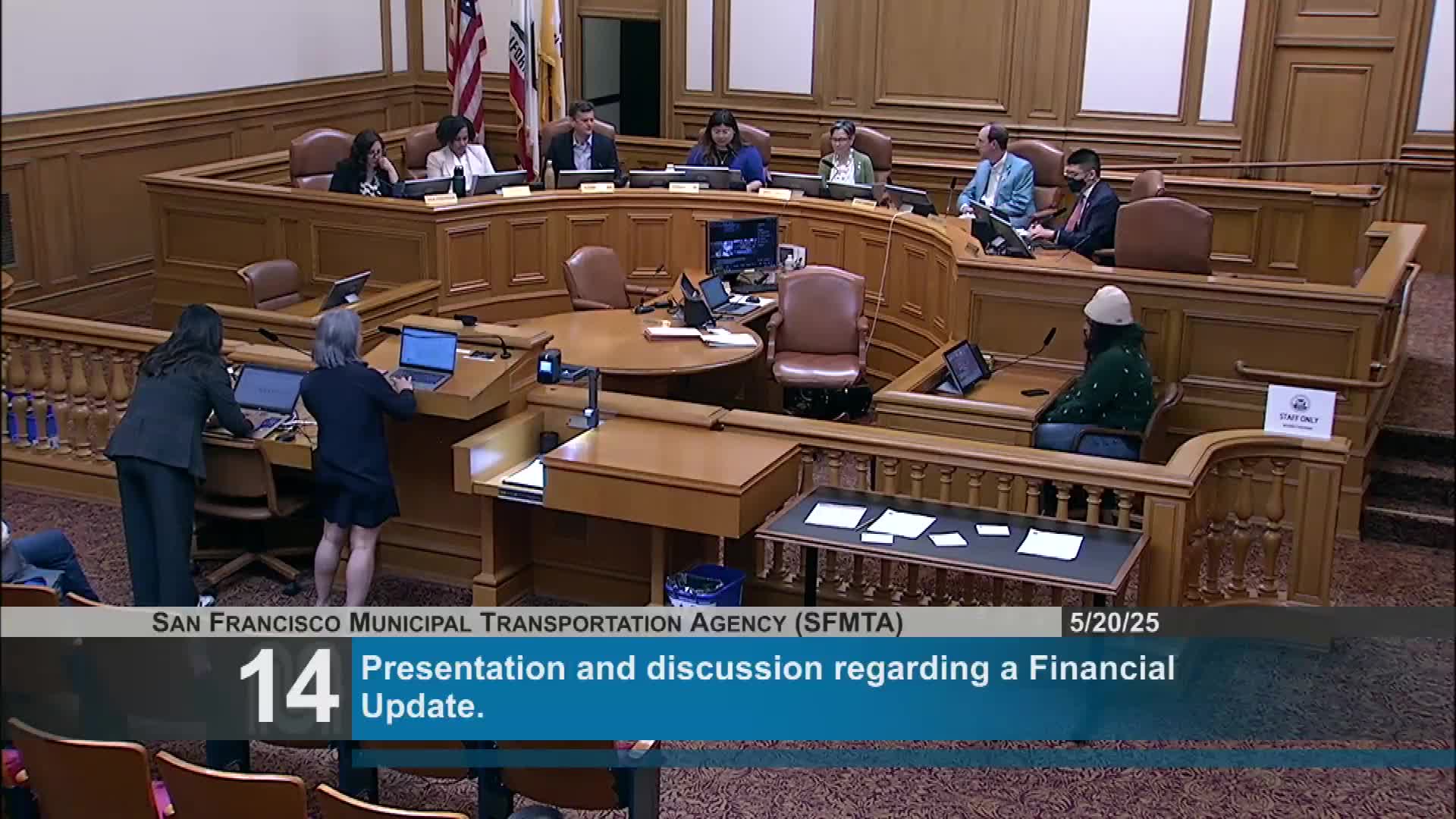
SFMTA CFO: small improvement in FY25 deficit, vacancies and work‑order reviews remain priorities
Summary
SFMTA Chief Financial Officer Breema Hoerger reported a modest reduction in the agency’s FY25 projected deficit from about $4 million to roughly $3 million, discussed hiring freezes, position deletions and intensive reviews of work orders and non‑personnel expenditures as tools to close multi‑year budget gaps.
San Francisco Municipal Transportation Agency Chief Financial Officer Breema Hoerger told the Board on Wednesday that the agency’s fiscal picture for the 2024–25 year has improved slightly but remains fragile, and that staff are pursuing hiring controls, work‑order reviews and other cost controls to address longer‑term deficits.
Hoerger said that as of the March close (the nine‑month point in the fiscal year) the agency’s projected deficit for FY25 had narrowed from a previously projected negative 4% to about negative 3% — roughly $1 million of improvement on a $1.4 billion operating budget. “$1,000,000 out of $1,400,000,000 is not a huge amount of movement, but I think it's success in that it's going the correct direction,” Hoerger said.
Revenue and expense drivers: The CFO highlighted two main revenue weaknesses: operating grants (timing nuances for a newly budgeted grant) and parking revenues, particularly downtown garage performance which remains below pre‑pandemic levels. Transit fare compliance work, however, was a revenue bright spot: Hoerger said efforts to increase fare compliance generated an estimated $4.6 million in additional revenue year‑over‑year by recovering about 1.7 million fares.
On the expense side, non‑personnel services (categories that include litigation and workers’ compensation) are running higher than budgeted; those categories account for most of the agency’s over‑budget picture in non‑labor spending. Hoerger said the agency has implemented a strict hiring freeze and has held many positions vacant: the FY25 budget deleted over 700 positions from the books (staff said the deletion work reduced the agency’s position count to better reflect affordable headcount), and the agency’s vacancy rate remains elevated — previously reported near 23% and still above 15% even after deletions.
Work‑order review and other controls: The CFO described a detailed, division‑by‑division review of more than 188 interdepartmental work orders that the agency uses to buy services from other city departments — the work seeks to confirm scopes, update prices, and identify opportunities to reduce or pause services if operating cuts become necessary. Hoerger said staff are also tightening projections and corrective action plans for professional services and materials and supplies, plus monitoring maintenance work orders closely.
Longer-term gap and strategy: Hoerger reiterated the five‑year forecast that shows a $322 million deficit in 2026–27 and said the agency is pursuing a mix of revenue measures and service adjustments. She said the agency will continue to work with the city controller and regional partners on possible regional revenue measures and other solutions. Hoerger also cautioned that the state May revision and other external fiscal pressures create continued uncertainty, and that citywide hiring and budget reduction directives increase the pressure on all departments.
Public and board response: Public commenters urged further staffing reductions and efficiency measures; one commenter suggested deeper head count cuts. Board members asked technical questions about work‑order timing and regional advocacy. The CFO said staff will return with updated forecasts after the city’s budget cycle and will reforecast the five‑year outlook in the summer.
Ending: The SFMTA faces a tenuous but not yet catastrophic fiscal path: staff reported minor near‑term improvement while emphasizing the need for continued controls, data hygiene on work orders, and regional collaboration to address the structural shortfall in later years.