Get Full Government Meeting Transcripts, Videos, & Alerts Forever!
Get email alerts on the Speed Enforcement topic
No spam. Unsubscribe anytime.
SFMTA: 21 speed cameras live issuing warnings; remaining cameras cleared by PG&E for early June activation
Summary
SFMTA officials said 21 automated speed‑safety cameras are live and issuing warnings; PG&E has given preliminary approvals for remaining sites, enabling activation of 33 cameras citywide and a single transition to citations after a 60‑day warning period.
San Francisco transportation officials told the Municipal Transportation Agency Board on Wednesday that 21 automated speed‑safety cameras are currently live and issuing warnings, and that the utility PG&E has granted preliminary approvals for the remaining sites needed to complete the planned 33-camera network.
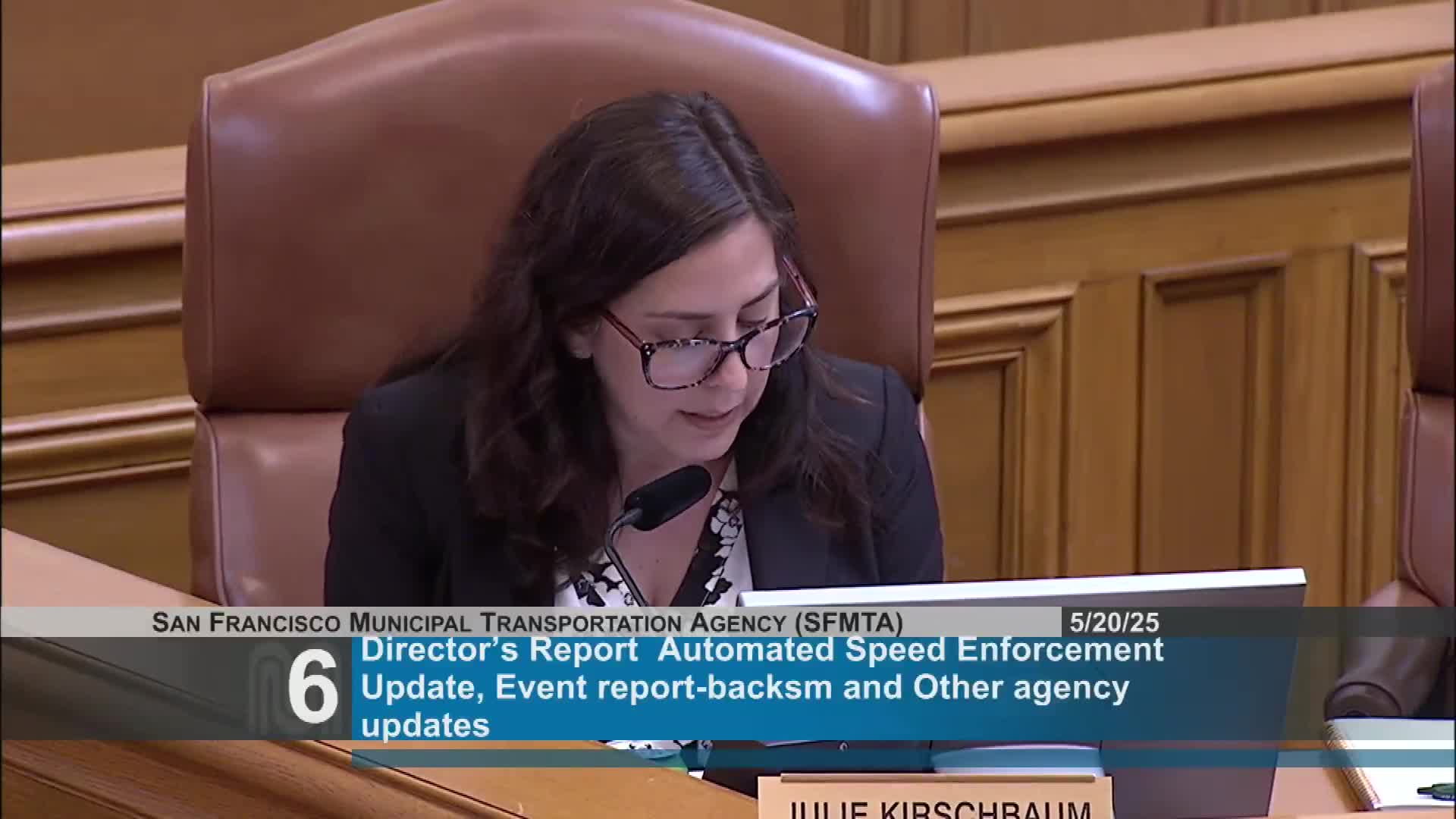
Executive Director Julie Kirschbaum said the agency has issued warnings — not citations — at the active sites and expects to activate the remainder of the cameras in early June. “We currently have 21 camera locations that are live and issuing warnings,” Kirschbaum said. “Based on this positive news [from PG&E], we're expecting we'll be able to activate the remaining cameras and the official 60‑day warning period will begin in early June.”
Staff provided early data showing the program is picking up substantial speeding: the agency reported issuing more than 30,000 warnings in April at camera locations where warnings were active. Warnings are issued for speeds 11 miles per hour above posted limits; the intersection generating the most warnings reported more than 900 warnings per day at one Fulton Street location between Arguello and Second Street.
Why the single switch to citations: Shannon Hake, program manager for the speed camera program, told the board the state law requires a 60‑day warning period per camera. Because cameras have come online at different times, SFMTA said it will keep all cameras in ‘‘warning’’ mode until the last camera has completed its 60‑day warning period, then transition all cameras at once to issuing citations to make the change easier for the public to understand.
Timeline staff gave: If staff can activate the remaining cameras in early June and run a 60‑day warning period, the agency estimated citations could begin in early August (Kirschbaum said citations “will likely begin in early August” but that the agency will announce an official date).
Public and board reaction: Board members and public commenters pressed for immediate enforcement in high‑volume locations and for engineering changes while cameras remain in warning mode. Director Hemminger asked whether police enforcement could supplement camera warnings in the interim; Kirschbaum said staff would “be happy to investigate” coordination with the Police Department. Walk San Francisco and other safety advocates urged quick activation and broader speed‑reduction measures; Melena Mackey Kabata of Walk San Francisco said early camera data showing that 33% of speeding drivers were traveling more than 15 mph over the limit demonstrates “a crisis” on the city’s high‑injury streets.
Staff measures beyond cameras: Kirschbaum said the agency is also installing larger signs and pavement markings at camera corridors and expanding educational communications before citations begin. Hake said engineering evaluation is already underway for locations generating heavy warnings; for example, the Fulton corridor will get more frequent and larger speed-limit signage and pavement speed markings to emphasize the 25 mph limit.
Ending: The Board received early program data and the staff timeline. The agency emphasized warnings will continue until 60 days after all cameras are active; staff said it will notify the public in advance of the citation start date and continue to evaluate engineering alternatives in places with heavy speeding.