Get Full Government Meeting Transcripts, Videos, & Alerts Forever!
Get email alerts on the Non Sworn Personnel topic
No spam. Unsubscribe anytime.
APD outlines widening use of non‑sworn staff: training, records, drones and mental‑health pilot
Summary
Assistant Chief James Mason briefed the Public Safety Committee on June 2 about existing civilian roles in APD and potential expansions, including drone 'first responder' trials, greater use of retired officers in report‑writing roles, and a mental‑health alternate response pilot expected to come to the committee in the next months.
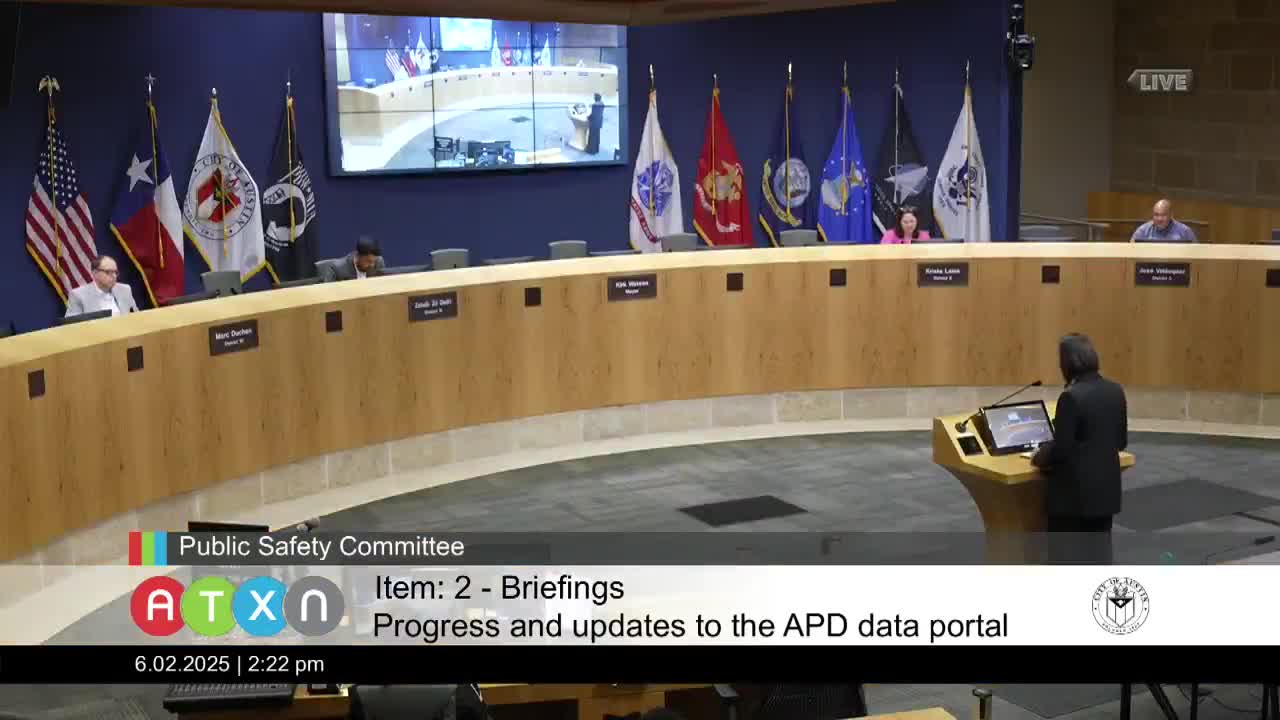
Austin — Assistant Chief James Mason told the Austin City Council Public Safety Committee on June 2 that the Austin Police Department is using and expanding non‑sworn personnel to carry out administrative, technical and some response functions as the department grapples with sworn staffing shortages.
Mason listed existing and potential non‑sworn roles: civilian staff in case‑management units such as SOAR (sex‑offender registration and tracking), retired officers doing background checks in recruiting, civilian analysts and technicians in the real‑time crime center, seven civilian full‑time equivalents supporting the training academy, a civilian burglar‑alarm unit, a reserve‑officer program of more than 30 people used for large events, and integration with 3‑1‑1 to get online reports into iReport for detectives.
Mason said APD has placed Integral Care clinicians in the 9‑1‑1/dispatch center to handle many crisis‑type calls without police response; he estimated that “about around a thousand a month” previously would have required officer response but are now handled by Integral Care or diverted at dispatch. He said EMS and other partners are interested in taking larger roles in medical or behavioral responses.
The department described an early-stage plan for drone-based “first responder” capability managed from the real‑time crime center by civilian operators; drones could be flown to a scene to determine whether a sworn response is necessary or to give officers information before arrival. Mason said vendors and other cities are further along, and APD is watching and testing approaches.
On vehicle crash reports, Mason told the committee that state law requires a licensed peace officer to sign the official collision form and that City Legal had taken the view that the signature requirement blocks replacing sworn officers for that certification. Council member Greg‑Alter (note: transcript attribution used "Alter") and Mason discussed whether trained civilians could complete reports that officers would then certify; Mason said legal and legislative work would be required to change the current practice.
Mason said the department is not moving non‑sworn staff into potentially dangerous field tasks such as vehicle abatement or unverified burglar‑alarm responses. The burglar‑alarm unit itself is civilian and handles false alarms, but the department said it does not want to place civilians in situations that could turn violent.
On implementation planning, Mason said a workload analysis requested by Chief Davis is in final stages; a draft was expected within several weeks and a final report in late summer to inform staffing and non‑sworn deployment decisions. Eddie Garcia, assistant manager of public safety, told the committee the alternate response model pilot for mental‑health calls was being finalized and the department hoped to bring the proposal back to the committee within a couple of months.
Committee members asked for more timeline detail and encouraged creative approaches — including pursuing legislative changes if needed — to reduce response times for collisions and to divert appropriate calls from sworn officers to civilians, EMS or behavioral‑health teams.
The committee did not take any formal votes on implementation at the meeting.