Get Full Government Meeting Transcripts, Videos, & Alerts Forever!
Get email alerts on the Transient Room Tax Compliance topic
No spam. Unsubscribe anytime.
Grand County looks to attorney memo after state auditor questions TRT spending; trail-ambassador salaries focus of review
Summary
Grand County commissioners spent a large portion of a May 20 special workshop focused on compliance questions arising from a recent state audit and the upcoming July 1 changes to state law that affect how transient room tax (TRT) revenue may be spent.
Grand County commissioners spent a large portion of a May 20 special workshop focused on compliance questions arising from a recent state audit and the upcoming July 1 changes to state law that affect how transient room tax (TRT) revenue may be spent.
The discussion centered on which TRT expenditures meet the statutory standard of "establishing and promoting" tourism, recreation, film production and conventions, and on several line items the county will likely need to justify or repay. County Attorney Steven Stocks told the commission he will prepare a written legal memorandum addressing past practice, the new law (House Bill 456) and how receipts collected before July 1 should be treated going forward. "My job is always to defend the county," Stocks said during the meeting.
Why it matters: the commission has already authorized multiple one‑time and ongoing expenditures tied to tourism and recreation funds, and the auditor has flagged some uses as questionable. Commissioners and staff said they want to ensure the county is in compliance before the new statutory framework takes effect July 1 and before the county begins to collect the altered TRT revenue later in the year.
What commissioners heard and asked staff to do
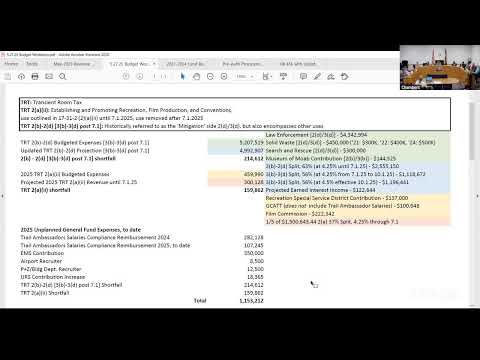
- Staff presented an account of TRT allocations and audit findings and said some previously budgeted items will need more documentation. The packet shared at the meeting shows the county originally budgeted about $5.2 million for a mitigation/3B–3D TRT category; an updated projection that factors in the statutory change reduces that line to roughly $4.99 million, producing a projected shortfall tied to the allocation shift of $214,612.
- Commissioners and staff identified a set of previously paid or budgeted uses that the office will need to review. In particular, the commission discussed reimbursement for trail‑ambassador support: staff reported roughly $282,000 in 2024 and $107,000 to date in 2025 that were charged to TRT 2A/2 funds; combined with an earlier $182,000 reimbursement, staff said the three figures sum to $571,000 in TRT 2A2‑tagged dollars that will need accounting and potential correction.
- The county attorney and auditor indicated the commission has the authority to set policy and make spending decisions, and that the attorney/auditor will provide advice and documentation. Stocks and staff recommended a conservative approach: tie expenditures as closely as possible to promotion or visitor attraction, and document the promotional nexus for each item.
- Commissioners asked for a formal, written attorney memo updating a prior 2019/2020 opinion and laying out the legal analysis under the old statute and the new HB456 language. They also asked staff to request a detailed breakdown from the Recreation Special Service District showing how the district used the county TRT dollars (program spending vs. salaries and benefits vs. capital work).
Next steps and schedule
- Stocks said he will draft a memo that separates receipts collected before the statutory change from revenue subject to the new July 1 standard and will work with the clerk/auditor as needed.
- The commission agreed to form a small working group (commissioner(s) plus auditor and county attorney and staff) to review the flagged line items line‑by‑line and to invite the state auditor or auditor staff to a follow‑up, focused session. Commissioners set a preliminary on‑site check‑in for the Tuesday before the next commission meeting at 3:30 p.m. to review progress and requested that Recreation Special Service District provide an itemized accounting of TRT‑funded activities.
- No formal reimbursement motions or votes were taken at the workshop; commissioners repeatedly emphasized they wanted more analysis before taking budget amendment action.
What remains uncertain
Staff and the attorney said several questions require follow‑up: whether particular program materials and education incentives count as promotional expenses, whether benefits tied to trail‑ambassador positions are allowable, and whether historical allocations previously not questioned by the auditor must still be repaid. The county will treat the answers to those questions as determinative for any proposed budget amendments or reimbursements.
Ending note
Commissioners said they want an accurate, defensible accounting before initiating formal budget amendments; Stocks and staff agreed to supply the legal memo, the recreation district breakdown, and a line‑by‑line review to support any future action.